Editor’s Note
**Editor’s Note:** This article highlights a breakthrough in sustainable packaging: the use of twin-screw extrusion to inject cellulose like a synthetic polymer, enabling innovative, form-liberating paper packaging.
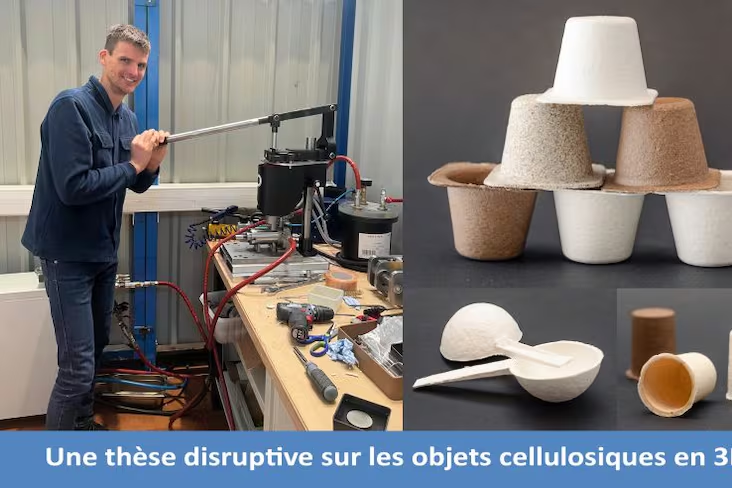
“Use of twin-screw extrusion for innovative cellulosic packaging obtained by injection and thermocompression”: this is the title of the “disruptive” thesis defended by Emilien Fréville in 2024 within the orbit of the Centre Technique du Papier (CTP) as part of the Twilight project. Injecting the natural polymer cellulose in the same way as a synthetic polymer to “liberate the forms” of paper packaging? This is indeed the path followed by Injectose, as reported by Emballages Magazine on June 17, 2025. Stemming from work carried out in Grenoble (Isère) by Emilien Fréville at the Laboratory of Process Engineering for Biorefinery, Biosourced Materials, and Functional Printing (LGP2), the startup, which includes researcher Julien Bras on its team, has patented a technology that enables the manufacture of caps, inserts, and other components for packaging. Luxury and cosmetics are among the priority segments.
The process is notably based on a biosourced additive designed to “lubricate” the fibers to ensure the molding and demolding phases. Since cellulose is available in granules like polyolefins, Injectose states that a simple adaptation kit allows the use of standard presses at identical cadences. Based in Gières (Isère), the company, currently preparing for industrial and commercial takeoff, is supported by Linksium within the Satt technology transfer network.
Winner of the Rotary Business Creation Trophies 38 in June, the company was also in the spotlight at the Edition Spéciale by Luxe Pack trade show, organized on June 17 and 18 by Infopro Digital in Paris. In the race for a Green Award, Injectose was nominated for ReCap, developed with partners such as Releaf Paper, Fedrigoni, and Eranova. While injection remains at the core of the approach, other three-dimensional shaping technologies such as thermoforming or compression are also exploitable. This helps companies implement the Packaging and Packaging Waste Regulation (PPWR), which comes into effect on August 12, 2026, and the Single-Use Plastics Directive (SUP).