Editor’s Note
Hong Kong Customs has advised halting use and removing a collagen cream from shelves after detecting the banned ingredient ‘Sudan Red’. Medicube, the brand behind the product, disputes the finding, citing a Korean test showing ‘not detected’, but has only released a partial test report.
Hong Kong Customs (海關) has advised the cessation of use and removal from shelves of a collagen cream in circulation after detecting ‘Sudan Red’, a banned cosmetic ingredient. Medicube, the derma cosmetic brand of APR led by CEO Kim Byung-hoon, countered within a day, stating that tests by a Korean accredited testing institution showed ‘not detected’. However, the test report the company released as evidence was only one cover page out of two, with the results missing.
According to Hong Kong Customs and local media outlets including Hong Kong Economic Times (香港經濟日報), Hong Kong 01, and Epoch Times on the 28th, Hong Kong Customs issued a press release on the 24th stating that “Government Laboratory test results showed that the product contained Sudan Red, a prohibited ingredient under cosmetic safety technical specifications.” Customs explained that they patrolled various districts, directly purchased the product for testing, and also searched retail outlets.
Customs did not disclose the brand name in the press release. However, the Hong Kong Economic Times reported that “Customs stated that a collagen cream from the Korean medical beauty brand Medicube contained the banned ingredient Sudan Red,” and included a product photo provided by Customs. Hong Kong 01 also identified the product as Medicube’s ‘PDRN Pink Collagen Capsule Cream’. Sudan Red is an industrial azo synthetic dye used to color plastics, leather, and shoe polish red, and is internationally banned in food and cosmetics.
On the 25th, a day after the Customs announcement, Medicube posted a statement on its official Hong Kong Facebook account, refuting the claim: “Our relevant product tested ‘not detected’ for Sudan Red at a Korean accredited testing institution.” It added, “We have always complied with quality standards, regulatory requirements, and testing procedures of each country and region,” and that “the relevant test report has also been submitted to Hong Kong Customs for reference.” The company also stated that “based on current understanding, Hong Kong Customs does not plan additional on-site inspections.” The Hong Kong Economic Times reported at 7:55 PM the same day that “Medicube issued a statement on social platforms today and refuted the claim.”
The company attached an image of the test report below the statement. Verification showed the report was issued by testing and certification company Intertek, with the applicant listed as APR Co., Ltd. headquarters, not the Hong Kong sales entity. The target product was ‘Medicube PDRN Pink Collagen Capsule Cream’, and the report number ‘RT26C-S1097-002-E’ matched the item identified by Hong Kong Customs.
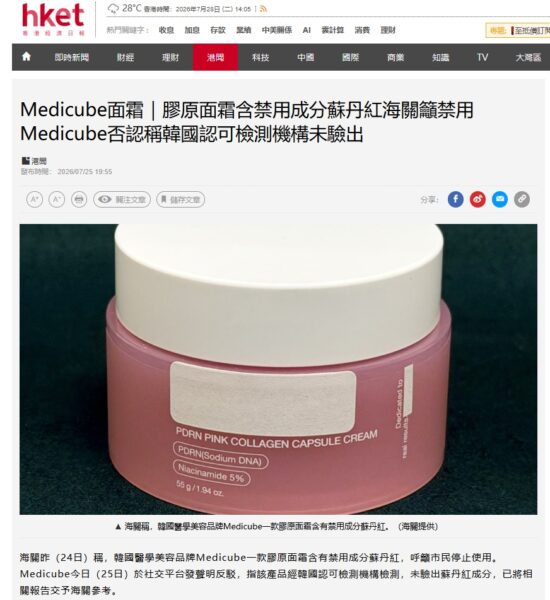
However, the section showing the Sudan Red detection result was not disclosed. The report indicated ‘PAGE 1 of 2’, but only the cover page was released. Both the test method and test result items stated “Please see the following page(s).” Comments on the company’s Facebook post also questioned why only the cover page was released.
The timing also predates the Customs announcement. The report shows a sample receipt date of June 18, a test period of June 18-26, and an issue date of June 26. This document was issued nearly a month before the Customs announcement on July 24.
The issue is compounded by the fact that this is the second time the company has publicly declared ‘not detected’ for this product. About seven months prior, on December 2 last year, Medicube posted an ‘Official Statement’ on its official social media accounts, stating that “to alleviate consumer concerns due to rumors circulating online, we commissioned a re-test from a credible professional testing institution” and that “all PDRN series products, including the ‘PDRN Pink Collagen Capsule Cream’, did not detect any Sudan Red-related ingredients.” Now, seven months later, the Hong Kong Government Laboratory has reached the opposite conclusion for the very product the company had named to guarantee safety.
Cosmetic ingredient analyst ‘ying.cosmeticslab’ pointed out on social media shortly after the Hong Kong Customs announcement: “The detection limit on the report is 50μg/g, and the result is N.D. (not detected). This only means it is below that limit, not proof that the substance is entirely absent.” The account added, “Pigments are typically added in trace amounts. It’s questionable whether the brand tested the raw material itself.” It further noted, “The problematic Sudan Red compound raw material was used in the old version of the capsule cream, which is still sold in some countries. The Korean official mall quietly switched to a new formulation using purple gromwell root extract instead of the pink color. If there was truly no Sudan Red, why change the formulation?” This leaves questions surrounding the test subjects and methods, given the contradictory conclusions between the brand-commissioned finished product test and the government agency test.
The controversy is spreading across the Greater China region. Chinese economic media outlet Yicai (第一財經) reported on the 28th via its English social media account that “Medicube’s customer service told The Beijing News that the product does not contain Sudan Red and added that the test report has been submitted to Hong Kong Customs.”
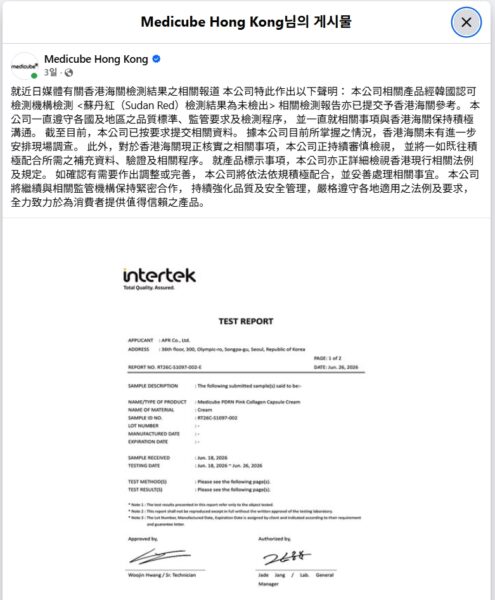
Hong Kong Customs pointed out two violations. One is the suspected violation of the Consumer Goods Safety Ordinance (CGSO) due to the detection of Sudan Red. The other is a labeling regulation violation unrelated to ingredients. Customs stated that “the product only has warning statements in English and Korean, with no Chinese warning statements at all, which is suspected to violate the subsidiary legislation Consumer Goods Safety Regulation (CGSR).” Hong Kong regulations require that warnings or precautions on consumer goods be written in both Chinese and English and placed conspicuously on the product or packaging.
While Medicube strongly denied the ingredient detection, it did not refute the labeling issue. In its statement, the company said, “Regarding product labeling, we are also reviewing the relevant current laws and regulations of Hong Kong in detail. If adjustments or supplements are deemed necessary, we will actively cooperate in accordance with the regulations.” If the violation is confirmed, a first offense carries a maximum fine of HKD 100,000 and one year imprisonment, while a repeat offense carries a maximum fine of HKD 500,000 and two years imprisonment.
This is not the first time APR has faced sanctions regarding labeling and advertising. According to its business report, on January 2, 2025, the company received a 2-month suspension of advertising for the relevant item from the Seoul Regional Food and Drug Administration for ‘misleading advertising to consumers’. The sanctions were based on Articles 13(1)(4) and 14 of the Cosmetics Act, and Article 22 of its Enforcement Rules. The company listed ‘periodic inspections and education on relevant laws’ as a preventive measure.
Concerns that this issue could translate into performance risk stem from the production structure the company itself disclosed. APR states in its business and quarterly reports that “the cosmetics division produces all products through OEM (original equipment manufacturing) without its own production facilities.” Key OEM partners include Cosmax, The Ordinary, and Hankook Cosmetics Manufacturing. The company also noted under raw materials that “as products are purchased in finished form, it is difficult to verify price fluctuations of raw materials.” Given that the Sudan Red incident originated from the raw material supply chain, this highlights the structural difficulty for the brand to directly oversee pigment raw materials.
The scale of exposure continues to grow. On a consolidated basis, 2025 sales were KRW 1.5273 trillion, of which exports accounted for KRW 1.2258 trillion, or 80.3%. This represents a 25 percentage point jump from 55.3% in 2024. In Q1 2026, sales reached KRW 593.4 billion, with exports at KRW 528.1 billion, increasing the share to 89.0%. During the same period, the cosmetics and beauty segment, which includes Medicube, generated KRW 452.6 billion in sales, accounting for 76.3% of the total. In Hong Kong, the stage of the controversy, the company operates a sales subsidiary, APR HK LIMITED (total assets KRW 6.4 billion), established in July 2018.
Coincidentally, last month on the 19th, the company voluntarily disclosed the publication of its first sustainability report, ‘2025 APR Sustainability Report’, verified by the Korean Standards Association. The report claimed to have identified core issues through materiality assessment and reported management directions. About five weeks later, a safety warning from a foreign regulatory authority emerged. Earlier, on June 9, Fidelity Management & Research of the US purchased 1,874,860 shares (5.01%) of APR stock on the market, filing a new substantial shareholding report.