Editor’s Note
**Editor’s Note:** This article highlights two groundbreaking biomedical innovations from National University of Kaohsiung, presented at the 2026 BIO Asia–Taiwan Exhibition. The developments—a high-performance implant material and a nanodrug delivery platform—represent significant advances in medical technology, offering improved patient outcomes and reduced side effects.
● Two research teams from the Department of Chemical and Materials Engineering at National University of Kaohsiung (NUK) presented innovative technologies—’High-Performance Medical Implant Materials’ and ‘Nanodrug Delivery Platform’—at the 2026 BIO Asia–Taiwan Exhibition.
● The next-generation biomedical implant material developed by Distinguished Professor Ho Wen-Fu’s team features high strength, low elastic modulus, and excellent corrosion resistance, reducing stress shielding effects and metal ion release risks after implantation.
● This biomedical implant material can be widely applied in high-end medical devices such as artificial joints and femoral stems, potentially extending implant lifespan and improving patients’ postoperative quality of life.
● The ‘Low-Temperature Self-Assembly Nanoencapsulation Platform’ developed by Distinguished Professor Chung Yi-Chang’s team overcomes traditional process limitations, enabling nanoencapsulation at room temperature, reducing energy consumption, and preserving active ingredient stability.
● This nanoencapsulation platform has been successfully applied in various product developments and is expected to be widely used in biotech pharmaceuticals, medical devices, health foods, and other industries, offering safer and more efficient drug and active ingredient delivery solutions.
[Focus Times / Reporter Tsai Tsung-Hsien] Two research teams from the Department of Chemical and Materials Engineering at National University of Kaohsiung, led by Distinguished Professors Ho Wen-Fu and Chung Yi-Chang, were invited to exhibit at the 2026 BIO Asia–Taiwan Exhibition. They showcased two innovative technologies: ‘High-Performance Medical Implant Materials’ and ‘Nanodrug Delivery Platform,’ demonstrating NUK’s R&D strength in biomedical materials, smart health, and medical technology.
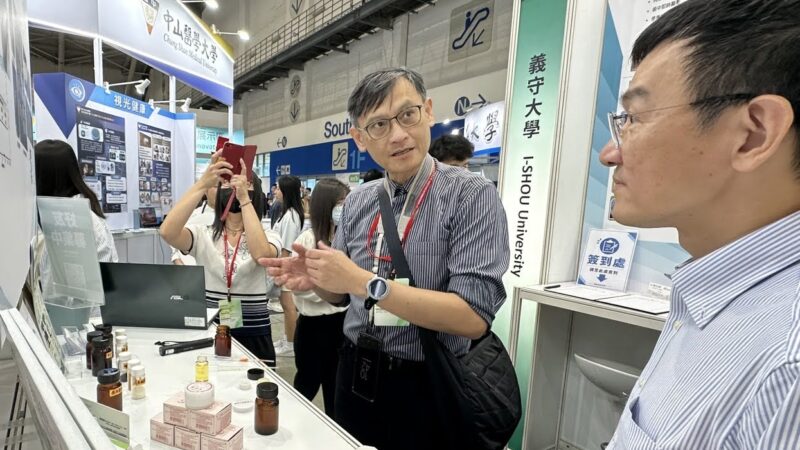
The Innovation and Incubation Center of NUK’s Office of Research and Development coordinated the participation, leading the two teams to display their representative achievements at Taipei Nangang Exhibition Center Hall 1 from July 16 to 19.
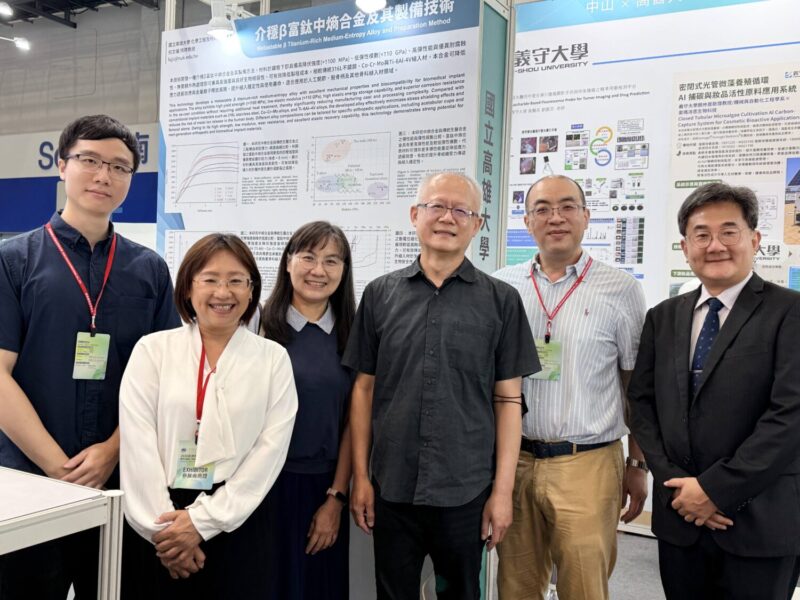
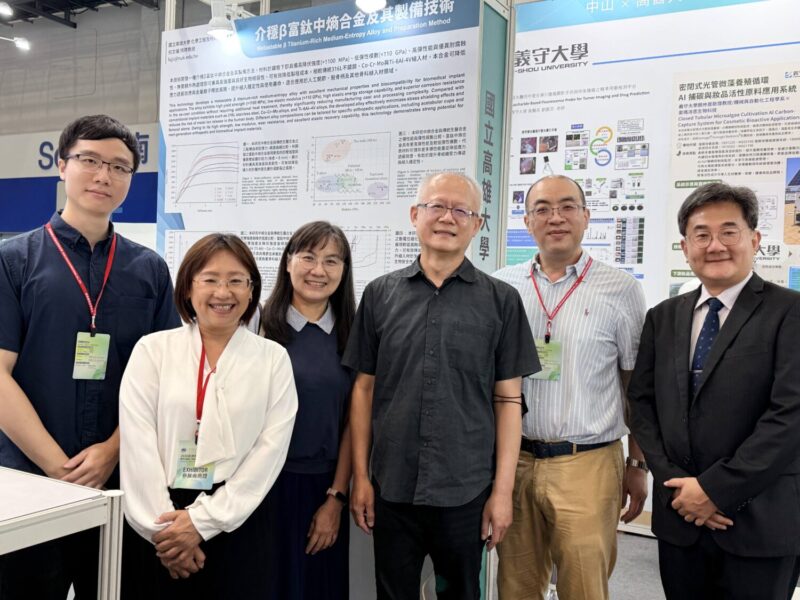
Distinguished Professor Ho Wen-Fu’s team presented ‘Metastable β-Rich Ti Medium-Entropy Alloy and Its Preparation Technology,’ successfully developing a next-generation biomedical implant material with high strength, low elastic modulus, high resilience, and excellent corrosion resistance. Compared to traditional medical implant materials like 316L stainless steel, Co-Cr-Mo, and Ti-6Al-4V, this technology effectively reduces stress shielding effects and metal ion release risks after implantation, enhancing implant stability and lifespan.
The material achieves a yield strength exceeding 1,100 MPa and an elastic modulus below 110 GPa in its as-cast state, without requiring additional heat treatment, combining excellent mechanical properties and biocompatibility while reducing manufacturing costs. The medium-entropy alloy developed by Ho’s team outperforms many existing biomedical alloys in resilience while maintaining a low elastic modulus, more closely matching human bone mechanical properties. This reduces mechanical mismatch between implants and bone, making it suitable for high-end medical devices such as artificial joints, femoral stems, and various orthopedic implants. It holds significant potential for extending implant lifespan and improving patients’ postoperative quality of life.
Distinguished Professor Chung Yi-Chang’s team showcased the independently developed ‘Low-Temperature Self-Assembly Nanoencapsulation Platform and Applications.’ This platform overcomes traditional nanocarrier limitations that rely on organic solvents, high-pressure homogenization, or high-temperature processes. Using a self-developed green phase transition technology, it achieves nanoencapsulation at room temperature, significantly reducing energy consumption and effectively preserving active ingredient stability.
The platform can encapsulate hydrophilic, hydrophobic, and biomolecular active ingredients, and allows layer-by-layer assembly to modify particle surfaces, greatly enhancing stability. It can even produce customizable adjustable nanoconcentrates. The designed nanocarriers, approximately 100 nm in size, can be formulated into sustained-release transdermal formulations, improving skin absorption efficiency and promoting cell penetration. They offer advantages for localized drug delivery, sustained release, and precision medicine.
This technology has been successfully applied in developing nano-astaxanthin, nano-curcumin, nano-plant extracts, nano-vitamins, and nano-Chinese herbal ointments. These can be formulated into various dosage forms such as serums, lotions, and ointments based on different needs. The platform is expected to be widely used in biotech pharmaceuticals, medical devices, health foods, medical aesthetics, and high-value natural plant extract industries, providing safer and more efficient drug and active ingredient delivery solutions.