Editor’s Note
This article covers the 27th Summer Conference of the Korean Society for Laser Dermatology, highlighting Professor Lee Dong-hoon’s insights on complexion as a composite of texture, transparency, and radiance beyond pigment alone.
Professor Lee Dong-hoon from Seoul National University Hospital presented the determinants of complexion and treatment strategies.
Amid the rapidly changing paradigm of aesthetic medicine, an academic forum was held to spotlight the latest trends in pigment treatment. The Korean Society for Laser Dermatology held its 27th Summer Conference on July 19 at Seoul St. Mary’s Hospital.
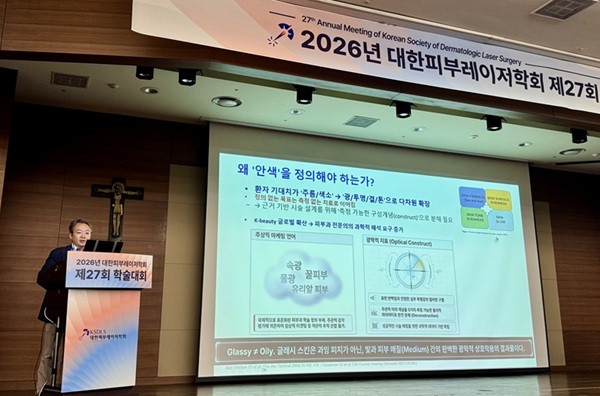
At the conference, experts delivered lectures on various topics based on their clinical research and experience. Professor Lee Dong-hoon of the Department of Dermatology at Seoul National University Hospital drew attention by presenting the diverse factors determining complexion and corresponding treatment strategies.
Professor Lee explained that while complexion has traditionally been described as a combination of skin chromophores such as melanin and hemoglobin, the concept has recently expanded to include skin radiance, transparency, and texture. He emphasized the growing importance of objectively evaluating and treating these factors.
He described complexion as a visual result created by the reflection and scattering of light on the skin surface and in the dermis. The condition of the skin surface determines specular reflection, while collagen and vascular structures in the dermis affect light scattering, which can alter skin brightness and transparency.
Professor Lee identified five core elements that determine complexion:
▲ Pigment
▲ Transparency
▲ Radiance
▲ Tone uniformity
▲ Fine skin texture
He explained that these elements must harmonize to create a healthy and bright skin impression.
Accordingly, he emphasized that treatment involving only pigment removal is insufficient. He noted that a tailored approach based on skin condition is necessary, such as using picosecond laser toning and exfoliation for epidermal pigmentation, radiofrequency (RF) and high-intensity focused ultrasound (HIFU) for reduced dermal elasticity, and devices that stimulate collagen production.
He also stressed the importance of moisturizing and regeneration management to restore the skin barrier before and after procedures.