Editor’s Note
**Editor’s Note:**
Despite a sluggish first half for Korean pharma and bio stocks, the sector’s strong showing at BIO USA 2026—with the second-largest national delegation—signals renewed global competitiveness and a promising growth trajectory ahead.
By Heo Ji-yoon
Published 2026.07.23. 06:02 | Updated 2026.07.23. 06:26
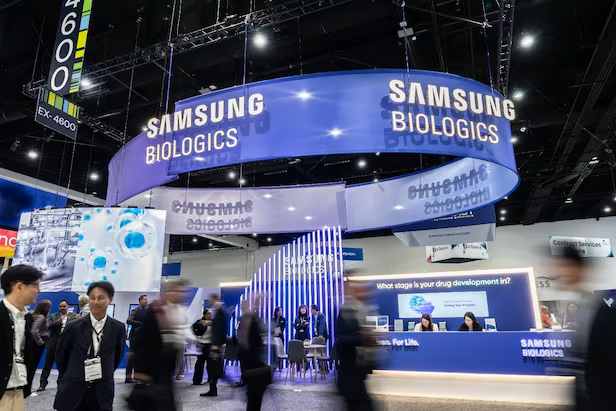
On June 22 (local time), the world’s largest pharmaceutical and bio industry exhibition, “BIO International Convention (BIO USA) 2026,” opened at the convention center in San Diego, California, USA. A total of 1,600 companies from 76 countries participated, with 20,000 attendees. Among them, 350 domestic pharmaceutical and bio companies and institutions participated, making it the second-largest delegation after the host country, the United States. / Samsung Biologics
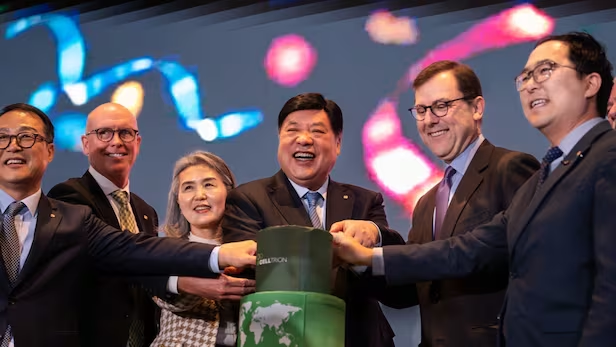
South Korea’s pharmaceutical and bio industry is entering a new phase of growth. In the first half of this year, Korean pharmaceutical and bio stocks underperformed due to market volatility and shrinking investor sentiment. However, the industry’s competitiveness is assessed to have further strengthened. In fact, achievements by Korean companies in the global biosimilar (follow-on biologics) and contract development and manufacturing organization (CDMO) markets are bearing fruit in the form of expanded exports. Biopharmaceutical export performance has set new records for three consecutive years. According to the Ministry of Food and Drug Safety, last year’s domestic pharmaceutical production reached a record high of 33.8466 trillion won. Pharmaceutical exports exceeded $10.438 billion for the first time, and the trade balance recorded a surplus of $1.50581 billion, also a record high. Biopharmaceuticals, in particular, drove this growth. Last year, biopharmaceutical exports amounted to $7.64 billion, accounting for approximately 73% of total pharmaceutical exports. Growth continues this year. In the first half of this year, biopharmaceutical exports reached $4.5 billion, a record high for a half-year period, representing an approximately 15% increase year-on-year. The expansion of biosimilar demand and increased CDMO orders for Korean companies drove exports. Export markets also expanded rapidly, particularly in Europe. Switzerland, Hungary, the Netherlands, and Germany have become key export destinations, further broadening K-Bio’s global supply network. The global commercialization of domestic new drugs, investment in production facilities, and technology exports have collectively elevated the competitiveness of K-Pharma and Bio to a new level. There is a view that competitiveness will become more pronounced, especially among companies that are actually generating results in the global market. Celltrion held a groundbreaking ceremony on January 5 (local time) at its production facility in Branchburg, New Jersey, USA. / Celltrion
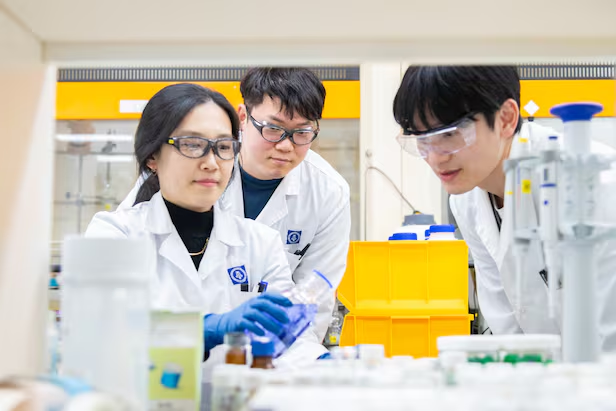
At the core of the growth of Korea’s biopharmaceutical industry are biosimilars and CDMOs. Samsung Biologics (1,379,000 won ▲ 7,000 0.51%) and Celltrion (172,200 won ▲ 2,100 1.23%) both surpassed 4 trillion won in sales last year, recording their best-ever performances. They are not only driving the growth of Korea’s bio industry but also contributing to the treatment environment for patients worldwide and the stability of drug supply. Of the 18 biosimilars approved by the U.S. Food and Drug Administration (FDA) last year, five were Korean products, ranking first by country. Celltrion is focusing on expanding its biosimilar product portfolio and strengthening its global direct sales capabilities. It currently has 11 biosimilar products and plans to expand to 18 by 2030 and 41 by 2038. After acquiring a production facility in Branchburg, New Jersey, operated by U.S. pharmaceutical company Eli Lilly, and starting full-scale operations in January this year, the company also acquired French healthcare company Gifrer in May. This strategy aims to simultaneously enhance the stability of the global supply chain and competitiveness in the European market by securing production bases and strengthening local distribution networks. Samsung Biologics is also expanding its production capacity to strengthen its competitiveness as a global CDMO. This year, it completed the acquisition of a biopharmaceutical production facility in Rockville, Maryland, USA, securing its first production base in the U.S., and added 60,000 liters (L) of production equipment, expanding its global production capacity from 785,000 L to 845,000 L. It also completed the acquisition of global peptide CDMO company Polypeptide Group. The acquisition scale is approximately 2.7 trillion won, the largest in the history of Korea’s pharmaceutical and bio industry. This strategy aims to expand from antibody drug-focused business to the peptide field, targeting the production market for next-generation drugs such as obesity and diabetes treatments. Researchers at Chong Kun Dang Pharmaceutical’s Hyojung Research Institute are conducting experiments to search for active substances. The company is expanding its new drug pipeline in areas such as cell and gene therapy (CGT) and antibody-drug conjugates (ADC). / Chong Kun Dang pharmaceutical
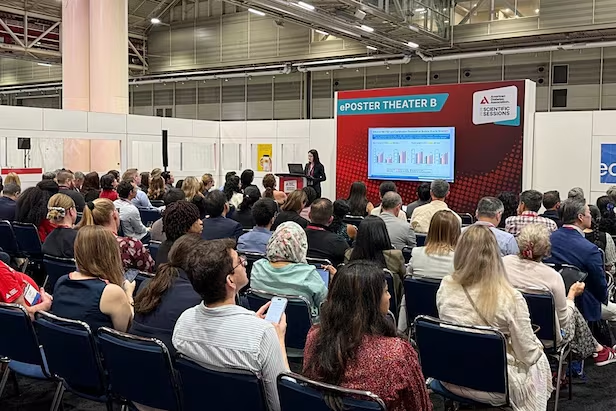
Achievements in the global sales expansion of domestic new drugs and large-scale technology exports continue. According to the Korea Pharmaceutical and Bio Association, the scale of technology export contracts announced by Korean companies in the first half of this year is estimated at approximately 13 trillion won. There are expectations that this will surpass last year’s annual record of 20 trillion won. Yuhan Corporation’s (71,400 won ▲ 1,200 1.71%) lung cancer new drug LECLAZA (ingredient: lazertinib) is considered a representative success story of open innovation strategy and global technology exports. The LECLAZA plus Rybrevant combination therapy, which was technology-transferred to U.S. pharmaceutical company Johnson & Johnson (J&J), recorded global sales of $289 million (approximately 430 billion won) in the second quarter of this year. This represents a 60.8% increase year-on-year. Cumulative sales for the first half of the year reached $546 million (approximately 810 billion won), a 70.4% increase from the previous year. GC Biopharma’s immunoglobulin blood product “Aligro” has also continued to grow since entering the U.S. market. Aligro’s sales more than doubled from approximately $50 million (approximately 48.6 billion won at the then-exchange rate) in 2024 to approximately $106 million (approximately 151.1 billion won) last year. In the first quarter of this year, it recorded sales of 34.9 billion won, an approximately 306% increase year-on-year. To respond to the expansion of the U.S. market, GC Biopharma is investing 140 billion won in its Ochang plant by 2030 to build a production line for next-generation subcutaneous immunoglobulin (SCIG). Hanmi Pharmaceutical (389,500 won ▲ 20,500 5.56%) demonstrated its global competitiveness this year by technology-transferring the Moebius syndrome treatment candidate substance sonepeglotide to U.S. company Eli Lilly for up to $1.26 billion. AriBio continues its global challenge in the dementia treatment field. In May, the company signed a global sales rights agreement worth up to 7 trillion won for its oral Alzheimer’s disease treatment candidate substance “AR1001.” Lee Sung-myung, Partner (Principal Researcher) at Hanmi Pharmaceutical’s Future Growth Division, presented key research findings on the world’s first muscle-increasing obesity treatment HM17321 at the American Diabetes Association (ADA 2026) held in New Orleans, USA, in June. / Hanmi Pharmaceutical
Alongside the growth of existing products, Korean companies are accelerating the development of next-generation new drugs. Hanmi Pharmaceutical is proceeding with the approval process for the launch of the first domestic obesity new drug, efeglenatide. Additionally, it is developing next-generation obesity drug pipelines, including the triple-action (GLP-1, GIP, glucagon)-based obesity treatment candidate “HM15275” and muscle-increasing obesity treatment candidates “HM17321” and “HM500197.” The company is also preparing to announce results from the Phase 2b trial of the MASH (metabolic dysfunction-associated steatohepatitis) treatment candidate epinopegdeutide. Chong Kun Dang Pharmaceutical (67,500 won ▲ 1,400 2.12%) has embarked on the development of anticancer new drugs based on antibody-drug conjugates (ADC) and the expansion of global open innovation. The ADC candidate “CKD-703” has entered the development stage with the initiation of first patient enrollment in a global Phase 1/2a trial in the U.S. The company is also collaborating with the Boston bio-cluster to identify promising biotechs. Dong-A Socio Group is simultaneously strengthening its capabilities in both new drug development and CDMO. Dong-A ST (36,200 won ▲ 1,800 5.23%) is seeking global technology export opportunities based on its innovative new drug pipeline in the fields of cancer, immune inflammation, and neurodegenerative diseases. ST Pharm (117,900 won ▲ 4,900 4.34%) is expanding its CDMO competitiveness in the fields of oligonucleotide therapeutics and mRNA. With the operation of its second oligonucleotide plant, it has secured production capacity capable of handling everything from early clinical trials to commercial production, and is targeting the RNA therapeutics market by leveraging its proprietary 5′ capping technology and LNP platform. The K-Medical Aesthetics field is also establishing itself as a global growth axis. Daewoong Pharmaceutical (123,800 won ▲ 4,100 3.43%) continues to expand in the U.S. market, led by its botulinum toxin product “Nabota.” Along with expanding sales in North America through its U.S. partner Evolus, it is targeting the South American and Southeast Asian markets. Companies such as Huons (241,500 won ▲ 20,000 9.03%), Pharma Research (360,000 won ▲ 37,500 11.63%), Medytox (71,500 won ▲ 3,200 4.69%), L&C BIO (63,100 won ▲ 2,100 3.44%), JETEMA (4,390 won ▲ 205 4.9%), and CLASSYS (44,250 won ▲ 850 1.96%) are continuing to expand overseas sales in the toxin, filler, and medical aesthetics device sectors, emerging as new export drivers.
※ This article was translated using AI. Please send your feedback through this form. | View original article (Korean)
#K-Pharma Bio’s Quantum Leap
Heo Ji-yoon Staff writer, Bio/Venture & Small Enterprises News Desk