Editor’s Note
**Editor’s Note:** This article highlights a landmark achievement in medical technology: the world’s first global confirmatory clinical trial for drug-delivery focused ultrasound, developed by Korean researchers. Set to begin in September, this innovation uses focused ultrasound to enhance anticancer drug penetration into tumors, marking a pivotal step in cancer treatment and underscoring Korea’s growing competitiveness in the medical device industry.
A “drug delivery focused ultrasound” technology developed by Korean medical staff will begin the world’s first global confirmatory clinical trial in September. This is the first time that a technology using focused ultrasound to increase the penetration of anticancer drugs into tumors has entered a large-scale clinical validation stage. Observers say it could showcase the competitiveness of Korea’s medical device industry, as a new anticancer treatment platform has moved beyond the lab and into the validation phase for global commercialization.
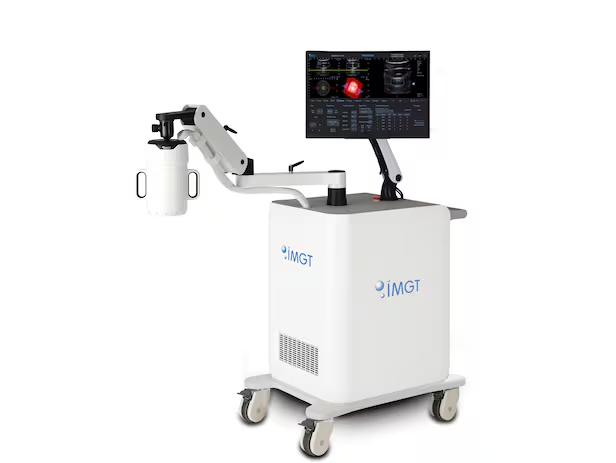
According to the medical community on the 28th, IMGT recently received renewed approval from the FDA for an investigational device exemption (IDE) for the global confirmatory clinical trial of IMD10, a focused ultrasound medical device for pancreatic cancer treatment, and is completing final procedures to launch the trial with major U.S. hospitals, aiming to register the first patient in September. A confirmatory trial is a large-scale clinical stage that finally verifies efficacy and safety for approval.
IMGT is a medical device corporation founded in 2010 by Lee Hak-jong, a professor of radiology at Seoul National University Bundang Hospital of Seoul National University College of Medicine. IMGT is short for Image Guided Therapy, and it has focused on developing a platform that combines image-guided technology and focused ultrasound to solve the drug delivery problem in hard-to-treat cancers.
Since 2020, Chief Executive Sohn Geon-ho, who developed ultrasound medical devices for more than 20 years at Medison (now Samsung Medison Co.) and Siemens, has joined as a co-CEO and is leading the push for commercialization.
IMD10, developed by the company, is a medical device that, after an anticancer drug is administered intravenously, irradiates the tumor with focused ultrasound to create temporary micro-passages (pores) in blood vessels and cell membranes, helping the drug penetrate deeper into the cancer tissue. The company named this the “ChemoSono Therapy” platform. Unlike conventional high-intensity focused ultrasound (HIFU), which directly burns or destroys tumors, the core is to boost the therapeutic effect of existing anticancer drugs.
IMD10 was designated an innovative medical device by the FDA last year, recognizing its technological innovation. The program gives the FDA authority to prioritize support for the development and approval processes of innovative medical devices intended to treat life-threatening or irreversible diseases. With this latest approval, the device has entered the global confirmatory trial stage, clearing a key hurdle toward commercialization.
The confirmatory trial will enroll a total of 360 pancreatic cancer patients in Korea and the United States. The company initially considered a trial of about 136 patients but expanded it to 360 during discussions with the FDA. The decision reflects the FDA’s view that a larger trial is needed to strengthen the evidence for future U.S. insurance reimbursement and commercialization.
Major U.S. cancer centers, including Brigham and Women’s Hospital (BWH), University of Virginia (UVA) Hospital, and the Mays Cancer Center, are expected to participate in the trial. The Focused Ultrasound Foundation, a global nonprofit institution in the focused ultrasound field, is also discussing the scale of support for U.S. clinical expenses.
IMGT’s technology takes a different approach from existing focused ultrasound medical devices. While HistoSonics in the United States uses ultrasound to directly destroy cancer tissue, IMD10 is a drug delivery platform that helps anticancer drugs penetrate cancer tissue more effectively. If HistoSonics is a “scalpel,” IMD10 is closer to a “syringe” that opens a path for drugs to enter the cancer tissue.
The company said,
The reason the company chose pancreatic cancer as the first indication is also the limitations of drug delivery. Pancreatic cancer is a representative intractable cancer in which the surrounding stroma is dense and highly fibrotic, preventing anticancer drugs from sufficiently penetrating the inside of tumors. IMD10 is focused on solving the problem of existing anticancer drugs not properly reaching cancer cells.
From the early stages of development, IMGT advanced the technology with support from the Pan-Ministry Medical Device Development Project across the full cycle and was selected as one of the “top 10 flagship projects.” It is evaluated as one of the representative cases in which research and development (R&D) supported by the government across the entire medical device development cycle—from basic research to clinical trials and regulatory approval—has led to a U.S. FDA global confirmatory trial.
If this trial succeeds, IMD10 will move closer to U.S. approval as the world’s first focused ultrasound medical device for anticancer drug delivery.
Lee Hak-jong, CEO of IMGT, said,