Editor’s Note
**Editor’s Note:** This article highlights key insights from the 27th Summer Conference of the Korean Society for Laser Dermatology and Aesthetic Medicine, focusing on Dr. Choi Cheon-pil’s presentation on melasma treatment. The piece underscores the foundational role of laser therapy while emphasizing the critical importance of restoring the skin environment for effective, long-term results.
The Korean Society for Laser Dermatology and Aesthetic Medicine held its ’27th Summer Conference’ on the 19th at Seoul St. Mary’s Hospital. During the conference, experts delivered lectures on various topics based on their clinical research and experience.
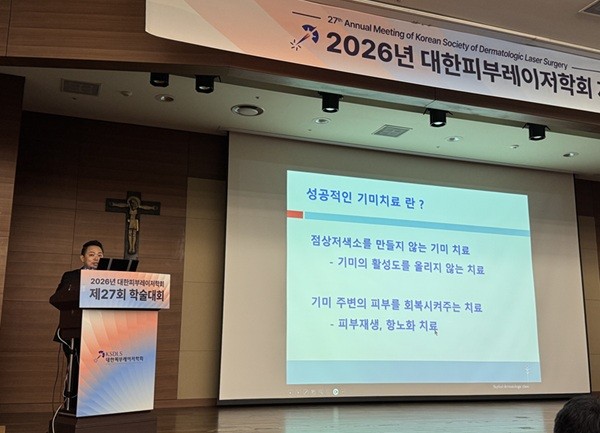
Dr. Choi Cheon-pil of Sky Feel Dermatology Clinic introduced a melasma treatment strategy centered on energy-based devices (EBD).
He pointed out that one reason melasma treatment is difficult is that the laser procedure can increase melasma activity, leading to side effects. Although repeated procedures may reduce pigmentation, if melasma becomes activated, treatment becomes more challenging, and natural recovery or drug therapy alone is insufficient.
Dr. Choi particularly stressed that the goal of melasma treatment goes beyond simply removing pigmentation. It involves improving the dermal environment to lower melasma activity, reduce inflammatory cytokines, and manage the long-term risk of recurrence.
To this end, Dr. Choi introduced dual laser toning, which sequentially uses a Q-switched 1064nm Nd:YAG laser and a long-pulse 1064nm Nd:YAG laser.
Furthermore, noting recent research suggesting that senescent cells play a significant role in the chronicity of melasma, he added that fractional radiofrequency microneedling (FRM) can also aid in improving the dermal environment and restoring normal cells.