Editor’s Note
**Editor’s Note:** This article explores how the rise of GLP-1 obesity drugs is reshaping the weight loss market, driving increased demand for post-weight-loss body contouring procedures like liposuction and fat grafting, as highlighted by 365mc’s latest data analysis.
As GLP-1 class obesity treatments like Wegovy and Mounjaro reshape the weight loss paradigm, new shifts are emerging in the obesity treatment market. Analysis suggests that after successful drug-induced weight loss, demand for localized body contouring to achieve desired body lines is increasing, reshaping the liposuction and fat grafting market.
365mc, a specialized liposuction medical institution, released on the 21st the results of an analysis of liposuction surgery data from its five nationwide hospital-level facilities in Seoul, Incheon, Daejeon, Daegu, and Busan over the past three years.
According to the analysis, total liposuction surgery volumes continued to increase even after the introduction of GLP-1 class treatments in Korea. However, the market is shifting toward body contouring, as demand grows for precise refinement of localized fat in exposed areas like the arms—which are difficult to improve with medication alone—while central fat in the abdomen and thighs is managed with drug therapy.
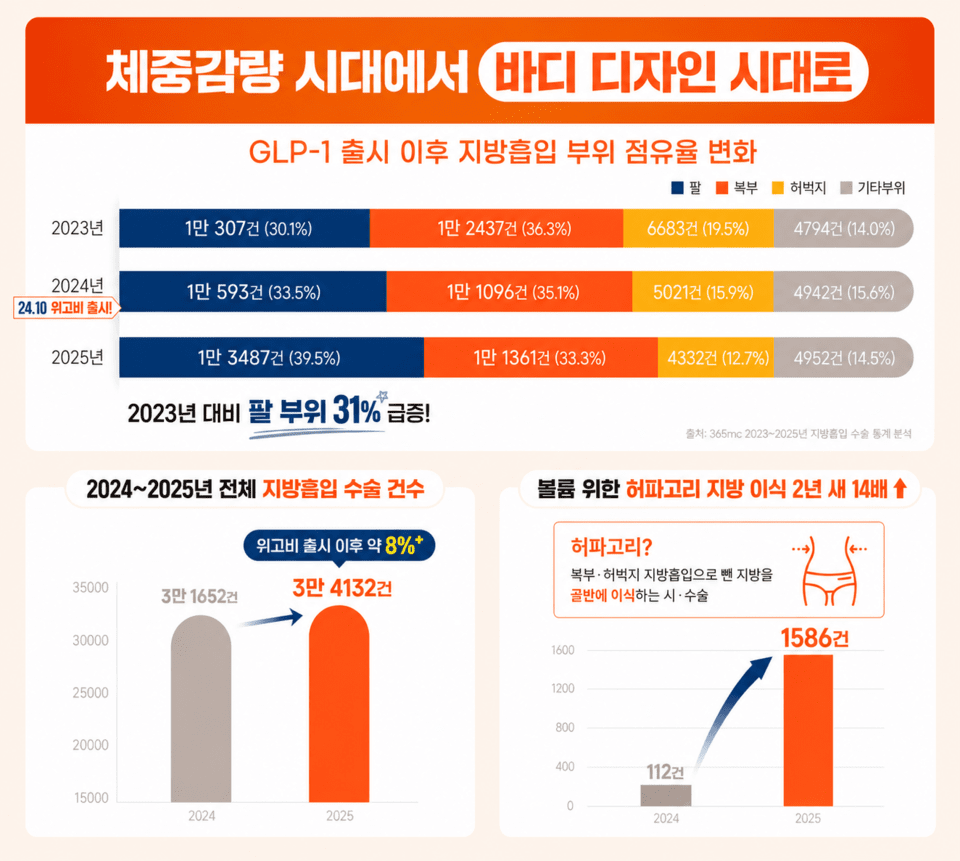
In terms of surgery counts by area, central liposuction decreased, while arm liposuction increased significantly.
Thigh liposuction dropped from 6,683 cases in 2023 (pre-GLP-1 introduction) to 4,332 cases last year, a 35.2% decline—the largest decrease. Abdominal liposuction also fell 8.7% from 12,437 to 11,361 cases over the same period.
In contrast, arm liposuction rose slightly from 10,307 cases in 2023 to 10,593 in 2024, then surged to 13,487 cases last year—an approximately 30.9% increase from 2023. Last year, it overtook abdominal liposuction to become the most performed liposuction area.
365mc analyzed that while GLP-1 class treatments are effective for overall weight loss, they have limitations in improving fat distribution or body lines in specific areas, driving demand for localized body contouring.
As weight loss becomes easier, demand to maintain or supplement body volume has also increased.
According to 365mc, the so-called ‘hip-fat grafting’ procedure—transferring fat harvested from the abdomen or thighs to the pelvis—surged from 112 cases in 2023 to 1,586 cases last year, an approximately 14-fold increase.
The explanation is that as rapid weight loss increasingly reduces fat in volume-critical areas like the buttocks, breasts, and face, demand for body supplementation through fat grafting is expanding.