Editor’s Note
**Editor’s Note:** This report explores the emerging potential of Azelamide MEA in the hypoallergenic functional skincare market, highlighting new growth opportunities and key market trends through 2032.
QYResearch has recently published its industry report “Global Azelamide MEA Market Research Report 2026-2032.” This report investigates product definitions, product types, market size, sales volume and price, competitive landscape, application areas, regional structure, and changes in the industrial chain for Azelamide MEA. This article focuses on demand shifts, technological evolution, and supply chain opportunities in oily/acne-prone skin care, brightening, acne scar care, sensitive skin conditioning, scalp sebum control, and functional personal care products.
Azelamide MEA (CAS No. 242132-61-2) is a functional active ingredient for cosmetics belonging to the azelaic acid derivative family, where MEA refers to the monoethanolamine structure. Compared to traditional azelaic acid, Azelamide MEA offers superior water solubility, lower irritation, and easier formulation, making it suitable for serums, lotions, creams, gels, scalp care solutions, and spot treatment products. Its core value lies in maintaining the benefits of azelaic acid derivatives in sebum regulation, acne care, skin tone improvement, and soothing, while overcoming the solubility, irritation, and formulation stability limitations of conventional azelaic acid.
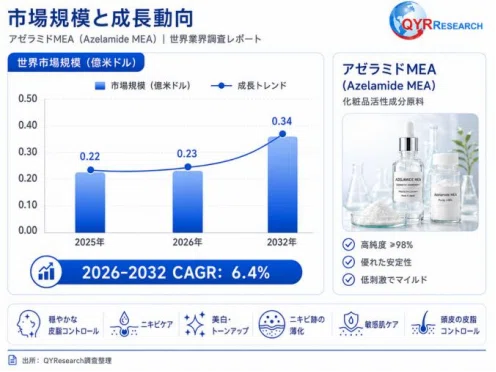
Figure: Global Azelamide MEA Market Size (USD Million), 2025 vs. 2026 vs. 2032
According to QYResearch’s preliminary study, the global Azelamide MEA market was valued at approximately USD 22 million in 2025, is expected to reach USD 23 million in 2026, and is projected to reach approximately USD 34 million by 2032, with a compound annual growth rate (CAGR) of about 6.4% from 2026 to 2032.
Azelamide MEA Classification
By product type, common classification axes for Azelamide MEA are mainly product purity and commercial form. By purity, it is divided into high-purity and standard-purity grades. High-purity products typically refer to powder-type active ingredients with purity ≥98.5%, suitable for premium functional skincare, sensitive skin formulations, oily/acne-prone skin care, and brightening products. Standard-purity products generally cover the 95%–98.5% range and are more commonly used in cost-sensitive functional products or compound ingredients. By form, it is divided into powder and liquid types. Powder types emphasize purity, stability, and formulation flexibility, while liquid types are often pre-dissolved or compounded, suitable for rapid prototyping and convenient addition.
In terms of applications, facial care is currently the largest consumption segment, used in serums, lotions, creams, gels, spot treatments, and products for oily skin. Scalp care focuses on sebum control, cooling sensation, and integration with cleansing care. Body care primarily targets back acne, uneven skin tone, and localized conditioning.
Other applications include professional care, compounded functional ingredients, and functional personal care products. Fast-growing segments include high-purity powder products, pre-dissolved liquid products, low-irritation sebum control and acne care, brightening and acne scar care, and scalp sebum control care.
Global Azelamide MEA Key Company Rankings and Market Share
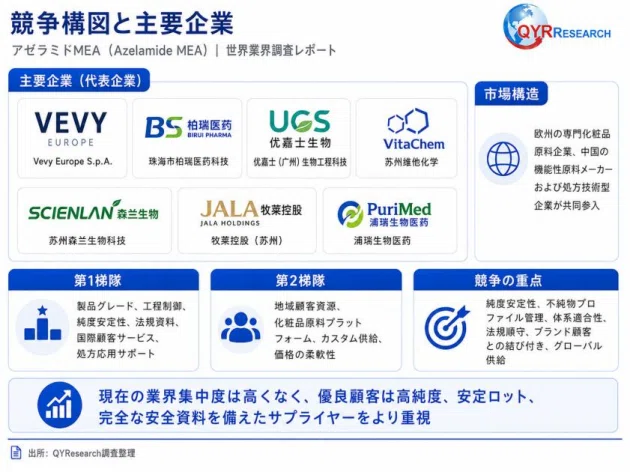
The global Azelamide MEA market currently exhibits a competitive structure involving European specialty cosmetic ingredient companies, Chinese functional ingredient manufacturers, and formulation technology companies. Representative companies include Vevy Europe S.p.A., Zhuhai Bairui Pharmaceutical Technology, Youjiashi (Guangzhou) Bioengineering Technology, Suzhou Vita Chemicals, Suzhou Senlan Biotechnology, Zhuanglai Holdings (Suzhou), and Purui Biomedical Pharmaceutical. Final sales shares, production capacity distribution, and customer structures are subject to confirmation in the full report.
Tier 1 companies typically have strengths in product stability, purity control, regulatory documentation, international customer service, and formulation support. Tier 2 companies participate in the market through regional customers, custom supply, pricing flexibility, and rapid delivery. Future competitive axes will shift from simple price competition to batch consistency, impurity management, system compatibility, completeness of regulatory documentation, and formulation support capabilities for downstream customers.
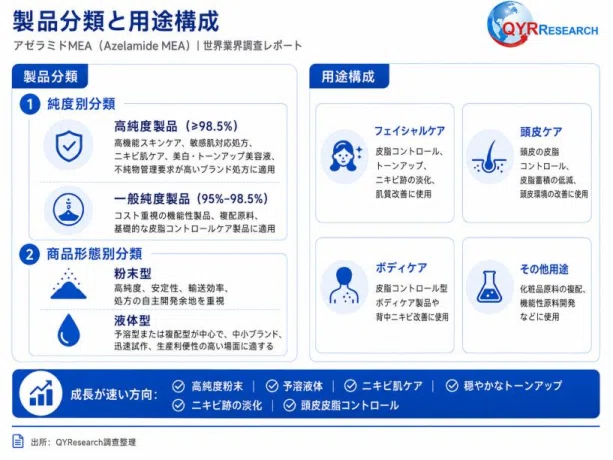
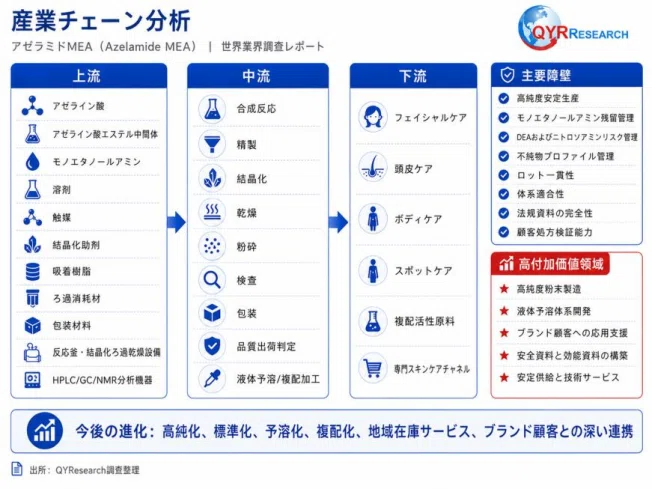
Figure: Azelamide MEA Industry Chain Analysis
The upstream of the Azelamide MEA industry chain mainly consists of azelaic acid, azelaic acid ester intermediates, monoethanolamine, solvents, catalysts, crystallization aids, adsorption resins, filtration consumables, packaging materials, reaction vessels, crystallization equipment, filtration and drying equipment, and inspection and analysis equipment. The midstream mainly includes synthesis reaction, purification, crystallization, drying, grinding, inspection, packaging, quality release determination, and liquid pre-dissolution or compounding processing of Azelamide MEA.
Downstream applications are centered on functional cosmetics and personal care products, extending to facial care, scalp care, body care, spot care, compounded active ingredients, and professional skincare channels.
Figure: Azelamide MEA Regional Structure and Market Opportunities
In terms of regional structure, global Azelamide MEA production is mainly concentrated in China and Europe. European companies have strengths in cosmetic active ingredient development, brand customer service, regulatory documentation, and international market recognition. Chinese companies have advantages in fine chemical synthesis, cosmetic ingredient manufacturing, cost management, specification development, rapid delivery, and custom supply.
On the consumption side, North America and Europe are important markets for premium functional skincare, acne and sebum control, brightening, and skin conditioning products. China, Japan, South Korea, and Southeast Asia are growing faster due to the upgrading of functional skincare consumption, ingredient education, increasing demand for sensitive skin care, and formulation innovation by local brands. Future regional opportunities are expected to be concentrated in the upgrading of the Chinese supply chain, onboarding of North American brand customers, sustained demand for premium ingredients in Europe, and market expansion in Asia for oily/acne-prone skin care, scalp care, and low-irritation brightening products.
In the coming years, as the functional skincare market moves toward low irritation, compound formulations, long-term care, and sensitive skin compatibility, Azelamide MEA is expected to evolve from a niche azelaic acid derivative into a key active ingredient in oily/acne-prone skin care, sebum control and acne care, brightening, acne scar care, and scalp sebum control formulations. Industry competition will also shift from “whether it can be supplied” to “whether it can serve global customers with stability, high purity, low impurities, compliance, and sustainability.”
https://www.qyresearch.co.jp/customized