Editor’s Note
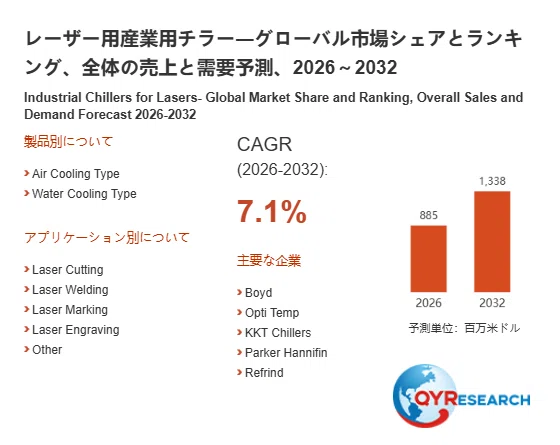
The global industrial chillers for lasers market is set for steady growth, rising from $832 million in 2025 to $1,338 million by 2032, driven by a 7.1% CAGR. This QYResearch report highlights increasing demand for precision cooling in laser applications.
The global market for industrial chillers for lasers is projected to grow from an estimated $832 million in 2025 to $885 million in 2026, with a compound annual growth rate (CAGR) of 7.1% from 2026 to 2032, reaching $1,338 million by 2032, according to the latest report by QYResearch.
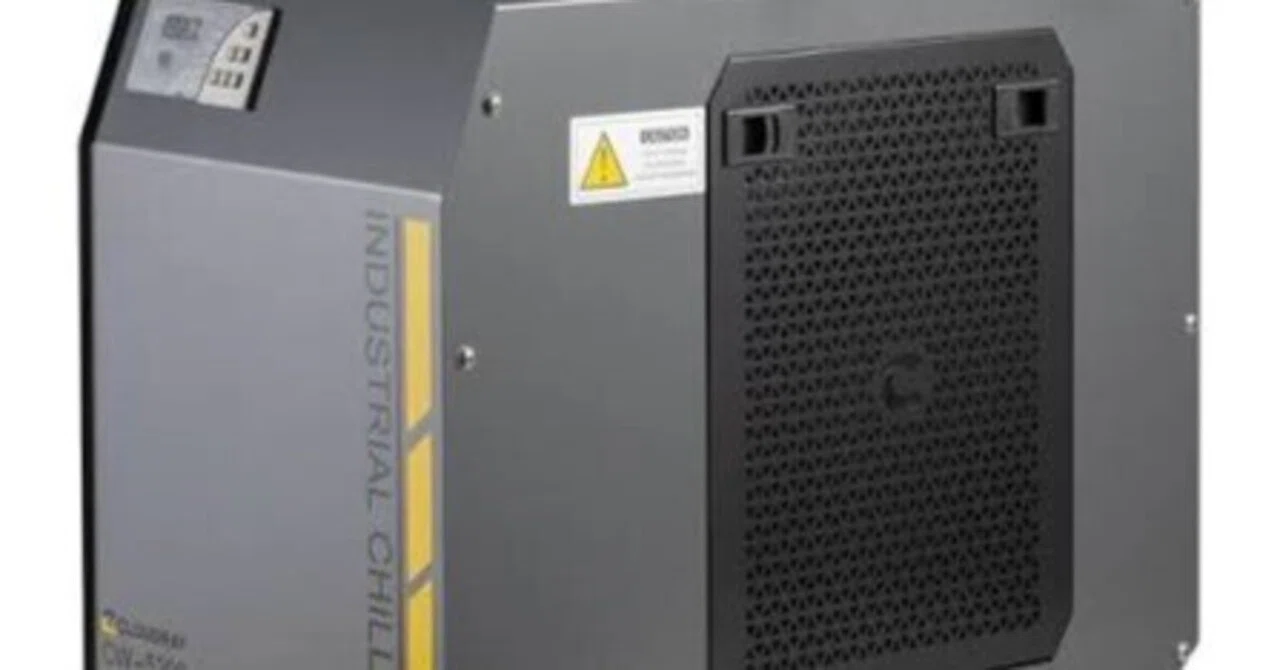
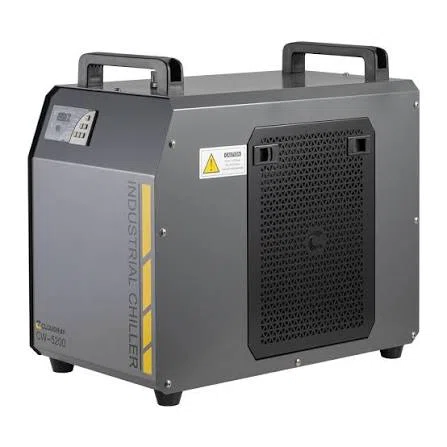
Industrial chillers for lasers are specialized cooling systems designed to precisely control the temperature of various laser devices, including fiber lasers, CO₂ lasers, and UV lasers. In laser processing, the heat generated during operation significantly impacts beam quality, output stability, and processing accuracy, making advanced thermal management by industrial chillers essential.
Typical industrial chillers for lasers employ a closed-loop cooling water circulation system to efficiently remove heat from laser diodes and heat-generating components, preventing performance degradation due to overheating. They are equipped with high-precision temperature control, low-noise design, intelligent alarms, and automatic control functions, making them widely used in applications such as laser cutting, laser welding, marking, medical lasers, and R&D equipment.
Key technological developments in the industrial chiller market for lasers include high-precision temperature control, energy efficiency, and intelligent features. In recent years, laser devices have simultaneously advanced toward higher power and miniaturization, requiring not just cooling capacity but also stable temperature management during prolonged continuous operation.
For high-power fiber lasers and ultrafast lasers, even minor temperature fluctuations can lead to wavelength or output variations, demanding high temperature stability from chillers. The latest models incorporate improved temperature control accuracy, multi-channel control technology, and real-time monitoring capabilities.
As laser processing equipment space shrinks, chillers must also be compact and densely designed. The shift from traditional large cooling units to compact, high-efficiency industrial chillers is accelerating, with space-saving, low power consumption, and low noise becoming key competitive factors.
Furthermore, smart chillers leveraging IoT and AI technologies are under development. Features such as remote monitoring, fault prediction, and operational data analysis help reduce equipment downtime and improve overall production efficiency of laser processing lines.
The primary driver of the industrial chiller market for lasers is the rapid expansion of laser application fields. Increasing demand for high-precision processing has led to laser technology adoption in automotive, electronics, semiconductors, solar power, and lithium battery manufacturing.
In the EV industry, laser processing is increasingly used in lithium battery cell processing, battery welding, and battery pack manufacturing. These processes require high precision and stable operation, boosting demand for industrial chillers to maintain laser device performance.
In semiconductor manufacturing, advances in microfabrication technology have tightened temperature management requirements for laser equipment. In nanoscale processing, cooling systems that minimize thermal fluctuations are critical to manufacturing quality, driving adoption of high-performance chillers.
The market is expected to accelerate the shift from standard products to customized thermal management solutions optimized for specific applications. Laser device manufacturers and end-users are evaluating not only cooling performance but also device size, power consumption, maintainability, and system integration.
Future trends in the industrial chiller industry for lasers include intelligence, environmental friendliness, and modularization. With the spread of industrial IoT, the latest chillers are incorporating remote monitoring, predictive maintenance, and energy management functions to improve operational efficiency.
Environmental regulations and decarbonization efforts are also influencing product development. Manufacturers are adopting low-environmental-impact refrigerants, variable-speed compressors, and high-efficiency control algorithms to reduce power consumption and CO₂ emissions.
Demand for modular industrial chillers for lasers is also growing. Their flexible cooling capacity expansion in response to production changes allows for lower initial investment while accommodating future equipment upgrades.
However, the industry still faces challenges. In the high-performance segment, overseas manufacturers remain highly competitive, and some regions rely heavily on imports for key components like compressors and high-precision sensors. Meeting strict quality requirements for long-term reliability, low noise, and electromagnetic compatibility (EMC) poses technical hurdles for manufacturers.
Additionally, varying cooling requirements across different laser processing applications make industry-wide standardization difficult. This complicates equipment selection and maintenance for users, highlighting the need for products that balance versatility and customization.
Key players in the industrial chiller market for lasers include Boyd, Opti Temp, KKT Chillers, Parker Hannifin, Refrind, SMC Corporation, Solid State Cooling Systems, Advantage Engineering, Technotrans, and Dimplex Thermal Solutions.
As laser processing technology advances and smart manufacturing progresses, industrial chillers for lasers are expected to evolve from mere cooling equipment into core components supporting the performance, quality, and productivity of entire laser systems, driving further market expansion.