Editor’s Note
**Editor’s Note:** This article examines growing safety concerns over the use of cadaveric tissue grafts in cosmetic dermatology, highlighting how their classification as “human tissue” allows them to bypass standard drug and device verification protocols.
Concerns are mounting over the booming popularity of so-called ‘skin boosters’ derived from cadaveric (allogeneic) tissue in the aesthetic dermatology market, with experts calling for urgent safety verification and closure of regulatory loopholes. Critics point out that human tissue approved for therapeutic purposes like skin reconstruction is being repurposed as injectable cosmetic products and distributed indiscriminately.
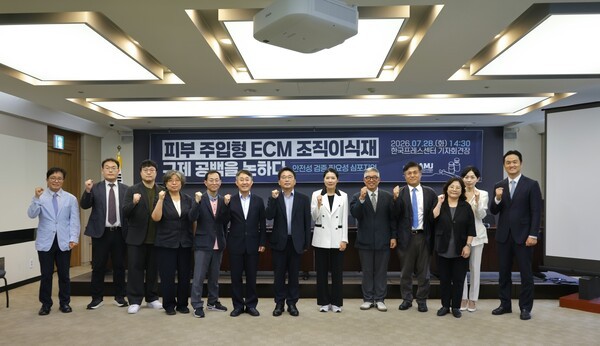
The Korea Medical Bio Journalists Association held a symposium titled ‘Discussing the Regulatory Gap of Injectable ECM Tissue Grafts – The Need for Safety Verification’ on July 28 at the Korea Press Center in Jung-gu, Seoul. The event brought together medical and biotech experts, government officials, and journalists to assess the current state of human-derived skin booster procedures and explore policy alternatives.
Professor Shin Hyun-young, the first presenter, delivered a talk on ‘Regulatory Gaps and the Need for Safety Verification of Cadaver-Derived Skin Boosters.’ According to Professor Shin, the controversial skin boosters refer to acellular dermal matrix (ADM), which is produced by removing the epidermis and fat layer, eliminating cells from the dermal tissue, and leaving only the extracellular matrix (ECM). The industry promotes these injections as a way to restore aging-related loss of elasticity, driving high-cost procedures.
Professor Shin criticized the situation, stating, “While the industry has evolved from hyaluronic acid and salmon DNA to cadaver-derived materials, these products bypass medical device and pharmaceutical regulations by being classified as human tissue without formal medical approval.” She noted that the Ministry of Food and Drug Safety (MFDS) had already advised in 2021 and 2022 that products not approved as drugs or medical devices should not be injected into the skin.
She emphasized that even ingredients used for burn treatment or skin reconstruction present separate safety concerns when used for cosmetic purposes.
Serious concerns were raised regarding domestic distribution and safety. Injection methods are not standardized, varying widely among practitioners, and there is no evidence on long-term toxicity from mixing with other ingredients. Recent academic papers have reported that acellular allogeneic dermal matrix skin boosters can induce platelet aggregation, potentially causing vascular complications like thrombosis. In the United States, procedures using cadaveric fat have been refused due to risks of calcification or misdiagnosis as tumors during future breast cancer screenings.
Professor Shin highlighted the core issue: “The biggest problem is that consumers undergo these procedures without accurately knowing that the products evade regulation or that the material is derived from cadavers. According to a forum survey, the acceptance rate for procedures drops sharply to 30% when patients are informed beforehand that the material is cadaver-derived.”
Professor Shin urged the government to adopt six policy measures:
– Conduct a full-scale investigation of skin booster products in circulation and document adverse events
– Provide an objective authoritative interpretation of ‘minimal manipulation’ and ‘homologous use’ standards
– Introduce a regulatory monitoring system aligned with global standards in the US, Europe, and Taiwan
– Establish clear legal criteria for the cosmetic use of human-derived materials
– Legislate mandatory disclosure of cadaveric origin and explanation of side effects
– Strengthen oversight of commercialization by private tissue banks
Attorney Lim Won-taek of law firm Moonjang then addressed ‘Legislative Intent of the Human Tissue Act and Legal Issues Arising from Route of Administration Changes,’ pointing out the potential illegality of ECM tissue grafts. He echoed concerns that classifying ECM tissue grafts as human tissue allows them to bypass the approval and safety verification required for drugs and medical devices.
He argued that the Human Tissue Safety Act presupposes tissue transplantation for disease treatment and functional recovery, so the current practice of grinding cadaveric tissue and injecting it for cosmetic purposes needs re-examination to see if it aligns with the law’s intent. He interpreted that ECM tissue grafts, after grinding and dilution, can no longer be considered human tissue with preserved original structure and function, nor do they constitute therapeutic tissue transplantation.
Attorney Lim proposed improvements including restricting cosmetic use, incorporating injectable processed products into the approval system, and strengthening the duty to explain to patients.
During the panel discussion, experts from various fields shared their views.
Professor Lee Jong-hee of Samsung Medical Center’s Dermatology Department (Future Innovation Director, Korean Dermatological Association) spoke from a dermatological safety perspective. He noted that while human acellular dermal matrix (hADM) has been used in reconstructive surgery for a long time, the accumulated safety and efficacy evidence cannot be easily generalized to injectable formulations. He stated that although no major adverse events have been reported in clinical studies to date, the study sizes and observation periods are limited and may not fully reflect repeated administration in real-world clinical settings.
Professor Lee recommended establishing scientific and regulatory evaluation criteria and appropriate advertising and disclosure principles for the proper clinical use of injectable human-derived ECM products, emphasizing the need to accumulate and verify objective safety and efficacy data to protect public health while supporting the K-medical industry.
Professor Bae Ha-seok of Ewha Womans University Mokdong Hospital’s Rehabilitation Medicine Department shared clinical insights. He pointed out that animal-derived or synthetic collagen used in musculoskeletal regenerative therapy is classified as a medical device and undergoes rigorous clinical verification, while human-derived collagen lacks comparable procedures. He stressed the need for clinical evaluation and safety verification systems equivalent to those for medical devices to alleviate clinical concerns and ensure safe use.
Professor Lee Ji-yoon of Chung-Ang University’s Pharmacy Department explained from a pharmacological risk perspective why safety verification is necessary. She warned that injecting ECM-based tissue grafts as skin boosters requires careful assessment of in vivo safety, noting that residual components from manufacturing—such as DNA, SDS (sodium dodecyl sulfate, an anionic surfactant), and EDC (1-ethyl-3-(3-dimethylaminopropyl)carbodiimide, a crosslinking agent)—can cause immunogenicity and cytotoxicity, leading to delayed hypersensitivity, autoimmune reactions, and granulomatous nodules. She emphasized the need for at least preclinical studies to confirm biological safety, residual chemicals, and cumulative exposure and distribution of degradation products.
Conversely, Professor Lee Won-jae of Severance Hospital’s Plastic Surgery Department (Chairman, Korean Society of Plastic and Reconstructive Surgeons) argued that injectable ECM human tissue grafts are a well-established tissue reconstruction technology with decades of use in burns, trauma, and cancer reconstruction, demonstrating long-term safety and efficacy. He claimed that ethically sourced and rigorously processed products show excellent biocompatibility with minimal serious adverse reactions.
Yoo Mi-hwa, Standing Representative of GCN Green Consumer Network, expressed a consumer perspective, stating that the issue is not about blocking new technologies but ensuring sufficient safety verification, transparent information disclosure, and the public’s right to know, so that innovation can continue with public trust.
Journalist Lim Tae-kyun of YakSa GongRon cautioned that regulation should not be designed merely to strengthen disclosure of tissue origin, as this could be exploited as a marketing tool by existing ECM tissue graft companies. He emphasized that the focus should be on objectively verifying the safety and efficacy of injectable products, manufacturing processes, and adverse event management systems.
Professor Yang Sung-il of Seoul National University Bundang Hospital (former Vice Minister of Health and Welfare), who moderated the session, evaluated ECM tissue grafts as a case showing the innovation potential of domestic bio-cosmetic medical technology but stressed that market growth requires trust in public health and safety. He concluded that the current lack of chemical residue safety standards and a clear legal classification between tissue grafts and medical devices necessitates institutional supplementation, hoping the symposium would serve as a starting point for a rational and balanced regulatory framework.
Min Tae-won, President of the Korea Medical Bio Journalists Association, noted that while ECM grafts from cadaveric tissue are rapidly expanding in the cosmetic market, the regulatory system lags behind technological advances, creating growing concerns about regulatory gaps. He emphasized that the current Human Tissue Act, designed for surgical transplantation, leaves injectable cosmetic procedures in a legal gray zone, and that changes in administration route can alter adverse event profiles, requiring clear safety verification standards.
Representative Seo Young-seok of the Democratic Party of Korea (National Assembly Health and Welfare Committee) also stated in a congratulatory address that the Human Tissue Safety and Management Act was designed for urgent and critical tissue transplantation, and that using the same tissue-based material via injection fundamentally changes the risk profile, necessitating scientific verification and clear standards for new usage methods.