Editor’s Note
**Editor’s Note:** This article examines the emerging technology of dissolving microneedle eye patches, highlighting their potential to enhance active ingredient delivery and efficacy in eye-area skincare.
The dissolving microneedle eye patch is a novel functional skincare product combining microneedle delivery technology with eye-area care. It typically utilizes a dissolvable microneedle structure to deliver active ingredients such as hyaluronic acid, collagen, peptides, and vitamins intensively into the epidermis or superficial skin layers around the eyes. Compared to traditional eye patches and serums, it emphasizes localized ingredient delivery, ingredient utilization efficiency, penetration, and a premium user experience, making it suitable for anti-wrinkle, fine line improvement, moisturizing, dark circle and puffiness care, and post-aesthetic procedure recovery.
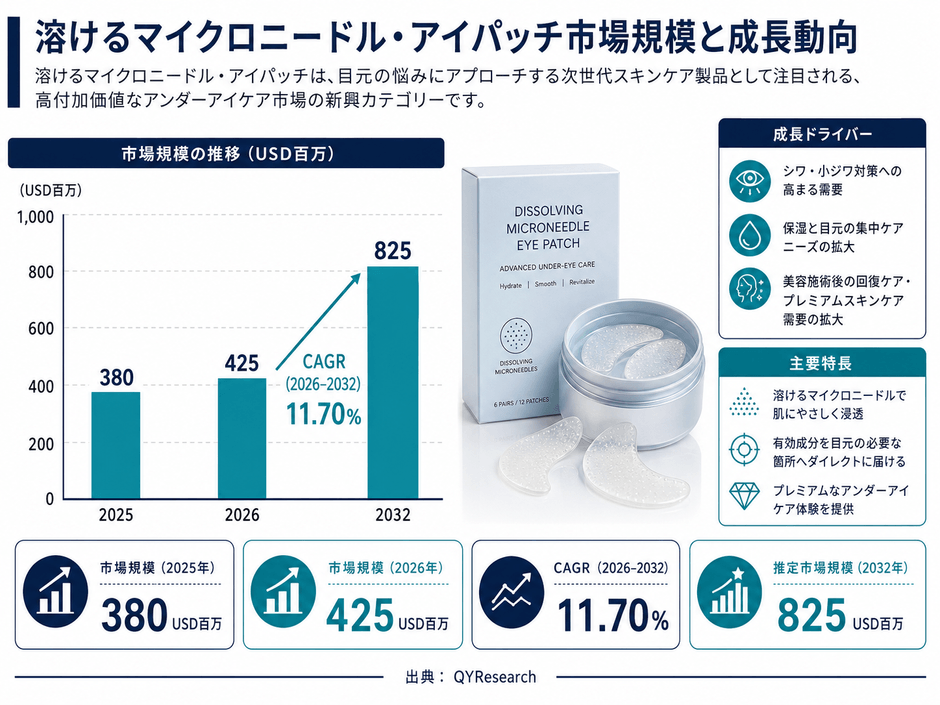
The global dissolving microneedle eye patch market was valued at approximately USD 380 million in 2025 and is expected to reach USD 425 million in 2026. The compound annual growth rate (CAGR) from 2026 to 2032 is projected at 11.70%, expanding the market to approximately USD 825 million by 2032. The market is still in its early growth to expansion phase, driven by rising anti-aging demand, maturation of microneedle manufacturing technology, consumer acceptance of intensive eye care, and the expansion of online beauty retail channels.
The future market is expected to develop around high-functional ingredient compound formulations, minimally invasive and gentle delivery, clear efficacy claims, and enhanced premium experience. Hyaluronic acid, collagen, peptides, and functional vitamins will remain key focuses in product development. Brands will also concentrate on needle stability, dissolution rate, adhesion during application, comfort, and safety. Companies with strengths in material research, microneedle design, efficacy evaluation, brand operation, and channel development are more likely to gain advantages in the mid-to-high-end eye care market.
The competitive landscape of the dissolving microneedle eye patch market is shaped by specialized microneedle technology companies, medical aesthetics and functional skincare brands, international cosmetics corporations, and Chinese innovative enterprises. Raphas, CosMED Pharmaceutical, and Nissha possess strong technical foundations in microneedle materials, patch structure design, and pharmaceutical-grade product development. Shiseido, skyn ICELAND, PCA Skin, 111SKIN, and Eyederm Cosmetics excel in premium skincare positioning, efficacy claims, brand image, and consumer education.
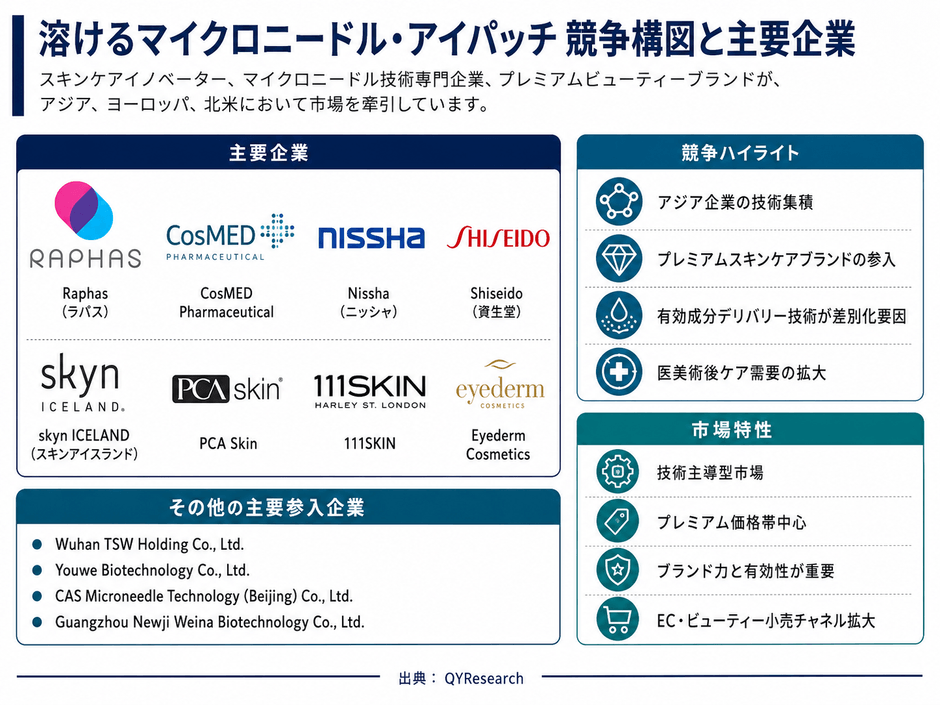
Chinese companies are also increasing their presence in this market. Wuhan TSW Holding, Youwe Biotechnology, CAS Microneedle Technology (Beijing), and Guangzhou Newji Weina Biotechnology are advancing in microneedle materials, manufacturing processes, OEM/ODM services, and collaborations with local skincare brands. Compared to international brands, Chinese suppliers have advantages in manufacturing responsiveness, cost management, channel adaptation, and rapid product iteration, enabling them to develop suitable products for emerging beauty brands, aesthetic clinics, and online sales.
Overall, the competitive focus extends beyond brand recognition to microneedle molding precision, active ingredient stability, dissolution experience, safety evaluation, and efficacy validation. Key players are required to possess both technical entry barriers and market commercialization capabilities. They must meet consumer expectations for comfort, safety, convenience, and premium feel while demonstrating actual efficacy. In the future, competition will expand from single eye patch products to ingredient platforms, microneedle delivery technology, post-procedure care applications, and multi-channel brand operations.
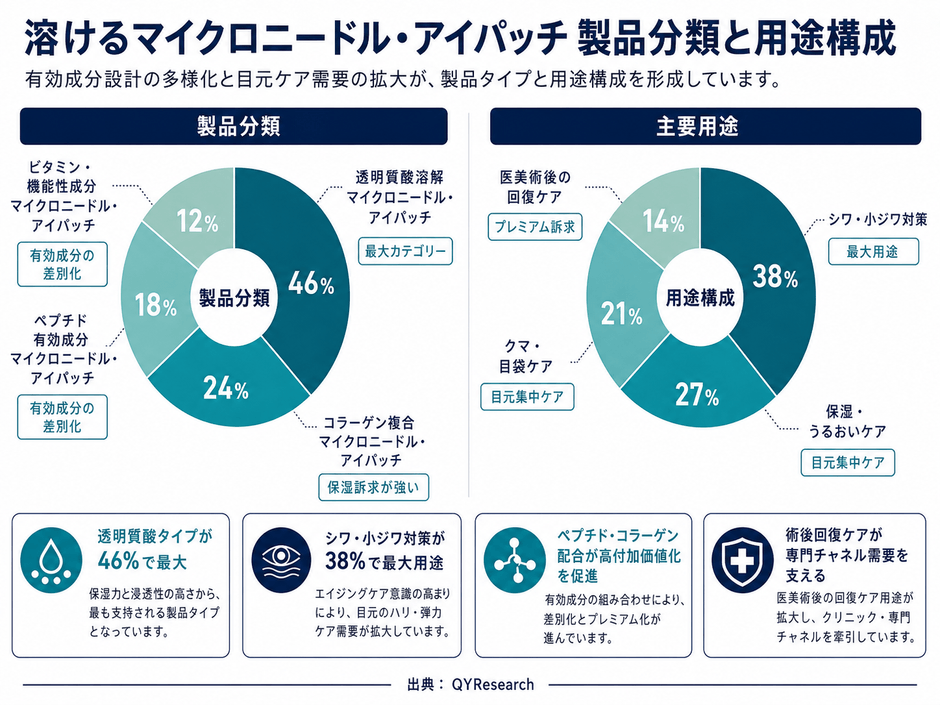
By product type, hyaluronic acid-based dissolving microneedle eye patches hold the largest share at 46%. This indicates that moisturizing and basic eye care remain the mainstream market demand. Hyaluronic acid offers high moisturizing properties, water retention, and skin affinity, making it suitable for a wide range of consumers and easily combinable with other active ingredients. Collagen composite types account for 24%, targeting elasticity support, firmness, and fine line improvement, suitable for early anti-aging and high-functional skincare.
Peptide active ingredient types represent 18%, often used for anti-wrinkle, repair, and more specific efficacy claims. Peptide ingredients have strong functional appeal and can form differentiated product features when combined with hyaluronic acid, collagen, and antioxidants. Vitamin and functional ingredient types account for 12%, supporting brightening, repair, soothing, and overall eye area conditioning through vitamins, antioxidants, and plant-derived ingredients.
By application, anti-wrinkle and fine line improvement represent the largest segment at 38%. This reflects that consumers prioritize aging signs around the eyes. Moisturizing care accounts for 27%, representing the basic daily eye care need. Dark circle and puffiness care holds 21%, targeting consumers concerned about sleep deprivation, stress, poor blood circulation, and dullness. Post-aesthetic procedure recovery care accounts for 14%, a relatively smaller but highly specialized segment with growth potential driven by the expansion of minimally invasive aesthetic treatments and post-procedure care demand.
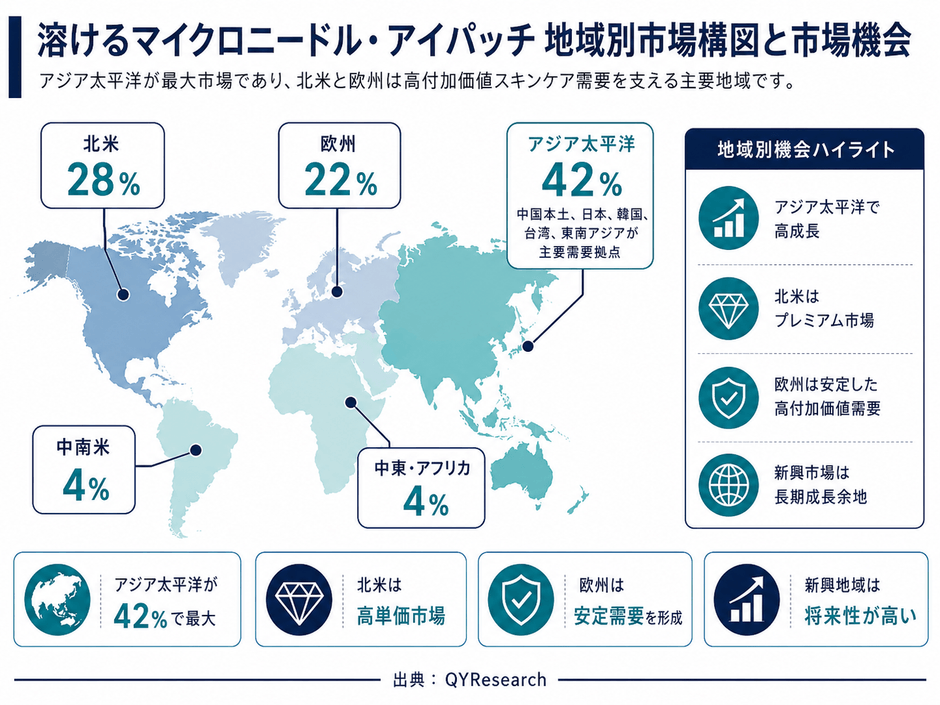
By region, Asia Pacific holds the largest share at 42%, making it the most important demand region for dissolving microneedle eye patches. In China, Japan, South Korea, Taiwan, and Southeast Asia, skincare consumption, medical aesthetics penetration, beauty innovation, and online retail are active. These markets show high acceptance of new eye care products. Particularly, China, South Korea, and Japan possess both mature skincare consumption bases and microneedle technology and functional cosmetics supply chains.
North America accounts for 28% and Europe for 22%, both being important markets for premium skincare and efficacy-driven beauty products. North American consumers value anti-aging, post-aesthetic procedure care, and convenient high-performance skincare products, with mature brand communication and e-commerce channels. Europe emphasizes ingredient safety, hypoallergenic properties, regulatory compliance, and sustainability, with stable demand for high-quality microneedle eye patches with clear efficacy validation.
Latin America and the Middle East & Africa each account for 4%. While current market sizes are relatively small, they hold medium-to-long-term growth potential driven by the expansion of premium beauty consumption, aesthetic medical services, and online retail channels. Overall, Asia Pacific serves as the primary growth engine, North America and Europe support stable high-value demand, and emerging regions are expected to gradually realize market potential through consumer education, channel development, and brand penetration.
The upstream of the dissolving microneedle eye patch industry chain consists of hyaluronic acid, collagen, peptides, vitamins, functional active ingredients, dissolvable matrix materials, humectants, preservative systems, microneedle molding materials, molds, freeze-drying equipment, coating equipment, and sterile packaging materials. The purity, stability, biocompatibility, and processability of upstream materials directly affect microneedle molding quality, dissolution rate, active ingredient release, and safety.
The midstream includes product R&D, formulation design, microneedle structure design, active ingredient loading, microneedle molding, drying/solidification, patch assembly, packaging design, quality inspection, and safety evaluation. This stage is technology-intensive, requiring strict control over process stability, batch consistency, needle mechanical strength, dissolution time, active ingredient content, and microbial safety. The core value of midstream companies lies in microneedle manufacturing capability, efficacy evaluation capability, and mass production management capability.
The downstream includes skincare brands, aesthetic medical institutions, beauty salons, cosmeceutical channels, e-commerce platforms, social commerce, brand official websites, and end consumers. End uses span anti-wrinkle, moisturizing, dark circle and puffiness improvement, post-aesthetic procedure recovery, and premium eye care. Through raw material supply, technology development, product manufacturing, brand promotion, channel sales, and consumer repurchase, the industry chain forms a complete value cycle. In the future, technological innovation, consumption upgrading, medical aesthetics penetration, and channel diversification will continue to support market growth.