
Editor’s Note
A new functional cosmetic for hair loss relief, developed using natural extracts from Centipede Grass and backed by technology from the Korea Atomic Energy Research Institute, has received approval from the Ministry of Food and Drug Safety.
There is a company developing functional cosmetics for hair loss relief using ingredients extracted from grass. The original technology for manufacturing these functional cosmetics was provided by the Korea Atomic Energy Research Institute (KAERI).
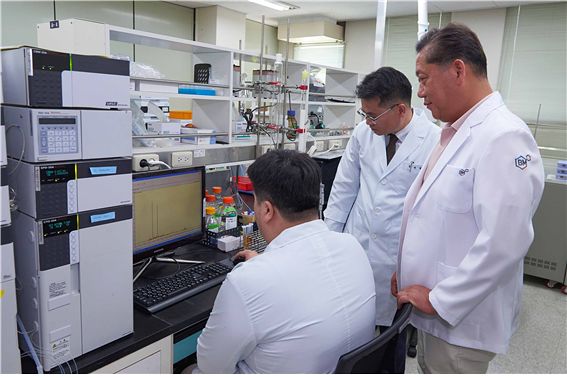
The Korea Atomic Energy Research Institute announced that a functional cosmetic for hair loss relief, whose main ingredient is a natural material extracted from Centipede Grass (a type of lawn grass), has finally passed the review by the Ministry of Food and Drug Safety (MFDS). The photo shows KAERI researchers conducting experiments. Photo: Korea Atomic Energy Research Institute
According to KAERI on the 18th, the product (Meicera Revive & Restore Hair Tonic, hereinafter referred to as Hair Tonic) manufactured by KAERI’s venture company, Biomeicin Co., Ltd., finally passed the MFDS’s functional cosmetic review for alleviating hair loss symptoms in May. This product is made with Maysin, an ingredient previously used in various fields such as skin soothing, UV protection, and sports care products. Maysin is a natural flavonoid compound known to be found in corn silk. Flavonoids are natural pigments found in plants with antioxidant and anti-inflammatory effects. Due to the difficulty of chemical synthesis, Maysin is considered a high-value natural material.
However, the Hair Tonic product extracts the Maysin ingredient not from corn silk but from Centipede Grass. Dr. Byung-Yeoup Jeong, Director of the Advanced Radiation Research Institute, observed an unusual scene while studying a lawn during his studies in the USA in 2012. The Advanced Radiation Research Institute is a subsidiary of KAERI located in Jeongeup, North Jeolla Province. Typically, grass cannot grow where chestnut tree larvae are present, but Dr. Jeong observed that in areas with Centipede Grass, the grass was healthy while the chestnut tree larvae were dead.
Centipede Grass, a type of lawn grass. Photo: Biomeicin Co., Ltd.
Consequently, Director Jeong researched Centipede Grass and discovered it contains Maysin. The Advanced Radiation Research Institute extracted Maysin from Centipede Grass. Centipede Grass was found to contain 15 times more Maysin than corn silk. Furthermore, unlike annual corn silk, Maysin can be extracted year-round from the perennial Centipede Grass. The Advanced Radiation Research Institute reported that applying the Maysin ingredient to the skin of rodents resulted in hair growth after 35 to 42 days.
The Hair Tonic developed by Biomeicin is a spray type, not a rub-in formula. Team Leader Nam-Hoon Kim of Biomeicin explained:
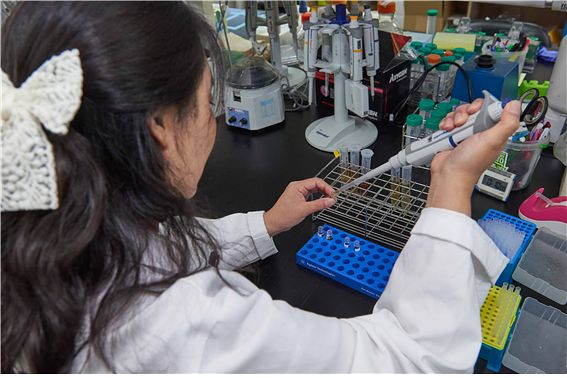
The Korea Atomic Energy Research Institute announced that a functional cosmetic for hair loss relief, whose main ingredient is a natural material extracted from Centipede Grass, has finally passed the MFDS review. The photo shows KAERI researchers conducting experiments. Photo: Korea Atomic Energy Research Institute
This product has also been confirmed to activate dermal papilla cells, which play a crucial role in hair growth, and is effective in improving scalp and hair follicle health and hair density. After 24 weeks of use, improvements in hair loss symptoms, hairline, and crown fullness were observed. The research team stated that no adverse scalp reactions such as itching or stinging were reported during the trials. Biomeicin plans to begin selling this product in the second half of this year.
KAERI in Yuseong-gu, Daejeon. JoongAng Photo
This product received functional recognition as a non-notified ingredient, unlike MFDS-notified ingredients. Non-notified ingredients require individual scientific evidence for functionality and safety, undergoing separate reviews including human application tests and safety evaluations. Maysin received final approval in May after approximately six months of review.
In-Cheol Lim, Acting President of KAERI, stated: