Editor’s Note
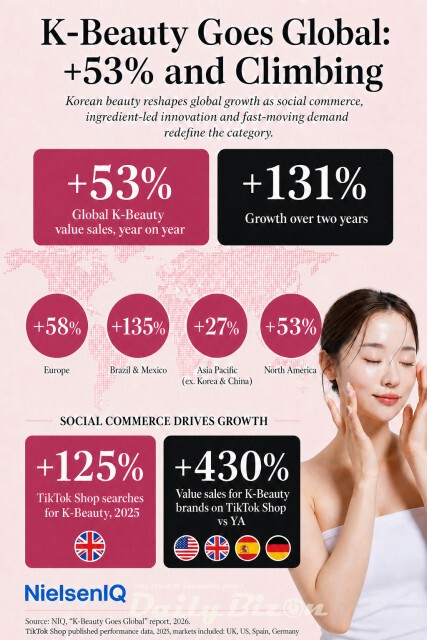
**Editor’s Note:** TikTok Shop is rapidly reshaping global beauty commerce, with K-Beauty leading the charge. New data reveals a 430% surge in brand sales across key markets and a 125% spike in UK search volume, underscoring the platform’s unstoppable momentum in Europe and North America.
K-Beauty’s hyper-growth is underpinned by digital-based social commerce. According to TikTok Shop data, K-Beauty search volume on the UK platform surged 125% year-over-year, while K-Beauty brand sales on TikTok Shop in key markets including the US, UK, Spain, and Germany skyrocketed 430% year-over-year.
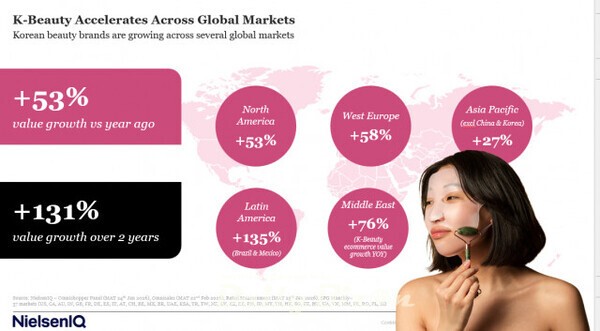
Regionally, Western Europe saw a 58% year-over-year increase in value-based sales. Korean brands now account for approximately 10% of total online skincare sales in Europe, with their share soaring to 15-20% in major markets considered beauty strongholds such as Italy, Spain, and France.
In the North American market, e-commerce drives 76% of K-Beauty sales, while the Canadian market recorded a 57% year-over-year sales increase to $164 million.
The reason global consumers are enthusiastic about K-Beauty lies in the popularization of products and innovative ingredients. Sheet masks, acne patches, essences, serums, and ampoules—once considered niche routines for a small group of enthusiasts—have now become everyday skincare habits for global consumers.
In particular, ingredient-centric innovative products unique to Korea, such as snail mucin, centella asiatica extract, and PDRN, are rapidly absorbing mass demand beyond the expert customer base. High-performance product lines offering reasonable prices and strong efficacy, along with innovation cycles that quickly reflect trends, are also cited as K-Beauty’s powerful competitive advantages.
K-Beauty’s growth momentum is rapidly shifting to emerging markets. The Latin American market, centered on Brazil and Mexico, recorded an astonishing 135% year-over-year growth in value-based sales. The Middle East region also saw K-Beauty e-commerce growth reach 76%, signaling the next phase of expansion centered on digitally savvy consumers. The Asia-Pacific (APAC) region, excluding China and Korea, also maintained solid growth of 27%.