Editor’s Note
**Editor’s Note:** South Korea’s top three botulinum toxin firms saw diverging Q2 export results, with Daewoong and Hugel growing while Medytox declined. Analysts point to U.S. market access as the key differentiator.
The second-quarter export results for South Korea’s three major botulinum toxin companies showed a clear divergence. Daewoong Pharmaceutical and Hugel continued their export growth, while Medytox experienced a decline. Analysts attribute the widening export gap to whether companies have successfully entered the U.S. market, the world’s largest toxin market.
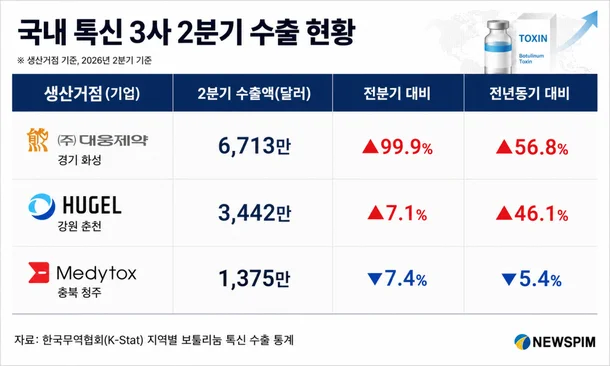
According to an analysis of regional botulinum toxin export statistics from the Korea International Trade Association, Daewoong Pharmaceutical’s exports from its production facility in Hwaseong, Gyeonggi Province, reached $67.13 million in Q2. This represents a 99.9% increase from the previous quarter ($33.59 million) and a 56.8% rise compared to the same period last year ($42.82 million).
Hugel’s exports from its production base in Chuncheon, Gangwon Province, recorded $34.42 million in Q2, up 7.1% from the previous quarter ($32.15 million) and 46.1% from the same period last year ($23.56 million).
In contrast, Medytox’s exports from its facility in Cheongju, North Chungcheong Province, totaled $13.75 million in Q2, down 7.4% from the previous quarter ($14.85 million) and 5.4% from the same period last year ($14.53 million), making it the only company to record negative growth.
Regional export statistics are used as an indicator to gauge overseas shipment trends for companies based on the concentration of their major production facilities.
The clear difference in export volumes among the three toxin companies is attributed to their success in the U.S. market. The U.S. botulinum toxin market is the world’s largest and is a critical factor for revenue growth. This is due to high procedure costs and a wide range of treatment channels, including dermatology clinics, plastic surgery clinics, medical spas, and beauty clinics.
Botulinum toxin is a prescription drug, and entering the U.S. market requires approval from the U.S. Food and Drug Administration (FDA). FDA approval is also regarded as a benchmark for product quality and reliability in other countries, positively impacting global market expansion.
Daewoong Pharmaceutical was the first Korean company to enter the U.S. toxin market in 2019. It currently sells its toxin product ‘Nabota’ (brand name ‘Juvue’ in the U.S.) through its U.S. partner, Evolus. Nabota has captured a 14% market share in the U.S. aesthetic botulinum toxin market, ranking second.
Hugel, a later entrant, is also accelerating its U.S. market strategy. After receiving FDA approval for ‘Letibo’ in 2024, it began commercialization in March of last year. As of Q1 this year, Letibo’s sales in North and South America increased by over 420%, indicating successful market penetration.
In the second half of the year, Hugel has started building a direct sales channel through its local subsidiary, Hugel America, to increase sales and profitability in the U.S. market. The company aims to gradually expand its direct sales organization to increase its U.S. market share to 10% by 2028 and 14% by 2030.
Meanwhile, Medytox, which was once considered the frontrunner as the first to introduce botulinum toxin in Korea, has yet to enter the U.S. market, widening the export gap with its competitors.
This is because, after applying for FDA approval for its non-animal liquid botulinum toxin product ‘MT10109L’ in 2023, the application was returned due to incomplete documentation. Although it was expected to reapply the following year after re-inspecting production facilities and supplementing data, no specific timeline has been announced.
Instead, Medytox is focusing on entering China, the second-largest market after the U.S. The company signed a general distribution agreement with Chinese company Hainan Stuwo at the end of last year for its next-generation toxin product, ‘Neurex.’ Hainan Stuwo will pursue Phase 3 clinical trials and approval in China. Medytox has also established a distribution foundation by signing an agreement with Chinese pharmaceutical company Sinopharm.
However, growing concerns over the delayed U.S. entry are impacting the company. Medytox’s stock closed at 68,400 won on the day, down approximately 58% from its 52-week high of 164,300 won. Minority shareholders cite the delayed U.S. entry and lawsuits with competitors as key reasons for the decline in corporate value.