Editor’s Note
**Editor’s Note:** This article explores the growing issue of hair loss among women and the potential of scalp micropigmentation as a solution. We hope it offers valuable insight for those seeking effective options.
Understanding Women’s Hair Loss
With many women experiencing some form of hair loss or thinning by the time they reach middle age, SoGlos sits down with the founder of Cheltenham’s HeadStrong Clinic to learn how scalp micropigmentation could help. Around 40 to 50 per cent of women experience some form of hair loss or thinning, often through age, stress, or illness, but scalp micropigmentation (SMP) can help make hair look thicker and denser.
About HeadStrong Clinic
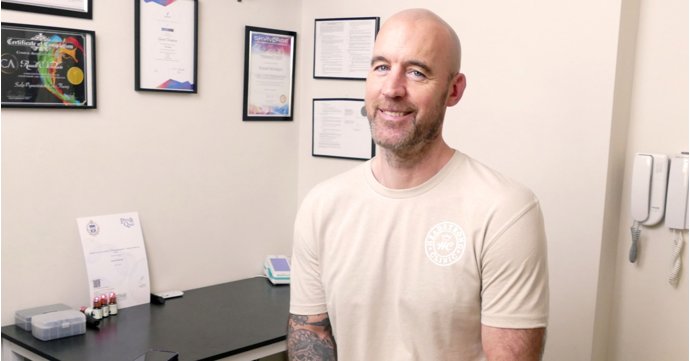
Helping men and women regain their self-confidence, HeadStrong Clinic in Cheltenham – founded by one of Europe’s leading SMP artists, Russ Nicholson – offers scalp micropigmentation and Hyper-Realism brows, as well as laser hair removal, laser tattoo removal, carbon laser facials and IPL skin rejuvenation, to address a spectrum of skin concerns. Women’s hair loss is something that’s often not discussed openly, but for those going through it, it affects much more than just their physical appearance.
Leading scalp micropigmentation artist and founder of Cheltenham’s HeadStrong Clinic, Russ Nicholson, breaks the silence around women’s hair loss – and shares how SMP can help.
The Reality of Women’s Hair Loss
“Honestly, it’s far more common than most people realise. We’re so used to seeing men lose their hair that it feels ‘normal’, but the truth is that around 40 to 50 per cent of women experience some degree of hair loss or thinning by the age of 50, and among women who’ve been through the menopause, more than half notice a change in their hair. So this isn’t a small or unusual thing — a lot of women are quietly living with it.”
“Where it differs is in the pattern. Men tend to lose hair in a very recognisable way — the hairline recedes, the crown thins, and it can progress towards baldness. Women very rarely follow that route. For women it’s usually more diffuse — an overall thinning across the top of the scalp.”
“The signs are subtler: the parting starts to look wider, the ponytail feels thinner than it used to, or you catch the light on your scalp in a photo and notice more skin showing through than before. It tends to concentrate around the crown and the top, and it usually doesn’t go all the way to complete baldness.”
“The difficult part is that because it’s so gradual, and often hidden under the rest of the hair, other people frequently don’t notice it at all — but the woman living with it notices every single day. And that’s really the heart of it. For a lot of women, hair is tied up with identity, with femininity, with feeling like themselves. So even a change that looks small from the outside can feel enormous on the inside.”
Causes of Hair Loss in Women
“There’s rarely just one cause, and that’s part of what makes women’s hair loss so complex. Genetics play a big role — female pattern hair loss is hereditary, just as it is in men, and while it can start any time after puberty, it usually becomes more noticeable with age.”
“Then there are life events and health factors. Pregnancy and the months afterwards are classic triggers — a lot of new mums experience quite dramatic shedding a few months after giving birth. Stress, illness, thyroid problems, and low iron can all cause hair to thin.”
“Significant or rapid weight changes are another one — and that’s become very topical with the rise of GLP-1 weight-loss medications like Ozempic and Mounjaro. What tends to happen there isn’t the drug attacking the hair directly, it’s that rapid weight loss and a drop in nutrition put the body under stress and push more hairs into a resting, shedding phase. Encouragingly, that kind of shedding is usually temporary and settles once nutrition and weight stabilise, but it can be very frightening while it’s happening.”
“And of course illness — cancer treatment in particular. Chemotherapy can cause hair loss, and when the hair grows back it often returns with a different texture or colour, and many women simply aren’t shown how to care for it or style it. That’s an area very close to my heart, and part of why I do the work I do supporting people through those moments.”
Advice for Women Experiencing Hair Loss
“My honest advice is: don’t panic, and don’t rush straight to a ‘fix’ before you understand what’s actually going on. The first step should be getting to the root of it — I’d always encourage someone to see their GP or a trichologist first. Some causes of hair loss are very treatable, and even reversible — a thyroid issue, low iron, a stressful period, postpartum shedding — and a simple set of blood tests can reveal a great deal. It would be a shame to spend time and money treating the symptom when the cause is something that can be put right.”
“Alongside that, the foundations really matter, and they’re the same foundations as general health: good nutrition — enough protein and iron in particular — managing stress where you can, decent sleep, and looking after your scalp, because healthy hair grows from a healthy scalp. There are some genuinely good supplements and treatments on the market now, far more than there used to be, but I’d always want someone to build on solid ground first rather than chase quick fixes.”
How Scalp Micropigmentation (SMP) Helps
“I’m always upfront with clients about this: scalp micropigmentation doesn’t grow hair, and it doesn’t treat the underlying cause. So the sensible order is — understand what’s happening, support your body and your hair health, and then, if the thinning has settled and you’d still like to create the look of more density, that’s where something like SMP comes in.”
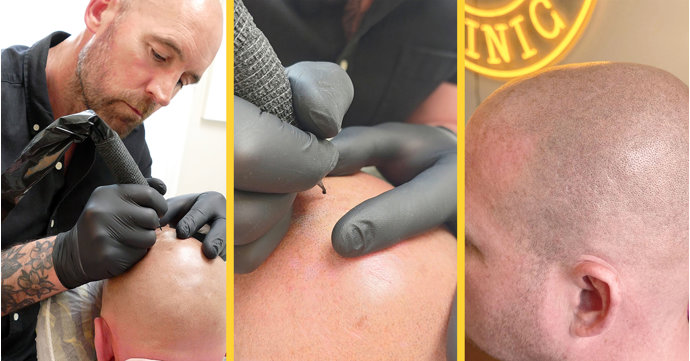
“The simplest way I explain it is that SMP reduces the contrast between your scalp and your hair. When hair thins, the reason it looks thin is that the paler scalp starts showing through the darker hair, and your eye reads that contrast as sparse. What SMP does is place tiny, precise deposits of pigment into the scalp, in between your existing hairs, so the scalp no longer stands out. Suddenly the hair you do have looks fuller and denser, because those gaps aren’t catching the light anymore.”