Editor’s Note
This article explores the growing “Seibunkai” trend in Japan, where consumers prioritize ingredient safety and efficacy over brand loyalty, reshaping the beauty market and intensifying competition among brands.
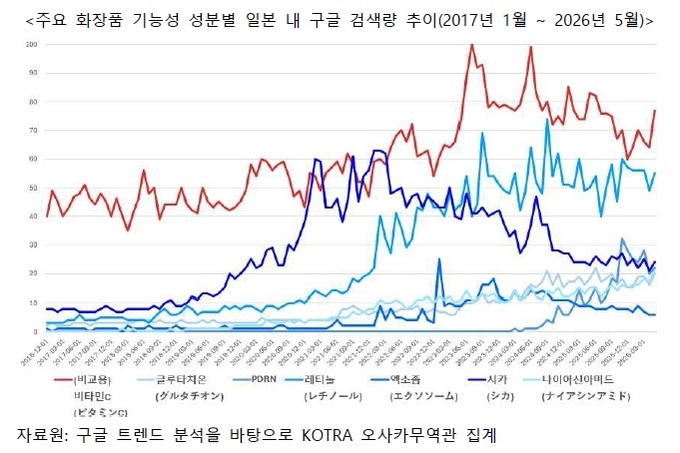
Japanese consumers are increasingly prioritizing ingredient safety and efficacy over brand recognition, a trend known as “Seibunkai” (ingredient buying). This has led to a surge in Google searches for functional ingredients and expanded use of ingredient analysis platforms like @cosme, further fueling the shift.
This trend is sparking a boom in new brands that emphasize superior ingredient competitiveness, triggering an ingredient war between emerging brands and large corporations, with moisturizing, whitening, and antioxidant active ingredients as key weapons. It is also increasing cases of product design and sales through OEM/ODM, and accelerating an efficacy-centered market restructuring.
The trend of integrating advanced technologies like AI across manufacturing, R&D, distribution, and marketing to enhance productivity is also strengthening. This is known as AX (AI Transformation) and DX (Digital Transformation).
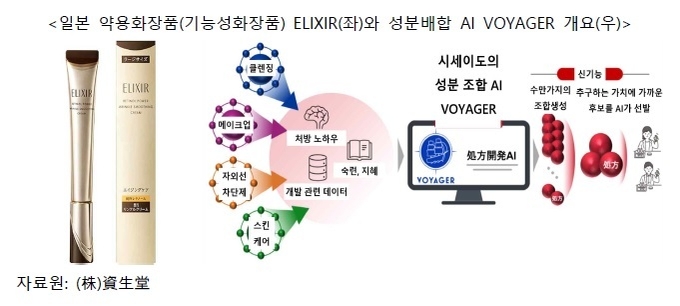
AI adoption in cosmetics R&D and manufacturing processes is accelerating new product development and shortening production cycles. Companies are building AI-powered ingredient formulation platforms that quantify the know-how of R&D personnel and accumulated data through AI algorithms, proposing optimized ingredient combinations to shorten development time and enhance development capabilities.
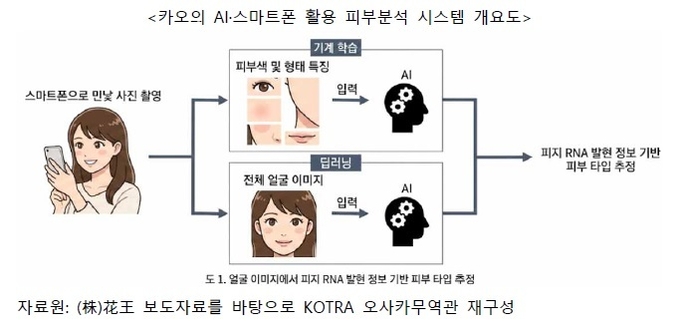
Gene analysis-based customized skincare manufacturing is also active. By analyzing RNA from human information, skin conditions are precisely classified at the genetic level, and personalized skincare formulas are developed using generative AI and scientific approaches.
This data-driven supply chain construction improves inventory demand forecasting and turnover rates, and when linked with AI logistics automation systems, maximizes efficiency in inventory management, high-mix low-volume production, and inbound/outbound processes.
Digital technology-based customer experiences and touchpoints are diversifying. Content commerce, including SNS ads, short-form content, and live streaming, has become a major marketing platform for the 2030 generation. Customer experiences are also linked to personalized consulting to expand touchpoints and drive purchases. The use of beauty tech such as AI and MR (Mixed Reality) for customized virtual makeup and product recommendations is increasing in offline store counseling.
Shiseido is targeting the medicated cosmetics market by launching its retinol anti-wrinkle cream, EXIXIR, at a mid-to-low price point. It is also capturing consumer needs with serums that encapsulate active ingredients like niacinamide for whitening and skin barrier strengthening.
Shiseido developed an AI formulation platform called ‘VOYAGER’, which quantifies 100 years of accumulated research know-how and over 500,000 prescription data points into a database. In summer 2026, it plans to launch a mist-type sunscreen developed with VOYAGER under the brand ‘fibona’.
Kao is developing new products through RNA analysis and AI analysis of reviews and feedback. It developed a product that minimizes surfactant use and uses nano-stabilization technology for ceramides, which are prone to hardening, to reduce skin irritation and maximize absorption. Kao also launched a ‘skinification’ product line that combines its proprietary skincare barrier technology with ceramides to form a protective film on the hair surface, blocking external stimuli.
Kao is also using AI and smartphones to analyze sebum RNA at low cost, using it as a simple and objective skin indicator. By fusing consumer reviews on @cosme with RNA information, it is building a customized cosmetics matching system for different skin types, actively addressing the problem of mass waste from consumer mis-selection.
Kosé has built an automated formulation system that uses a quantum computer to calculate over 100 billion ingredient combinations in about 10 seconds. It drew attention by developing a cleansing oil (DECORTÉ AQ Pore Serum Oil, launched May 2025) that combines efficacy ingredients using the world’s first quantum computer. It also plans to launch hyper-personalized cosmetics incorporating iPS cell formulation technology based on stem cell research within 2026.