Editor’s Note
**Editor’s Note:** This article highlights a promising advancement in photodynamic therapy for skin cancer, where dissolving microneedles may improve light distribution and drug delivery within tissue, building on prior research showing deeper, more uniform treatment.
Dissolving microneedles may help spread light from photodynamic therapy (PDT) more effectively within tissue, according to a study published in the Journal of Biomedical Optics.
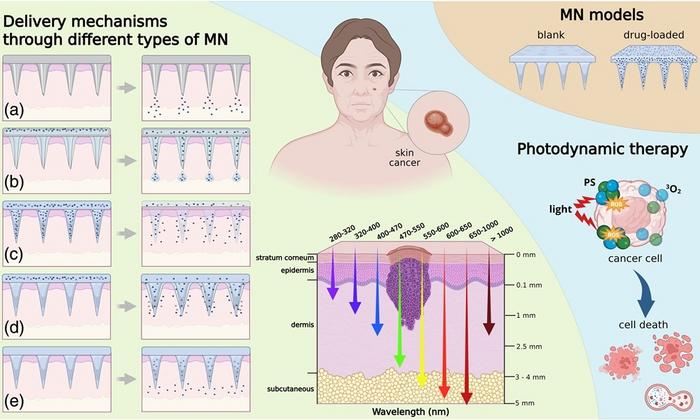
Previous studies by the research group showed that microneedles loaded with aminolevulinic acid (ALA), a drug commonly used in PDT, delivered the treatment more deeply and evenly into skin tumors than traditional creams. This led to a more uniform production of the light-activated compound responsible for killing cancer cells upon light exposure.
The new study sought to determine if the microneedles improve the delivery of light.
To find out, the researchers from Texas A&M University Biomedical Engineering in College Station, TX, and the Sao Carlos Institute of Physics at University of São Paulo in Brazil fabricated arrays containing hundreds of pyramid-shaped microneedles and illuminated them with a green laser. By photographing the light emerging from the arrays at different angles and analyzing the images, they mapped how the microneedles changed the path of the incoming light.
The experiments revealed that the tiny structures acted almost like miniature light spreaders. Instead of allowing light to travel only in a straight line, the microneedles redirected it in many directions through a combination of internal reflections and scattering. As a result, light emerging from the needle tips was distributed much more evenly than light passing through the spaces between them.
Measurements showed that light coming from the microneedle tips maintained similar intensity across a range of viewing angles, indicating that the structures produced a nearly uniform, multidirectional pattern of illumination.
This type of light distribution could be especially useful in biological tissues, where conventional surface illumination often leaves some regions underexposed, the researchers note.
The team also developed a mathematical model to examine how thousands of microneedle tips might distribute light inside tissue. Their analysis suggests that this broader scattering pattern could reduce the rapid loss of light intensity typically seen with standard directed illumination.
For PDT, that could be important. Successful treatment depends not only on the amount of light delivered but also on how evenly that light activates the photosensitive drug throughout the lesion. Uneven illumination can leave pockets of tissue insufficiently treated, increasing the likelihood that cancer cells remain. By helping light spread more uniformly, microneedles may improve activation of the therapy across a larger volume of tissue.
The technology could potentially be used in two ways. One option is to use drug-loaded microneedles first and then apply a second microneedle array designed specifically to improve light delivery. Another possibility is a single microneedle system that performs both functions simultaneously, delivering the drug while also guiding and redistributing light. Such an approach could simplify treatment and improve precision by ensuring that drug release and light exposure occur in the same location.
The researchers caution that their optical measurements were performed in a simplified laboratory setup rather than living tissue. Additional studies in tissue models and preclinical systems will be needed to determine how much the light-redistribution effect improves treatment in real-world conditions.
IMAGE CAPTION: In photodynamic therapy, a light-sensitive drug accumulates in cancer cells and is then activated by light, producing cell-killing molecules. Microneedles can help deliver the drug and distribute light more effectively within non-melanoma skin cancer.
IMAGE CREDIT: M. Requena et al.