Editor’s Note
This article highlights a key trend in Japan’s beauty device market, where over 80% of current device owners show strong interest in replacement or additional purchases, signaling sustained demand among existing users.
In Japan’s beauty device market, demand for device replacement and additional purchases among existing users is notably high. While a significant portion of beauty-enthusiastic consumers already own devices, their purchase intention remains strong. Over 80% of current device owners expressed interest in buying or adding more devices.
According to a survey conducted by Japanese beauty media Mimi Beauty among 518 members aged 15-44, 68.0% of respondents currently own a beauty device. Including those who owned one in the past but no longer do (10.2%), the total experience rate reaches 78.2%.
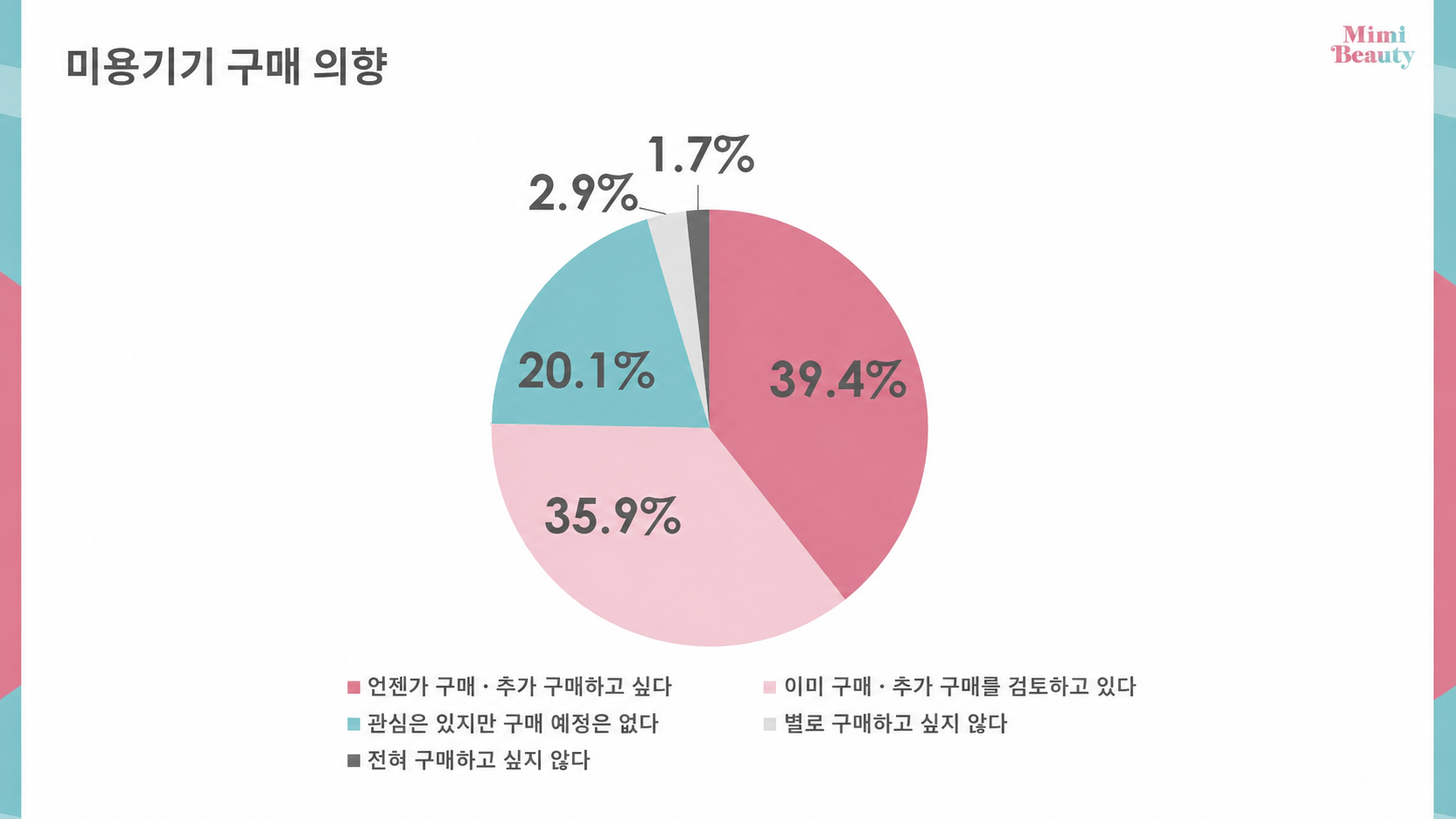
Despite high penetration, purchase demand has not declined. Looking ahead, 39.4% said they “want to purchase or add a device someday,” and 35.9% are “already considering a purchase or additional purchase.” In total, 75.3% of respondents are positive about purchasing. Only 20.1% expressed interest but no purchase plans, while 2.9% and 1.7% said they “don’t really want to buy” or “don’t want to buy at all,” respectively.
Among current device owners, the additional purchase intention rate reached 80.1%. This suggests that demand is shifting from first-time buyers to replacement and additional purchases by existing users.
By device type, certain categories showed high ownership, but many consumers use multiple devices with different functions. In a multiple-response question about devices currently in use, EMS beauty devices had the highest ownership rate at 76.1%, followed by LED beauty devices at 41.5%. Steamer (34.7%), ion introduction/extraction devices (33.8%), and combination/multi-function products (30.7%) were also popular choices. While EMS has established itself as a representative type, demand for devices with different management purposes and operating mechanisms remains steady.
Many respondents cited high usage frequency and perceived effectiveness as factors supporting additional purchase potential. Regarding effectiveness after using beauty devices, 23.9% said they “felt a strong effect,” and 58.2% said they “felt some effect.” In total, 82.1% reported positive effects. Only 12.2% said “average,” and 4.8% said “didn’t feel much effect.”
In terms of usage frequency, “2-3 times per week” was the most common at 31.3%. Consumers who use devices “almost every day” accounted for 18.5%, and “4-5 times per week” for 12.8%. Overall, 62.6% of consumers use beauty devices at least twice a week. “About once a week” was reported by 13.1%, and “when I remember” by 16.8%. Only 2.0% said they never use their devices. This indicates that a significant number of consumers use devices repeatedly rather than just temporarily after purchase, aligning with the perceived effectiveness results.
However, the expansion of beauty device usage did not appear to replace medical aesthetic treatments. Among respondents, 39.8% had experienced medical aesthetic procedures a few times, and 12.2% had extensive experience. Over half (52.0%) had some experience with medical aesthetic treatments.
When asked whether they believe the effects of beauty devices can be equal to or greater than those of medical aesthetics, 34.6% said “not really,” and 15.8% said “I don’t think so.” A total of 50.4%—over half—do not view home care and medical aesthetics as equivalent, indicating they distinguish between the two and use them separately.
In brand selection, Japanese domestic brands showed clear strength. Among beauty device brands with usage experience or interest, Panasonic, YA-MAN, and ReFa ranked at the top. K-beauty brand medicube placed fourth, indicating its growing presence in the Japanese beauty device market.