Editor’s Note
This article examines the growing trend of skin lifting procedures offered at Oriental medicine clinics in Seoul, raising critical questions about regulatory boundaries, patient safety, and the use of aesthetic medical devices by non-specialist practitioners.
By Hyun Jung-min
Published 2026.07.23. 06:01
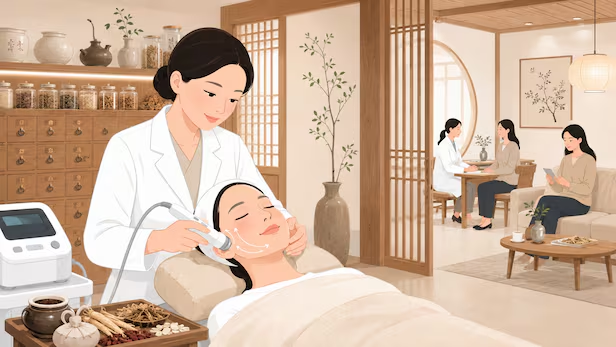
Illustration = ##ChatGPT##
On the 22nd, at Oriental Medicine Clinic A in Gwangjin-gu, Seoul, signs advertising skin lifting procedures lined the entrance. The clinic’s signboard and windows also displayed various types of skin lifting procedure names, all utilizing laser equipment. Ultra-low-price events were also underway, offering procedures typically costing over 50,000 won in the city for less than 10,000 won. The promotional text included the phrase, “All procedures are based on fixed quantities and genuine products.”
Is it safe to receive lifting procedures at an Oriental medicine clinic instead of a dermatology or plastic surgery clinic? Is it permissible for Oriental medicine doctors to use aesthetic medical devices? Are the safety and after-sales service of the devices properly managed? Out of curiosity, we spoke with industry and legal experts.
Skin lifting procedures are performed using laser devices. The principle involves applying physical stimulation to the internal tissues of the skin to induce a regeneration process, lifting sagging skin and promoting collagen production. These include ultrasound and radiofrequency procedures that apply thermal energy, as well as thread lifts using medical threads.
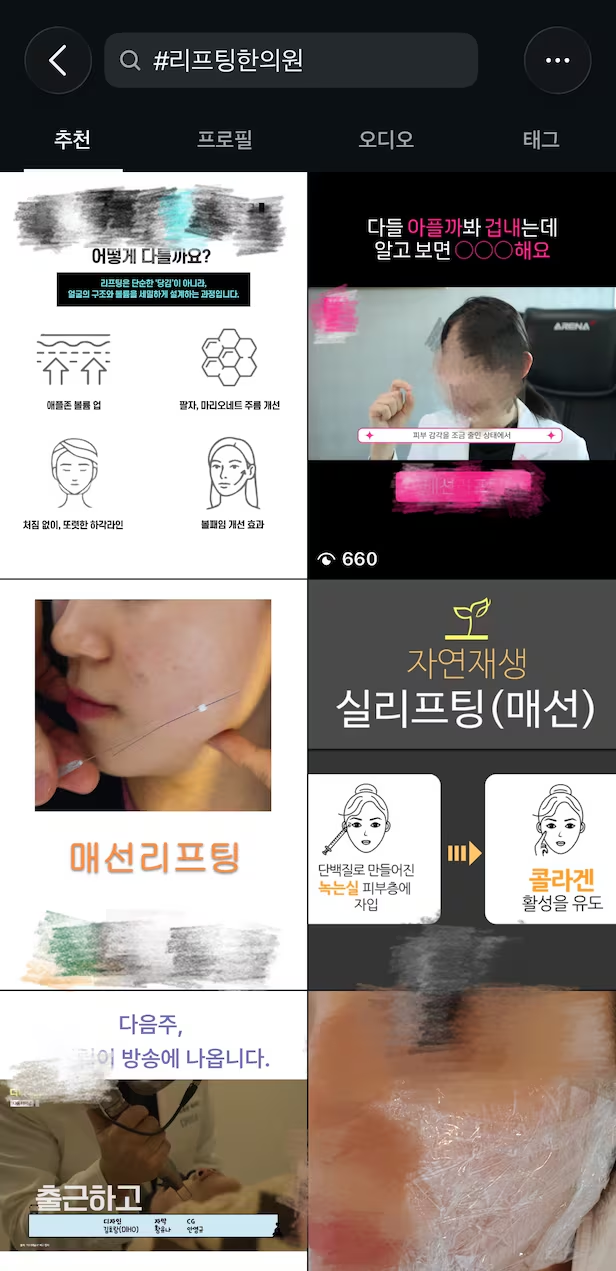
Typically, consumers seeking lifting procedures visit dermatology or plastic surgery clinics, but recently, more Oriental medicine clinics are prominently offering aesthetic procedures. A search for “lifting Oriental medicine clinic” on social media yields over 100 related promotional posts.
The number of Oriental medicine doctors specializing in the use of medical devices like lasers is also increasing. The Korean Society of Integrated Laser, under the Korean Oriental Medical Association, holds annual academic conferences and clinical special lectures.
A search for “lifting Oriental medicine clinic” on social media on the 22nd showed over 100 related posts. / Instagram screen
There is no regulation that uniformly prohibits Oriental medicine doctors from using medical devices. However, whether a specific procedure falls outside the scope of an Oriental medicine doctor’s license should be determined based on the device’s principle, risks, and purpose of use. While the acceptance criteria remain unclear, the aesthetic procedure market in Oriental medicine clinics appears to be expanding rapidly.
Companies that produce and sell lifting medical devices state they do not directly supply devices to Oriental medicine clinics. Inquiries to four major companies all resulted in responses that they “do not supply products to Oriental medicine clinics.”
Company A announced on its website that it “supplies products and related consumables only for the purpose of medical procedures by doctors” and “does not supply for dental or Oriental medicine diagnosis and treatment.” Company B also noted on its device demo application page that “Oriental medicine clinics, skincare salons, and individuals cannot apply.”
The primary reason companies avoid supplying Oriental medicine clinics is legal risk. Article 27 of the Medical Service Act stipulates penalties for inducing or aiding medical personnel to perform medical acts outside their licensed scope. Article 2 of the same act defines the duties of Oriental medicine doctors as “Oriental medical care and Oriental health guidance.”
As long as there is no clear standard on whether the use of a specific lifting device falls under Oriental medical care, manufacturers cannot help but worry that supplying the device could lead to future legal disputes.
So, how do Oriental medicine clinics acquire these devices? An industry insider stated, “Rather than direct supply from manufacturers, they may have used used medical device dealers or wholesalers.” Under current law, medical device sellers are not restricted in their trading partners based on the type of medical institution.
Purchasing devices through used dealers or other distribution channels is not inherently illegal. It cannot be concluded that a device is defective or the procedure is dangerous solely because the manufacturer did not supply it directly.
However, when devices are used outside the manufacturer’s training and after-sales service system, there may be gaps in consumer protection. If the device’s output and usage are not fully understood, or if genuine consumables are not used, the risk of side effects such as burns or hyperpigmentation may increase.
The unclear responsibility in case of product malfunction or procedure accidents is also a burden. If the manufacturer did not supply the device for use in Oriental medicine clinics, it may be difficult to receive support during device training, inspection, or side effect management.
On the other hand, some argue that the claim that lifting device companies do not supply Oriental medicine clinics should not be taken at face value. Due to strong opposition from medical doctor groups, it is not uncommon for companies to choose indirect supply through distributors.
An Oriental medicine industry insider stated, “Oriental medicine clinics also use genuine products,” adding, “Since dermatology clinics are important customers, many companies do not disclose that they supply products to Oriental medicine clinics.”
Legal opinions are also divided regarding the scope of medical device use by Oriental medicine doctors.
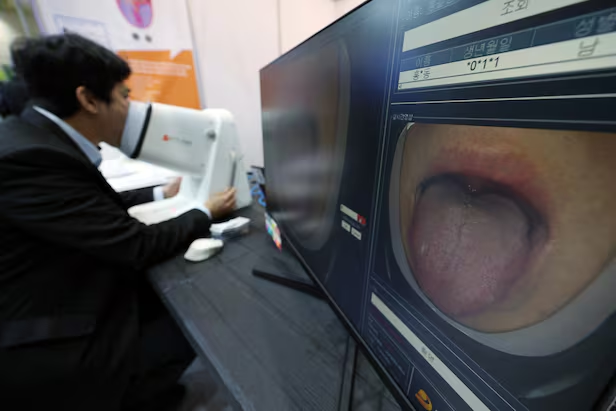
In June 2024, at the “Oriental Medicine & Integrative Medicine International Industrial Expo” held at COEX in Samseong-dong, Gangnam-gu, Seoul, a staff member at Daesung Medical Devices Co., Ltd.’s booth demonstrated a tongue diagnosis video analysis system. / News1
Indeed, last November, police concluded that an Oriental medicine clinic accused of performing laser procedures had no suspicion of wrongdoing and closed the case. In 2023, the Supreme Court also ruled that an Oriental medicine doctor’s use of an ultrasound diagnostic device could not be punished as a violation of the Medical Service Act.
There are counterarguments. The fact that the use of some diagnostic devices is permitted should not be interpreted as allowing the use of all aesthetic and therapeutic devices.
* This article is translated by AI. Please send your feedback through this form. View original article (Korean)
Hyun Jung-min Trainee Reporter, Newsroom