Editor’s Note
**Editor’s Note:** This article explores a novel microneedle patch featuring 361 tips designed to distribute light evenly for advanced skin treatment. We present the findings as reported by our editorial team.
Skin Treatment: Microneedle Patch with 361 Tips Distributes Light Evenly
Published on: 24.07.2026 at 02:05 UTC | Editorial Team boerse-global.de
Innovative light-based procedures using microneedles and LED home devices show success against skin conditions. Over-the-counter anti-inflammatory creams are also moving closer.
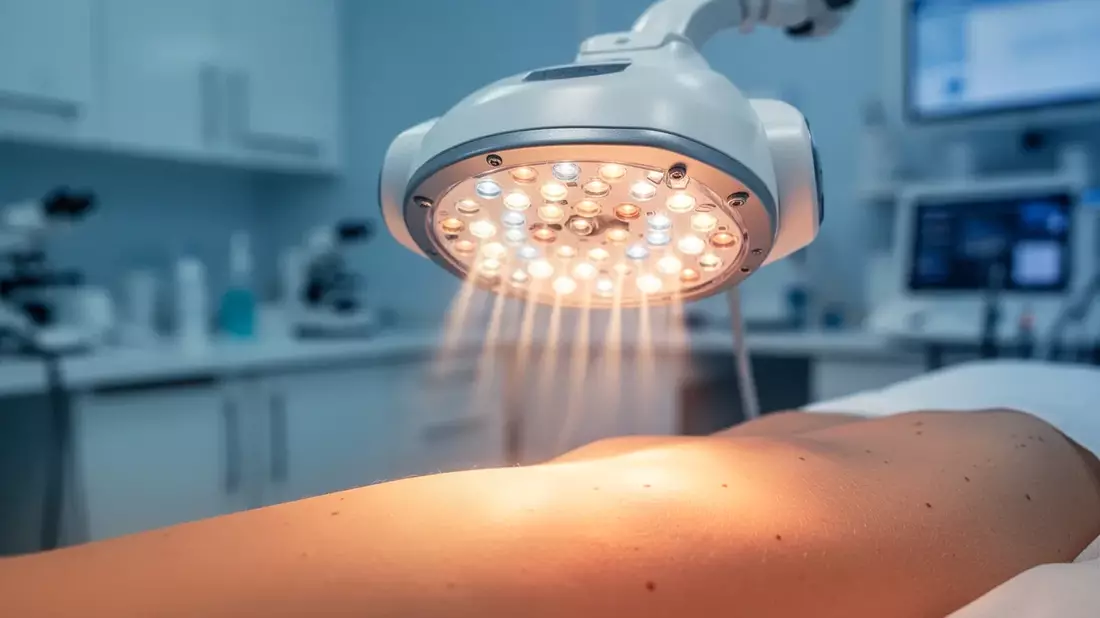
State-of-the-art LED light therapy technology in dermatological application on the skin surface. Illustration created with AI, transmitted by boerse-global.de
Dermatology is experiencing a technological boost: light waves combined with microneedles or photodynamic procedures are intended to treat inflammatory skin processes more efficiently. Both clinical approaches and home devices are coming into focus.
A problem with photodynamic therapy (PDT) for skin cancer and severe inflammation: light and active ingredients often reach deeper skin layers unevenly. Researchers at Texas A&M University and the University of São Paulo have developed a solution for this.
Their microneedle patch features 361 pyramid-shaped tips with a length of up to 500 micrometers. The structure transports the active ingredient aminolevulinic acid (ALA) deeper into the tissue. In laboratory experiments with a green laser, the patch acted as an isotropic emitter – the light was distributed significantly more evenly. So far, only in-vitro tests and tissue model experiments are available; clinical studies on humans are still pending.
Light therapy also shows effectiveness against infectious diseases such as leishmaniasis – which causes severe skin inflammation and lesions. The so-called MAC method (Método de Aceleração Cicatricial) combines LED light with a photosensitizer.
In experimental series, lesions and parasite load were reduced by 83 percent. The procedure shows significantly lower toxicity compared to conventional medications. The photodynamic effect specifically targets the pathogens without burdening healthy tissue.
Parallel to clinical research, the market for LED home applications is growing. Modern systems use flexible materials such as silicone for a better fit and consistent light output.
Devices like the FAQ 201 combine different wavelengths. Red light promotes collagen and skin regeneration, while blue light fights acne bacteria. According to manufacturer data, blue LED light reduces inflammatory acne symptoms by 48 percent within two weeks. The systems work with up to 600 light points for full-area irradiation. In clinical tests for anti-aging devices, skin firmness improved within two weeks, and skin moisture increased by 45 percent.
Complementing the technical advances, there are efforts to facilitate access to proven active ingredients. An expert committee recently issued recommendations to exempt certain anti-inflammatory preparations from prescription requirements.
Among those affected is prednisolone cream, a glucocorticoid for inflammatory skin conditions. If the Federal Ministry of Health follows the recommendations, patients could obtain such active ingredients over the counter in pharmacies in the future. This would accelerate the treatment of acute inflammation – often accompanying physical therapies such as light treatment.
Research on the effects of light is now also extending to indoor spaces. New office lighting systems, such as the LumiD³ model, integrate UV-B modules intended to enable vitamin D synthesis. An integrated timer and proximity sensors regulate the irradiation duration – the dose corresponds to a short summer walk. The targeted use of specific light wavelengths is thus gaining importance beyond dermatology as a preventive health factor.