Editor’s Note
This article examines the ongoing debate over safety regulations for injectable ECM tissue grafts, highlighting a consensus on the need for improvement but divergent views on application and management standards.
The government has launched a study to strengthen consumer safety management and is reviewing cases from major countries.
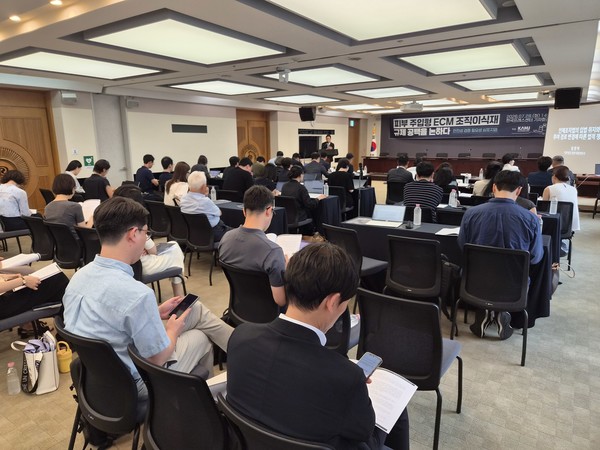
On the 28th, the Korea Medical Bio Journalists Association held a symposium at the Korea Press Center in Jung-gu, Seoul, under the theme “Discussing the Regulatory Gap of Injectable ECM Tissue Grafts – The Need for Safety Verification.” [Photo by Reporter Lee Jae-hyung]
Discussions surrounding the regulatory framework for injectable ECM (extracellular matrix) tissue grafts have officially begun. With various opinions presented by experts, industry attention is focused on the future direction of institutional improvements.
On the 28th, the Korea Medical Bio Journalists Association held a symposium titled “Discussing the Regulatory Gap of Injectable ECM Tissue Grafts – The Need for Safety Verification” at the Korea Press Center in Jung-gu, Seoul. Experts from the medical, legal, and academic fields addressed clinical safety verification and the need for institutional improvements.
Professor Shin Hyun-young from the Department of Family Medicine at Seoul St. Mary’s Hospital, Catholic University, presented her views as a clinician on the topic of “Clinical Safety and Policy Direction of Injectable ECM Tissue Grafts.”
According to Professor Shin, most ECM tissue grafts are used by freeze-drying and pulverizing skin dermal tissue from overseas donors, then mixing it with saline solution for direct injection into the skin.
She also criticized that while many injectable skin boosters used in medical settings are managed as medical devices after undergoing clinical trials and regulatory approval, ECM tissue grafts are distributed as human tissue without undergoing the same level of safety verification.
However, some voices urge a cautious approach to such criticisms. A legal expert stated:
According to Article 2, Paragraph 1 of the Medical Device Act, a medical device is defined as “instruments, machines, devices, materials, software, or similar products.” Whether ECM injections fall under this definition must be determined by comprehensively considering the product’s form and intended use.
Various opinions were also raised regarding clinical safety. Professor Lee Jong-hee from the Department of Dermatology at Samsung Medical Center shared his perspective from a dermatological safety standpoint.
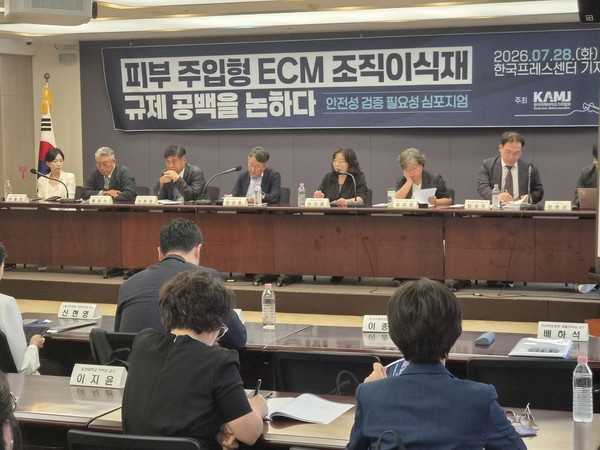
A panel discussion was held at the symposium “Discussing the Regulatory Gap of Injectable ECM Tissue Grafts – The Need for Safety Verification.” [Photo by Reporter Lee Jae-hyung]
Some view injectable ECM human tissue grafts as a technology with biocompatibility and safety based on long-term clinical experience. Professor Won-jae Lee from the Department of Plastic Surgery at Severance Hospital stated:
He reported that products obtained through ethical and lawful donation and rigorous processes demonstrate excellent biocompatibility immunologically, with almost no serious adverse reactions such as local or systemic toxicity.
He added, “For tissue restoration, using the body’s own original tissue is the most biocompatible and safe approach.”
Regulatory authorities state they are pursuing policies to strengthen safety management. Lim Sang-woo, Team Leader of the Advanced Biopharmaceuticals TF at the Ministry of Food and Drug Safety (MFDS), stated:
The MFDS plans to revise the tissue transplantation outcome record form to strengthen labeling regulations for consumers. Additionally, regulations are being prepared to provide a basis for consumer reporting of adverse events beyond serious side effects.
Meanwhile, Professor Yang Sung-il from Seoul National University Bundang Hospital, who served as the moderator, evaluated ECM tissue grafts as an example of innovation potential in Korea’s bio-cosmetic medical technology. However, he made it clear that sustainable market growth is only possible with public trust in health and safety.
Concluding the discussion, Professor Yang said: