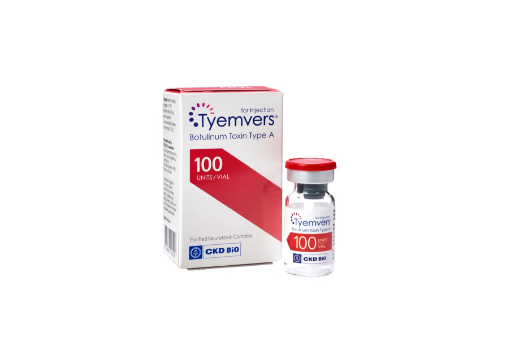
Chong Kun Dang Bio's botulinum toxin has entered the local approval preparation process in China following the success of its Phase 3 clinical trial.
On April 7, the Center for Drug Evaluation (CDE) under China's National Medical Products Administration (NMPA) confirmed that Chong Kun Dang Bio and its partner CUTIA Therapeutics had submitted an import application for 'Botulinum Toxin Type A Standard Substance' on April 6.
This application is seen as a preparatory step for quality standards and registration testing ahead of the Chinese marketing authorization application for 'CU-20101' (brand name: TMBUS). The standard substance is a reference material used to compare and verify the potency and quality of botulinum toxin.
Industry analysis suggests that CUTIA is likely to file a marketing authorization application in China in the near future, following the standard substance acquisition and registration testing preparation. CU-20101 previously demonstrated non-inferiority to BOTOX® in a Chinese Phase 3 trial, and the current phase is interpreted as the compilation of approval documentation and quality verification procedures.
Last month, CU-20101 met all primary and secondary endpoints in the Chinese Phase 3 trial. The study enrolled patients with moderate to severe glabellar lines and used AbbVie's BOTOX® as an active comparator to assess non-inferiority. No treatment-related serious adverse events or deaths were reported, and repeated administration maintained similar efficacy and safety profiles to single-dose administration.
CU-20101 is characterized by a manufacturing process that does not use animal-derived materials or human serum albumin. The company expects this to reduce the risk of transmissible spongiform encephalopathy (TSE) infection and potential allergic reactions.
Chong Kun Dang Bio signed an exclusive license agreement with CUTIA in January 2022 for the rights to CU-20101 in China, Hong Kong, Macau, and Taiwan. The total contract value is $7 million. Chong Kun Dang Bio has already received $5.5 million in upfront and milestone payments, and will receive an additional $1.5 million upon marketing authorization in China.
Source: Read the original report | Published: May 08, 2026