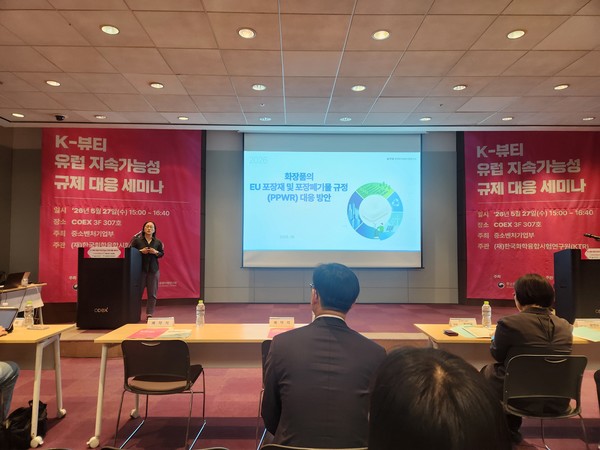
At a seminar titled 'K-Beauty EU Sustainability Regulation Response' held on March 27 at COEX in Seoul, South Korea, industry experts emphasized the need for proactive compliance with EU sustainability regulations to maintain K-beauty's growth trajectory in the European market. Organized by the Ministry of SMEs and Startups, the event featured presentations on the EU's Packaging and Packaging Waste Regulation (PPWR) and Ecodesign for Sustainable Products Regulation (ESPR).
Minister of SMEs and Startups Sung-sook Han stated in her opening remarks, 'Europe has rapidly emerged as a key export market for Korean cosmetics, especially for SMEs. The EU's packaging and packaging waste regulations differ from ours, so it is crucial to understand what is allowed there but not here, and how to respond.'
K-beauty has been riding the Korean Wave to expand in the EU, but various regulations are set to take effect from the second half of this year, putting the industry on alert.
During the seminar, Dr. Hana Ryu, a senior researcher at the Korea Testing & Research Institute (KTR), presented on 'Cosmetics Response to EU PPWR.' She advised, 'The immediate task for August is to address heavy metal restrictions. Companies must secure documentation proving the content of substances of concern.' She further recommended, 'Think about all your packaging products, disassemble them by component, and check what certificates you have. Do this in advance.'
Under PPWR, from August, packaging materials—including bottles, caps, labels, adhesives, and printing inks—must limit the total content of four heavy metals (lead, cadmium, mercury, and hexavalent chromium) to 100 mg/kg. Additionally, manufacturers must prepare and retain Technical Documentation (TD) and Declaration of Conformity (DoC). Importers must verify that imported packaging complies with all PPWR requirements and keep copies of TD and DoC. Distributors must check the producer's registration and labeling status before sale and stop sales if suspicious.
Dr. Ryu explained, 'DoC and TD are a set. TD is complex, but until August, it only needs to cover heavy metal hazardous substances. For recyclability or packaging minimization, just mention them. Once specific implementing regulations are issued, you can comply then.'
She proposed a seven-step practical response to PPWR: 1) Identify packaging stages and components, 2) Secure packaging data, 3) Build a packaging inventory, 4) Obtain evidence of substance content, 5) Prepare TD, 6) Issue DoC, and 7) Register as an EU producer.
The seminar also addressed the ESPR, a key policy tool for achieving circular economy goals and improving product environmental sustainability. Although cosmetics are not currently listed as a priority product, the industry was urged to prepare.
Dr. Hankyung Lee, CEO of Eco & Partners, presented on 'EU ESPR and DDP Overview and Impact on the Beauty Industry.' He noted, 'Cosmetics were excluded from the ESPR scope in 2025, but this is not permanent. The priority product report is expected next year or the year after, so we need to monitor how cosmetics are treated.'
He suggested a response strategy starting with establishing a Program Management Office (PMO) as a control tower to manage cross-departmental regulatory compliance and transformation tasks. 'Many companies haven't decided who is responsible. We often recommend appointing a PMO first,' he emphasized. The strategy should then extend to R&D, production, collaboration, and digitalization.
Source: Read the original report | Published: May 27, 2026