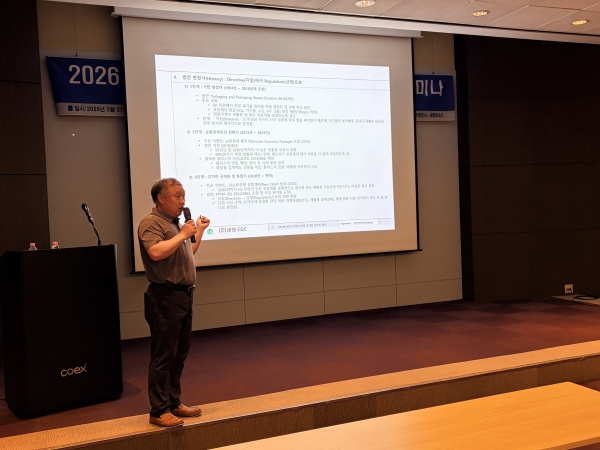
A seminar titled 'K-Beauty Global Market Leading Strategy' was successfully held by Jangup Newspaper, providing a platform for sharing practical strategies to strengthen the global competitiveness of the domestic cosmetics industry. The event, attended by industry officials, brand companies, manufacturers, and raw material and packaging firms, focused on the latest trends and response strategies for targeting global markets.
The seminar took place on May 27 in Conference Room 318 of COEX, during the '2026 CosmoBeauty Seoul' exhibition held from May 27 to 29. Jangup Newspaper CEO Kim Jung-kyu introduced the event, stating, 'As K-Beauty moves beyond the era of $10 billion in exports and enhances its status in the global market, Jangup Newspaper is taking practical steps to support the overseas competitiveness of the domestic cosmetics industry.' He added, 'Celebrating its 32nd anniversary this year, Jangup Newspaper has continued various activities to support the development of the domestic cosmetics industry and global market entry. This seminar on strengthening global competitiveness marks its 13th edition. From introducing global platforms like Alibaba during the initial boom in the Chinese market, we have consistently provided strategies for various global platforms and market responses.'
Kim further noted, 'This year's seminar particularly focuses on AI-based global marketing strategies and responses to non-tariff barriers for the European market. As AI use spreads across industries, we will share AI-based marketing techniques and practical application strategies to help domestic cosmetics companies secure global competitiveness.' He concluded, 'Jangup Newspaper will continue to provide various global strategies and information that the industry can utilize in the field.'
The seminar featured presentations on key challenges facing the K-beauty industry, including: 'AI Utilization Strategies for Strengthening K-Beauty Global Market Penetration' by Lee Kwang-il, Director of Intivitem; 'Material Utilization for Global Market Penetration' by Ko Yong-eui, Team Leader at SK Chemicals; 'Strategies for Overcoming Global Barriers like European PPWR' by Heo Byung-tae, Managing Director of Semyung E&C; and 'K-Beauty Export Strategy to Create 20 Billion Won: Persuade with Data, Not Words' by Baek Sang-yeol, CEO of Amuty. Topics covered AI and data-driven global marketing, European packaging regulations (PPWR), and material and packaging innovation, drawing high interest from participants. The seminar was particularly meaningful for introducing practical, field-applicable strategies beyond mere information delivery.
Heo Byung-tae of Semyung E&C explained the EU Packaging and Packaging Waste Regulation (PPWR), set to take full effect in 2026, emphasizing, 'In the future European market, not only product competitiveness but also the recyclability and sustainability of packaging will become core competitive factors.' According to the presentation, PPWR operates on three key pillars: sustainability, labeling and information provision, and economic operator responsibility. All packaging must meet requirements for Design for Recycling (DfR), Post-Consumer Recycled (PCR) content standards, and digital labeling. Notably, from 2030, only packaging with recycling grades A to C will be allowed on the market, significantly tightening regulations.
Heo explained, 'From August 2026, it will be mandatory to have a Declaration of Conformity and technical documentation for all packaging. Incomplete data could increase the likelihood of customs rejection.' He stressed that cosmetics companies must systematically prepare for recyclability, packaging minimization, hazardous substance management, and QR-based digital labeling from the product design stage.
The importance of Technical Documentation was also detailed. It must include product identification, packaging structure, Bill of Materials (BOM), recycling assessment reports, PCR certificates, hazardous substance test reports, and labeling drafts, covering the entire supply chain, with a retention obligation of at least 5 to 10 years.
Key challenges highlighted include securing data to prove actual recycling process suitability, such as RecyClass-based recyclability assessments, NIR sorting tests, and density separation data. Detailed design-stage regulatory responses were also discussed, including restrictions on carbon black, improvements to metal spring structures, and the application of water-soluble adhesives.
The seminar emphasized that for K-Beauty to sustain growth in the global market, a 'data-driven strategy' rather than 'gut feeling' is essential. Baek Sang-yeol, CEO of Amuty, diagnosed, 'K-Beauty has already grown into a next-generation core industry for South Korea, but existing overseas expansion methods still suffer from high marketing costs and inefficiency.' He introduced an O2O platform strategy based on global consumer reviews and skin data analysis, explaining a structure where product competitiveness is pre-verified through actual reviews and local consumer data before linking to B2B exports. He particularly stressed, 'We must move away from intuition-based traditional trade methods and minimize buyer risk through data-driven verification.'
Amuty explained that it is building a platform ecosystem using a global micro-influencer network and skin-type data analysis to precisely analyze consumption tendencies by region and ethnicity, connecting with global distributors and buyers. It highlighted the advantage of minimizing inventory risk by connecting only brands verified through B2C real-use data to B2B distribution networks.
Industry insiders evaluated the seminar as a platform for sharing 'practical strategies' for actual survival in the global market, beyond mere market outlooks. This is because the simultaneous strengthening of AI-based data marketing and ESG/circular economy-focused global regulations makes the response capabilities of K-Beauty companies increasingly important.
A Jangup Newspaper official stated, 'The global market is changing rapidly, and data-driven export strategies and eco-friendly regulatory responses are no longer options but necessities. We will continue to provide strategies and information that the industry can practically utilize.'
Source: Read the original report | Published: May 29, 2026