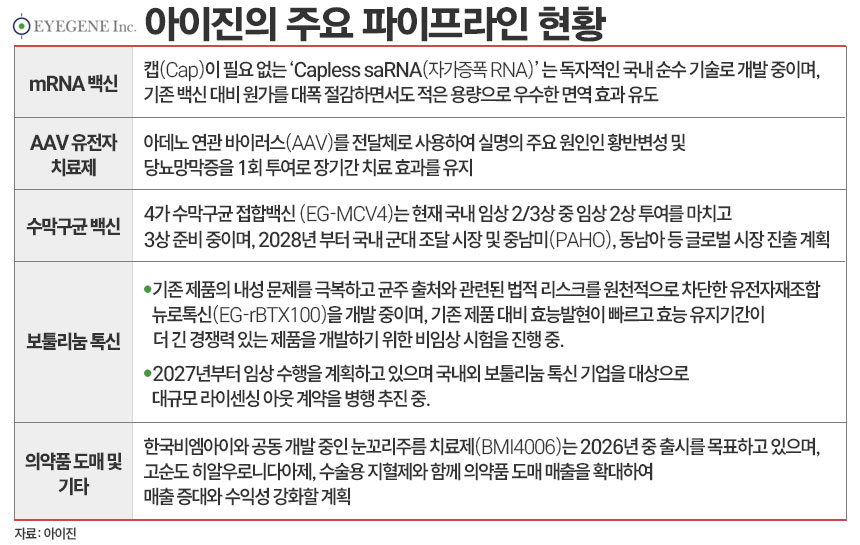
EyeGene is pursuing global partnerships at BIO USA, centering on its meningococcal vaccine and recombinant botulinum toxin. While the mRNA platform draws attention, the company's strategy is to prioritize pipelines with higher near-term commercialization potential to build a revenue base. Leveraging national projects for hantavirus and severe fever with thrombocytopenia syndrome (SFTS) vaccines, as well as secured production infrastructure, EyeGene plans to accelerate expansion into mRNA-based preventive vaccines and cell and gene therapy in the medium to long term.
According to industry sources on the 27th, EyeGene will focus on establishing a technology transfer foundation through partnerships at BIO USA, held from June 22 to 26 in San Francisco, USA. The company is concentrating on its meningococcal vaccine and recombinant botulinum toxin, which have high commercialization potential. An EyeGene official stated, "As this is our first BIO conference after restructuring our pipeline in 2024, it will be an opportunity to introduce the pipelines we have established. Finding overseas partners for EG-MCV4 is our most important goal."
**Meningococcal Vaccine Partnership Core to Near-Term Strategy**
EG-MCV4 is a quadrivalent meningococcal vaccine targeting entry into domestic Phase 3 clinical trials in the second half of this year. Meningococcus is a bacterium that can cause meningitis or sepsis, rapidly worsening and becoming life-threatening upon infection. It is considered essential for individuals at risk, such as military recruits, students in group settings, and overseas travelers. The company aims to secure overseas partners for EG-MCV4 through BIO USA, enhancing its potential for global market entry.
The recombinant botulinum toxin EG-rBTX100 will also be actively promoted. Unlike conventional products that cultivate bacteria and purify toxins, this is manufactured using genetic recombination technology to improve production stability and quality uniformity. The company plans to introduce the competitiveness of its candidate and platform, targeting clinical trial entry in 2027, while simultaneously pursuing global partnerships.
EyeGene's strategy is to secure new revenue streams by highlighting vaccine and botulinum assets with high near-term commercialization potential. This approach diverges somewhat from market perception of the company as a COVID-19 mRNA vaccine developer. While EyeGene aims to become an mRNA-based preventive vaccine and cell and gene therapy company in the long term, it seeks immediate technology exports and commercialization opportunities from pipelines closer to clinical stages.
The focus on near-term commercial assets is seen as a necessary choice given the company's financial structure. EyeGene has been incurring losses due to R&D expenses. Last year, on a consolidated basis, it reported revenue of KRW 3.6 billion, an operating loss of KRW 9.8 billion, and a net loss of KRW 19.2 billion. Given its limited revenue base and ongoing R&D spending, securing short-term funding is a priority.
**mRNA-Based Therapeutics as Long-Term Goal: Two-Track Strategy Under Scrutiny**
The company presents mRNA-based infectious disease vaccines and cell and gene therapies as its mid- to long-term growth drivers. Notably, this year's selection for national projects on hantavirus and SFTS vaccines has refocused attention on its mRNA technology capabilities. Hantavirus and SFTS vaccines address significant preventive needs, but there is a demand for next-generation vaccines with improved immunogenicity and efficacy. EyeGene is advancing R&D using mRNA-based technology. It plans to leverage the mRNA vaccine research, clinical experience, and manufacturing know-how accumulated during the COVID-19 pandemic. Through collaboration with its affiliate Korea BMI, the company has also secured large-scale production facilities.
The use of its proprietary delivery platform EG-R in major mRNA pipelines appears limited. EG-R is a cationic liposome-based delivery technology used in early-stage COVID-19 mRNA vaccine research. It has been confirmed that this technology is not directly applied to the COVID-19 vaccine or hantavirus vaccine currently under development. The company explained that it is utilizing an improved lipid nanoparticle (LNP) delivery technology owned by its joint research partner, Medicibio. The aim is to enhance commercialization potential by applying technology with improved delivery efficiency and stability compared to its own platform.
An EyeGene official explained, "mRNA technology is a platform already validated through the COVID-19 pandemic. Actively utilizing mRNA platform technology enables rapid development of preventive vaccines through research on hantavirus antigen gene sequences. This can serve as a foundation to shorten the overall vaccine development timeline."
As the company simultaneously pursues near-term cash-generating vaccine and botulinum pipelines alongside long-term mRNA R&D, demonstrating tangible results is deemed critical. A biotech industry insider commented, "With the company's current valuation lower than in the past, if the business strategy yields results, there is potential for revaluation." The success of overseas partnerships for EG-MCV4, validation of EG-rBTX100's technological differentiation, and the connection of the mRNA platform to commercialization following national projects are expected to be key variables for future corporate value.
There is also an assessment that EyeGene is attempting to reposition itself from a COVID-19 mRNA vaccine company to a complex biotech firm that combines vaccine and botulinum commercialization with platform technology. Attention is focused on whether this two-track strategy of securing a near-term revenue base and pursuing a long-term platform strategy will translate into tangible outcomes.
An EyeGene official stated, "Our short-term goal is to secure new revenue and profit sources by 2027-2028 through the development of the meningococcal vaccine and recombinant botulinum toxin. We are also preparing to develop and launch products in areas where we can actively utilize our production facilities."
Source: Read the original report | Published: May 28, 2026