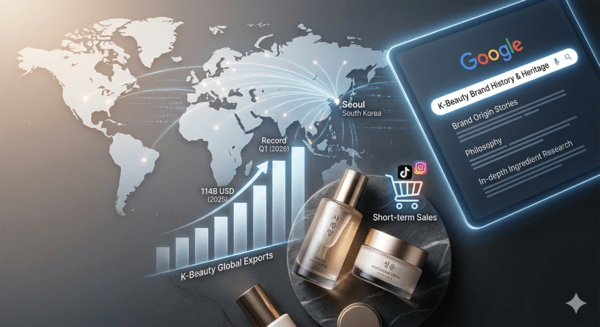
K-Beauty has fully transitioned into an export-driven industry, with exports surpassing $11.4 billion in 2025 for the first time ever. In Q1 2026, exports reached a record quarterly high of $3.135 billion, underscoring sustained growth. Industry observers note that the center of gravity for K-Beauty has shifted decisively from the domestic market to the global stage.
According to South Korea's Ministry of Trade, Industry and Energy, K-Beauty exports continue to rise, strengthening its position in global markets, particularly in the United States, Japan, and Southeast Asia.
Meanwhile, the domestic cosmetics market has become a red ocean of hyper-competition. Industry insiders now describe the Korean market not as a profit center but as a "showroom" to validate brand credibility. One industry source explained: "The domestic market is no longer a revenue model but a proving ground to show that a product works in Korea. It has become a test bed for global expansion."
Behind the export growth lies a lesson from past failures in China. Korean cosmetics companies once saw explosive sales in China but neglected brand storytelling, search-engine content accumulation, and long-term brand asset management. The lack of content strategies on local search platforms like Baidu proved critical. As local Chinese brands grew, K-Beauty brand recognition quickly eroded. This is cited as a classic example of the fragility of a sales-only strategy.
Experts now identify "digital brand history" as a core competitive factor in the global beauty market. While TikTok and Instagram can drive short-term sales spikes, they lack sustainability. In contrast, Google search results, news articles, wiki and brand pages, and review content serve as long-term assets that build brand trust. Top Amazon brands consistently invest in search engine optimization (SEO), brand story content, and external media coverage to build a "digital genealogy." Global consumers typically discover products on social media but then verify brand credibility through Google searches.
As K-Beauty transitions fully to an export-led model, building brand power on global platforms is essential. The next strategic challenge, according to experts, is "digital territory expansion" rather than mere distribution. The key is to establish brand philosophy and history on Google, Amazon, and global media platforms. The success of K-Beauty over the next decade will depend on the number of global legacy brands created, the accumulation of search-based brand assets, and the development of sustainable brand stories.
Source: Read the original report | Published: May 29, 2026