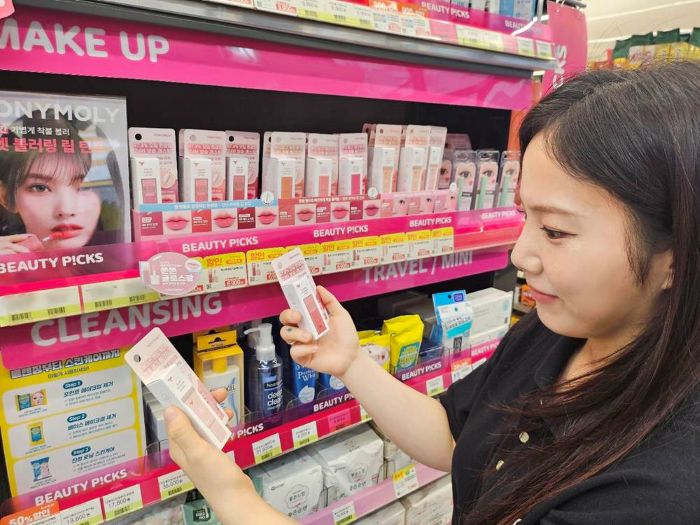
The 'value-for-money beauty' trend ignited by Daiso is rapidly spreading across South Korea's retail sector. Amid deepening consumption polarization and prolonged high inflation, consumers increasingly seek affordable yet high-performing products. This trend is particularly pronounced among teens and consumers in their 20s, who typically have lower incomes. In response, major retailers including convenience store chains CU and 7-Eleven, as well as home shopping channel GS Shop, are strengthening their beauty categories by launching new products and renewing private brands (PBs). **CU, 7-Eleven, GS Shop Strengthen Beauty Categories** On April 28, convenience store CU began exclusive sales of nine new lip makeup products in collaboration with beauty brand Tony Moly. Initially available at around 400 beauty-specialized stores, the lineup will expand to all national stores next month. The new products include three lip tints, three lip glosses, and three blushers, all offered at under 10,000 won (approximately $7.50) — about half the price of standard color cosmetics while maintaining the same volume. CU also launched an exclusive mini version of the 'Super Thin Pen Eyeliner' from makeup brand Merimong. The product retains the same volume but is reduced to two-thirds the size for enhanced portability. CU has been actively developing its beauty category since designating it as a key growth area last year. The number of beauty-specialized convenience stores has expanded to over 600 nationwide, and beauty product SKUs grew from around 230 in 2023 to over 300 in 2024. According to BGF Retail, CU's beauty category sales have grown year-on-year by 28.3% in 2023, 16.5% in 2024, and 20.9% in 2025, maintaining double-digit growth for three consecutive years. A CU official noted, "Currently, 70% of our cosmetics sales come from consumers in their teens and 20s." 7-Eleven also launched two sun care products last month in preparation for summer: a sunscreen cream and a sunscreen stick, priced 40% and 35% lower respectively than existing products. A 7-Eleven representative said, "We have steadily expanded our beauty lineup, focusing on basic skincare items frequently used in daily life. As a result, our fashion and beauty category sales grew 20% year-on-year in 2024."
GS Shop recently renewed its private beauty brand 'VU' after four years, introducing a new line of cosmetics that maintain ingredients and functionality while lowering price points. For the renewal, GS Shop surveyed 500 customers over five months about skin concerns and product preferences, incorporating their feedback into new product development. The new lineup includes sunscreen, serum, and cream. GS Shop plans to further develop the 'VU' brand and strengthen product differentiation. **K-shaped Consumption Pattern Evident Amid High Prices and Income Polarization** These moves reflect a clear 'K-shaped consumption' pattern, where the wealthy increase spending while others cut back. According to the National Data Processing Agency's '2026 Q1 Household Income Trend Survey' released on April 28, the income gap between the top and bottom 20% widened to its largest in six years. The top 20% saw average monthly wages exceed 12 million won ($9,000) for the first time, while the bottom 20% saw virtually no income growth. This polarization extends to consumption. According to the Ministry of Trade, Industry and Energy, department store sales rose 21.7% year-on-year in April due to increased demand for premium and luxury goods, while large supermarkets and SSMs (super supermarkets) saw sales decline 6.6% and 6.9% respectively. Daiso's sales growth underscores this trend. The value retailer's annual revenue surged from 2.9457 trillion won in 2022 to 4.5363 trillion won in 2025. Notably, Daiso's beauty category is booming. According to market research firm Embrain Deep Data, estimated annual beauty product purchases at Daiso reached 361.96 billion won ($270 million) as of March, up 39.6% from 259.24 billion won a year earlier. The number of beauty brands and SKUs at Daiso jumped from 7 brands and 120 SKUs in 2022 to over 150 brands and 1,429 SKUs by end of 2024. With strong demand for value-for-money products, the trend of retailers launching affordable beauty items is expected to continue in the near term.
Source: Read the original report | Published: May 29, 2026