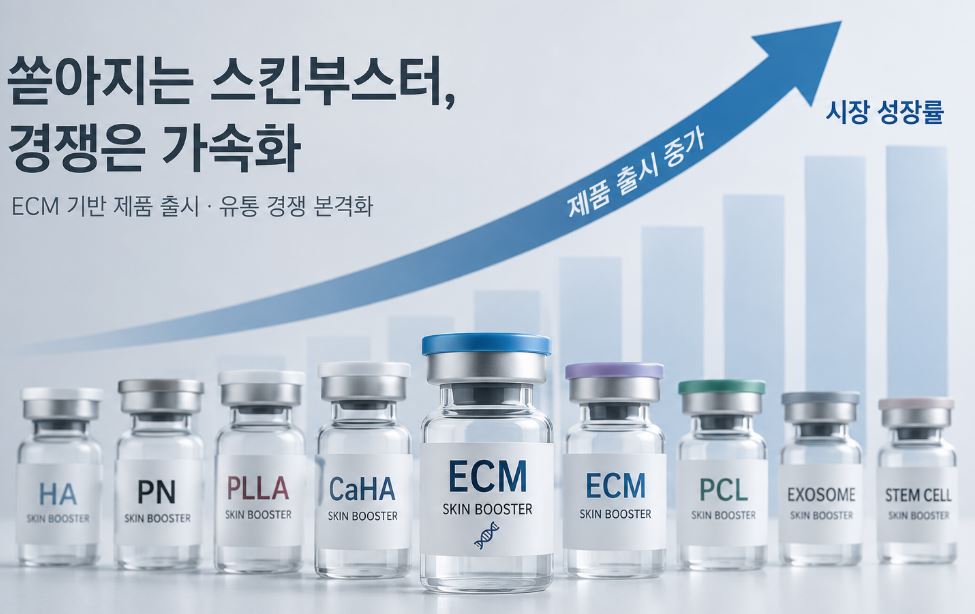
The skin booster segment of the medical aesthetics market in South Korea is experiencing an overheated competitive landscape, with new product launches accelerating faster than market growth. According to industry sources on May 18, the market is rapidly segmenting as companies introduce extracellular matrix (ECM)-based skin boosters alongside established products containing hyaluronic acid (HA), polynucleotides (PN), poly-L-lactic acid (PLLA), and calcium hydroxylapatite (CaHA).
In the first half of this year alone, six new skin booster products have entered the market. Companies are actively pursuing distribution agreements and obtaining human tissue bank licenses for ECM material handling, distribution, and supply.
The domestic skin booster market has seen high growth in recent years, driven by a shift in consumer demand from simple volume enhancement (fillers) to procedures focused on skin regeneration, elasticity, and texture improvement. This has positioned skin boosters as a core category in medical aesthetics.
Key product launches include: - Dongbang Medical launched calcium-based 'Chaol' and PLA-based 'PLAvia' in February. - Cha Meditech introduced 'Hailora Skin Booster' in March, targeting the professional market with a focus on dermal white adipose tissue (dWAT) layers. - Jeisys Medical (Jeisys) unveiled ECM-based 'ADITE' this month, emphasizing skin structure restoration and regeneration using human acellular dermal matrix (hADM).
ECM-based skin boosters are gaining attention for their ability to restore skin structure rather than merely stimulating collagen production. Dongbang Medical announced a distribution agreement for an ECM skin booster in April, while Lameditech obtained a human tissue bank license from the Ministry of Food and Drug Safety (MFDS) this month to enter the ECM-based regenerative medicine materials business. Lameditech is also developing a combined solution integrating its laser drug delivery system (DDS) technology with ECM materials.
Pharmaceutical e-commerce company BlueMTek has partnered with BioPlus to secure exclusive distribution rights for HA filler brand 'HyalDew' and skin booster 'Kiara' in domestic hospitals and clinics.
Industry analysts note that the competitive axis is shifting from ingredient differentiation to regenerative medicine platforms. Beyond ECM, companies are exploring next-generation materials such as PCL, exosomes, and stem cell-derived substances. Last year, T&R Biofab obtained approval for 'Addum,' an ECM-combined medical device, signaling potential expansion into skin boosters and cosmetics.
However, concerns about market overheating are growing. The pace of product launches may outpace market growth, leading to fragmentation. Many products claim similar mechanisms, with only ingredient combinations differing. Clinical data accumulation and long-term safety validation remain in early stages for many products.
An industry insider from a skin booster manufacturer commented: "Previously, a few representative products led the market. Now, almost every company is preparing skin boosters. It's not just about adding one more product; the combination with regenerative medicine concepts makes competition much more complex."
"As the number of products increases, each company's market share inevitably shrinks," the insider added. "Just as botulinum toxin products differentiated through safety and resistance data after intense price competition, skin boosters will ultimately survive based on clinical data, procedural reproducibility, raw material sourcing capabilities, and global regulatory approvals."
Source: Read the original report | Published: May 19, 2026