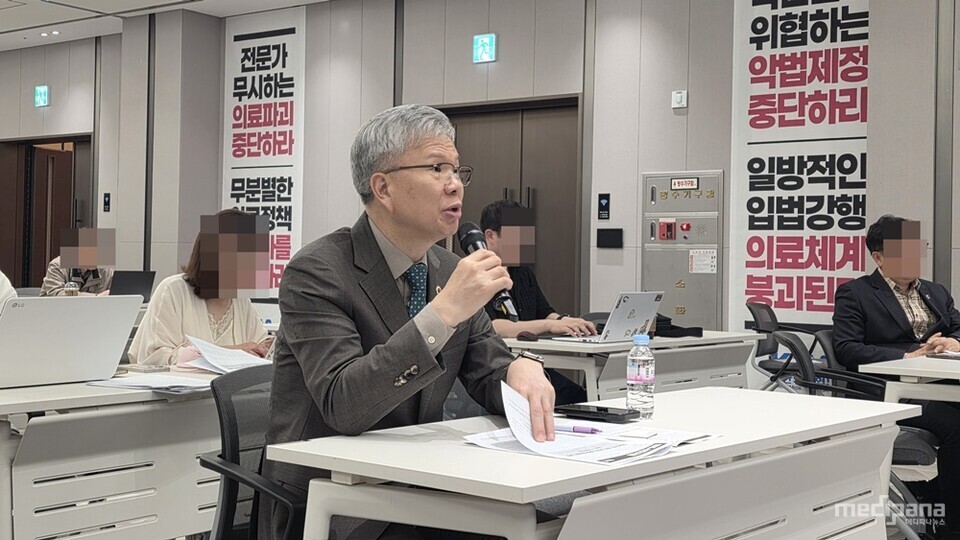
South Korea's mainstream medical associations have formally condemned the widespread use of aesthetic medical devices and pharmaceutical-grade injectables by Korean medicine (Hanui) clinics, labeling such practices as unlicensed medical acts. On April 7, the Korean Medical Association's Special Committee on Korean Medicine, together with the Korean Society of Plastic and Reconstructive Surgeons, the Korean Dermatological Association, the Korean Association of Plastic Surgeons, and the Korean Dermatology Association, held a joint press conference titled "Joint Press Conference Condemning Illegal Medical Practices by Korean Medicine Using PDRN and PN." They accused Korean medicine clinics of crossing professional boundaries by performing laser, radiofrequency, ultrasound, and injection procedures—including skin boosters containing PDRN (polydeoxyribonucleotide) and PN (polynucleotide)—which they argue are based on modern medical principles and fall outside the scope of traditional Korean medicine licenses. "The skin of the people should not be a testing ground," said Park Sang-ho, chairman of the Korean Medical Association's Special Committee on Korean Medicine. "We will track down all illegal medical practices that go beyond the scope of license and respond using all legal and institutional means." He emphasized that "a license is not a right to arbitrarily expand one's scope of practice, but a minimum standard to protect the lives and safety of the people." The groups pointed out that the Supreme Court has previously ruled that the use of IPL (intense pulsed light) devices by Korean medicine doctors constitutes a medical practice based on modern medical principles, thus recognizing its illegality. They also cited a 2022 Supreme Court en banc decision that limited Korean medicine doctors' use of ultrasound devices to diagnostic purposes only, as an auxiliary tool for Korean medicine diagnosis. Noh Si-kyun, public relations director of the Korean Society of Plastic and Reconstructive Surgeons, stated, "Aesthetic medical procedures are by no means simple or trivial treatments. They require a thorough understanding of each patient's skin thickness, skin barrier condition, presence of inflammatory diseases, and skin anatomy." He added that these are high-difficulty medical procedures that must be able to immediately respond to complications such as granulomas, allergic reactions, skin necrosis, nerve paralysis, and infectious complications.

The medical associations specifically criticized the growing use of PDRN and PN-based skin booster injections in Korean medicine clinics. PDRN is a pharmaceutical-grade drug derived from DNA fragments extracted from salmon, while PN is a tissue-repair biomaterial medical device used for skin improvement. Noh emphasized that these are "products of modern medicine, thoroughly developed based on modern medical and scientific principles," and that preparing and using them as herbal acupuncture (yakchim) in Korean medicine clinics constitutes illegal medical practice. Data submitted by lawmaker Lee Ju-young of the Reform Party, obtained from the Health Insurance Review and Assessment Service, showed a sharp increase in PDRN injection supply to Korean medicine clinics. In 2024, 226 units were supplied to 16 clinics; by July 2025, that number had jumped to 2,234 units supplied to 626 clinics. Kim Jae-hong, external cooperation committee member of the Korean Dermatological Association, called this "a clear indicator that the use of pharmaceutical drugs is spreading across the entire Korean medicine sector, not just a simple increase." He warned that the structural expansion of drug use beyond the scope of license is a very serious issue. The groups also criticized that while herbal acupuncture is supposed to be based on herbal preparations rooted in Korean medicine principles, PDRN and PN-based injections are not only unrelated to such principles but also lack safety and efficacy verification by the Ministry of Food and Drug Safety. They warned that injecting unverified substances into the human body could constitute unlicensed medical practice and pose significant risks to public health. Another issue raised was that yakchim solutions prepared at external herbal dispensaries are classified as "prepared herbal medicines," falling into a regulatory blind spot. While pharmaceutical-grade injectables undergo strict approval processes, clinical trials, and Good Manufacturing Practice (GMP) certification, the solutions produced at external dispensaries lack adequate manufacturing and quality control standards despite being directly administered to patients.

Lee Jae-man, policy director of the Korean Medical Association, noted that many products used in Korean medicine clinics as skin boosters lack proper labeling of ingredients or efficacy. "The biggest problem is that procedures are being performed without the capacity to appropriately respond to adverse reactions," he said. Ban Jun-seop, vice president of the Korean Association of Plastic Surgeons, expressed concern about patient safety, stating, "When drugs enter the human body, hypersensitivity reactions can occur. In the event of anaphylaxis, Korean medicine clinics are likely not even adequately equipped with the necessary medications to respond. This could pose a serious risk to public health." The medical associations called on the government to overhaul the management system for yakchim and similar injectables, strengthen oversight across manufacturing, distribution, and use, and clarify the scope of Korean medicine doctors' licenses. They demanded that Korean medicine clinics immediately cease all illegal aesthetic procedures using medical devices and PDRN/PN ingredients, and initiate scientific verification of PDRN and PN yakchim. Kim Taek-woo, president of the Korean Medical Association, who attended the press conference, stated, "If there is no appropriate punishment for wrongful acts, the same problems will inevitably repeat. We will continue to discuss the issue of unlicensed medical practice with the Ministry of Health and Welfare through the medical policy consultative body and respond in conjunction with National Assembly activities."
Source: Read the original report | Published: May 07, 2026