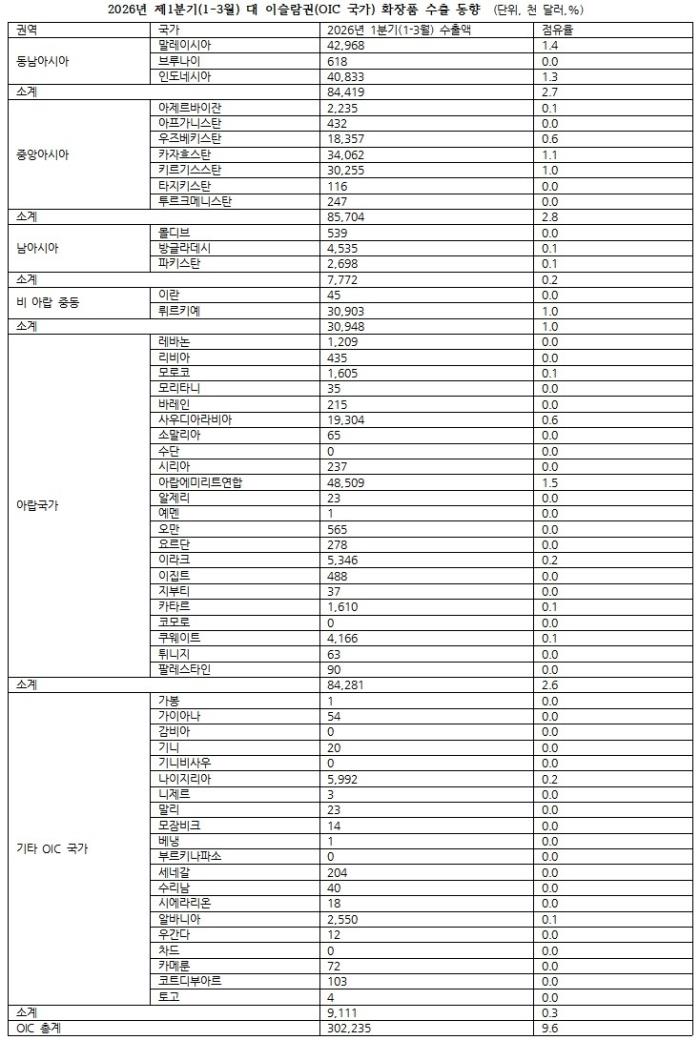
South Korea's cosmetic exports to Islamic countries reached an all-time high of over $302 million in the first quarter of 2026, accounting for 9.6% of total cosmetic exports. This signals growing demand in OIC markets for overseas buyers and distributors seeking halal-compliant beauty products.
Market breakdown
Exports to the 57 member states of the Organisation of Islamic Cooperation (OIC) totaled $302.235 million in Q1 2026. The Middle East region, combining Arab and non-Arab Middle Eastern countries, led with $115.229 million (3.6% of total exports). Central Asia followed with $85.705 million (2.8%), and Southeast Asia with $84.419 million (2.7%). South Asia and Africa contributed $8.354 million and $1.697 million, respectively.
Top country destinations
Among individual countries, the United Arab Emirates topped the list at $48.509 million, followed by Malaysia ($42.968 million) and Indonesia ($40.833 million). Kazakhstan ranked fourth with $34.062 million, and Kyrgyzstan fifth with $30.255 million. Turkey stood out in the non-Arab Middle East region with $32.797 million, while Saudi Arabia reached $12.025 million within the Arab Middle East.

Africa and smaller markets
African exports remain modest, led by Nigeria at $1.058 million, followed by Algeria ($0.202 million) and Uganda ($0.082 million). The region's overall share is still negligible but shows potential for future growth.
What buyers should watch
Dr. Jang Geon, head of the Korea Halal Industry Research Institute, stated: "We aim to provide annual and current-year export trends to cosmetic companies already exporting or seeking to enter Islamic markets, helping them select target markets." Distributors and clinic buyers should monitor halal certification requirements and emerging demand in Central Asia and Southeast Asia, beyond traditional Middle Eastern markets.
Source: Read the original report | Published: May 31, 2026