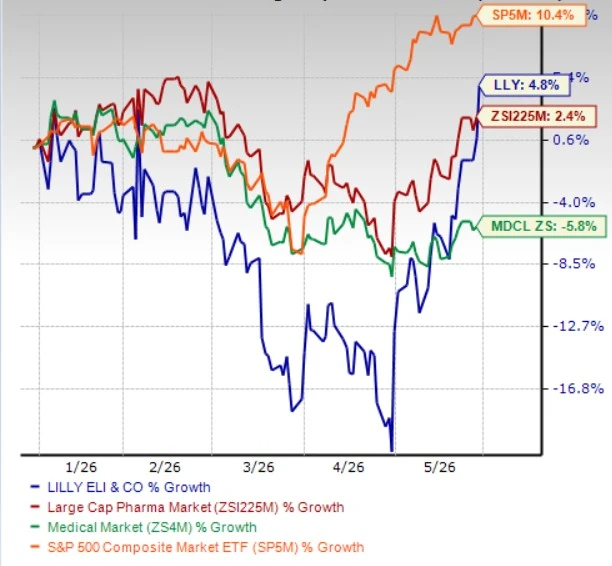
Eli Lilly (LLY) shares rose 4.1% on Thursday to a record high of $1,126.80, pushing its market capitalization to approximately $1.02 trillion. The surge followed the company’s announcement that all three of the largest U.S. pharmacy benefit managers (PBMs) now cover its obesity medicine portfolio. Notably, CVS Caremark will begin covering Lilly’s newly launched oral GLP-1 pill, Foundayo, from June 1, 2026, and will resume broader coverage of its injectable GLP-1 therapy, Zepbound, across template plans by October 1, 2026. This development significantly expands patient access to Lilly’s obesity treatments through existing insurance plans.
Novo Nordisk (NVO) remains Lilly’s primary rival in obesity treatment, marketing its blockbuster GLP-1 therapy Wegovy as both an injectable and an oral medication. Novo Nordisk established an early lead in the oral obesity market with the January 2026 launch of the Wegovy pill, giving it a first-mover advantage over Lilly’s Foundayo, which debuted in early April. CVS has now effectively removed that competitive edge by restoring Zepbound coverage and adding Foundayo to its formulary, placing both companies on much more equal footing in terms of patient access. Both obesity leaders now have covered injectable and oral treatment options available to a broad U.S. patient population.
The shift comes at a challenging time for Novo Nordisk, which has warned of negative sales and operating profit growth in 2026 due to intensifying competition across the GLP-1 market. Even without CVS coverage, Zepbound had captured a larger share of the injectable obesity market, highlighting strong physician and patient demand. Lilly also benefits from Zepbound’s clinical profile: in a head-to-head study against Wegovy, Zepbound demonstrated greater weight-loss efficacy. With broader insurance coverage improving affordability, that efficacy advantage could influence prescribing decisions and pressure Wegovy’s market share.
CVS’ prior coverage decisions had amplified Novo Nordisk’s advantage. Last year, CVS removed Zepbound from coverage after negotiating more favorable pricing terms for Wegovy and designated Novo Nordisk’s drug as its preferred GLP-1 weight-loss therapy starting July 1, 2025. Following approval of the oral Wegovy formulation, the pill was also added to coverage. However, Lilly could narrow the gap quickly through Foundayo’s expanded coverage and growing commercial rollout. Foundayo offers a convenience advantage, as it can be taken at any time of day without food or water restrictions, whereas the Wegovy pill must be taken on an empty stomach with a 30-minute wait before eating. However, Novo Nordisk’s product may hold a modest advantage in tolerability, as Foundayo has been associated with gastrointestinal side effects.
Smaller biotech firms are also advancing GLP-1–based therapies. Viking Therapeutics is developing VK2735, a dual GIPR/GLP-1 receptor agonist, as both oral and subcutaneous formulations for obesity, with plans to advance the oral version into phase III development in the fourth quarter of 2026. Structure Therapeutics’ phase II ACCESS study on its oral GLP-1 RA, aleniglipron, demonstrated significant weight loss across all doses, and the company expects to initiate a late-stage program in the second half of 2026.
Eli Lilly shares have gained 4.8% year to date, compared with the industry’s 2.4% growth. The stock trades at 28.86 forward earnings, above the industry average of 17.42 but below its five-year mean of 34.56. Estimates for Lilly’s 2026 earnings have improved from $33.79 to $35.43 per share in the past 30 days, and 2027 estimates have risen from $42.54 to $44.33 per share over the same period.
Source: Read the original report | Published: May 29, 2026