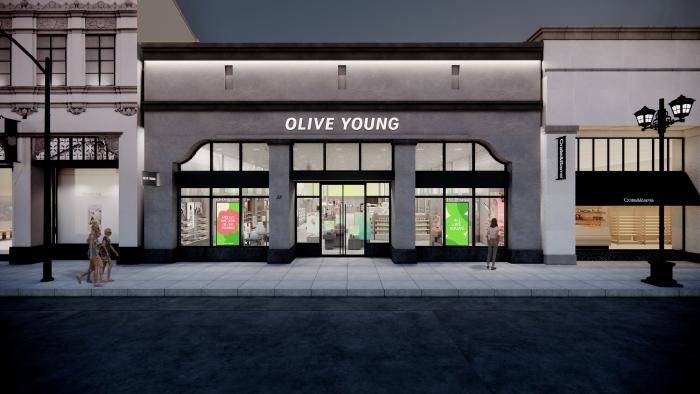
CJ Olive Young has opened its first offline store in the US mainland, marking a shift in the K-beauty industry from a simple export-centric structure to a competition for local distribution platforms. Previously, K-beauty brands expanded by entering global distribution networks like Amazon, Sephora, Ulta Beauty, and TikTok Shop. Now, the trend is to transplant the Korean health and beauty (H&B) store model directly into local markets to secure consumer experience and distribution leadership.
According to Olive Young on May 25, the 'Olive Young Pasadena Store' will open on May 29 in Pasadena, California. This commercial area is a high-income consumer district in northeastern Los Angeles, densely populated with global brand stores such as Apple Store, Lululemon, Alo Yoga, and Tiffany & Co. The store spans approximately 803 square meters (243 pyeong) in a single-story layout, similar in scale to the large domestic 'Olive Young Town'.
On the same day, a US-exclusive online mall will also launch. Olive Young had already established a western integrated logistics center in Bloomington, California, in March, covering about 3,600 square meters, with plans to operate an automated logistics system expandable up to 5,000 pyeong. This logistics infrastructure is designed as an omnichannel structure handling both online delivery and offline store inventory.
Delivery competitiveness has also been strengthened. The average delivery period for the US-exclusive online mall has been halved to 3-5 business days compared to the previous global mall, and the free shipping threshold has been lowered from $60 to $35. In-store pickup services are planned for the future. Additionally, an integrated online-offline membership program called 'OY MEMBERS' will offer point accumulation and discount benefits.
This US entry aligns with structural changes in the K-beauty market. According to the Ministry of Food and Drug Safety, Korea's cosmetic exports reached a record $11.4 billion last year, with the US becoming the largest export destination at $2.2 billion, surpassing China for the first time. K-beauty consumption in the US is spreading through social media, driven by skincare trends like 'glass skin'.
Major US media outlets are also noting K-beauty's expansion. Vogue has highlighted ingredient-focused skincare trends and K-beauty growth, while CNBC and The New York Times have assessed K-beauty as a key axis in the transformation of US beauty consumption.
Industry insiders view Olive Young's US entry as the beginning of platform competition, not just distribution expansion. Previously, K-beauty brands entered distribution networks like Sephora and Ulta Beauty, but key decisions on shelf placement and exposure were controlled by the distributors. In contrast, Olive Young differentiates itself by directly leading brand selection and consumer experience design through a curation-based structure.
The store is divided into eight categories: skincare, makeup, hair care, body care, inner beauty, and lifestyle, with products curated around ingredients and skin concerns. Functional keywords like hyaluronic acid and PDRN are used to group products, enhancing a 'discovery shopping experience'.
Experiential elements have also been strengthened. The 'Skin Scan' skin diagnostic device and 'THE BEAUTY LAB' experience space allow customers to directly try skincare routines, with personalized coaching based on Korean cleansing methods and layering care.
The store will feature approximately 400 brands and over 5,000 products, centered on K-beauty brands such as Mediheal, Biodance, Anua, Torriden, and Romand. Global brands like The Ordinary, CeraVe, and Supergoop are also included to enhance accessibility for local consumers.
An industry insider commented, "In the past, the goal was simply to enter US distribution networks. Now, we are at a stage where Korean-style distribution platforms are directly entering overseas markets. If the Olive Young model takes hold, the entire method of K-beauty global expansion could change."
However, the US market is fiercely competitive among Sephora, Ulta Beauty, and large retailers, with high logistics and labor costs posing operational risks. Past cases of Japanese and Chinese cosmetic brands struggling with localization in the US market suggest that success depends on early stabilization.
Nevertheless, the industry sees this entry as a structural transformation for K-beauty, moving from manufacturing-focused competition to platform competition based on distribution, content, and data. Olive Young's omnichannel strategy, integrating online mall, membership, and offline experience spaces in the US, is expected to serve as a test bed for the broader expansion of the K-beauty ecosystem.
Source: Read the original report | Published: May 25, 2026