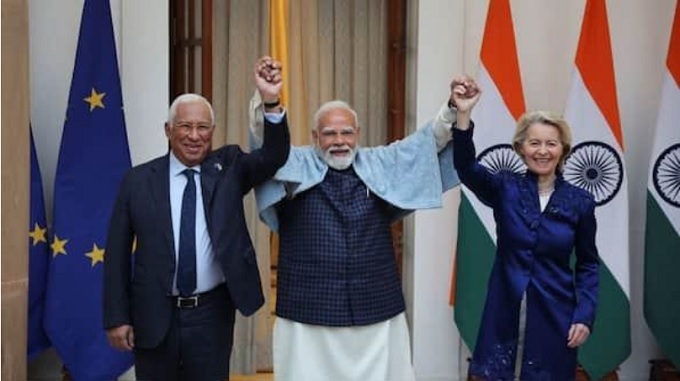
The recently concluded EU-India Free Trade Agreement (FTA) is set to reshape India's premium beauty market, intensifying competition for K-Beauty exporters and distributors. With India set to eliminate import tariffs of up to 22% on cosmetics over 5-7 years, European luxury and dermocosmetic brands will gain significant price advantages, challenging Korean brands in a market where prestige products currently hold only 10% share. This development signals urgent strategic implications for overseas buyers and suppliers eyeing India's rapidly growing beauty sector.
FTA details and timeline
After 18 years of negotiations, India and the EU signed an FTA on January 27, 2026. The EU will eliminate tariffs on over 90% of tariff lines, while India will phase out tariffs on 86% of lines. For cosmetics, India's current import duties of up to 22% will be completely removed within 5-7 years after the agreement enters into force. The FTA is expected to be formally ratified by the European Parliament and Indian cabinet in 2026-2027.
Market context and competitive dynamics
India, with 1.4 billion people, a growing middle class, and rapidly expanding e-commerce ecosystem, is a key emerging market for global beauty. The FTA was partly driven by European cosmetics seeking alternative markets after US tariff impacts. Currently, India's beauty market is split 90% mass and 10% prestige. With tariff elimination, European premium and dermocosmetic products will become more price-competitive, enabling their full entry into India's high-end channels.
Global players' strategic moves
L'Oréal announced in January 2026 the establishment of a Beauty Tech hub in Hyderabad, India, with investments of approximately INR 35,000 crore (about USD 4.2 billion) by 2030, creating over 2,000 beauty tech jobs and accelerating AI-based beauty solutions globally. Although 95% of L'Oréal's India sales are locally produced, its luxury lines—Lancôme, Yves Saint Laurent, and Giorgio Armani Beauty—rely on imports, which will benefit from tariff elimination. Estée Lauder agreed in March 2026 to acquire Forest Essentials, a premium Ayurveda skincare brand with about 200 standalone stores across India, the UK, and UAE, reporting EUR 54.7 million in revenue for fiscal year ending March 2025, up 18% year-on-year.
K-Beauty's current position and challenges
K-Beauty holds leading import shares in India for skin/makeup other (23.8%) and organic soap (22.2%), with meaningful shares in personal care other (16.9%) and lip makeup (11.6%). However, brand awareness remains nascent. Key retail platforms like Nykaa and Tira offer consumer touchpoints, but K-Beauty brand penetration is still limited. The Korea Cosmetic Industry Institute advises Korean brands to build presence on these platforms before European brands fully enter premium channels.
What buyers should watch
Industry analysts recommend K-Beauty focus on product differentiation tailored to Indian skin characteristics: sunscreens without white cast and color cosmetics reflecting Indian skin tones—areas where European brands are slower to respond. India's e-commerce-driven beauty consumption is rapidly expanding into Tier 2 and 3 cities, favoring K-Beauty's online channel strengths. For overseas buyers and distributors, the window before tariff elimination offers a strategic opportunity to secure brand recognition and develop India-specific products through online channels.
Source: Read the original report | Published: June 15, 2026