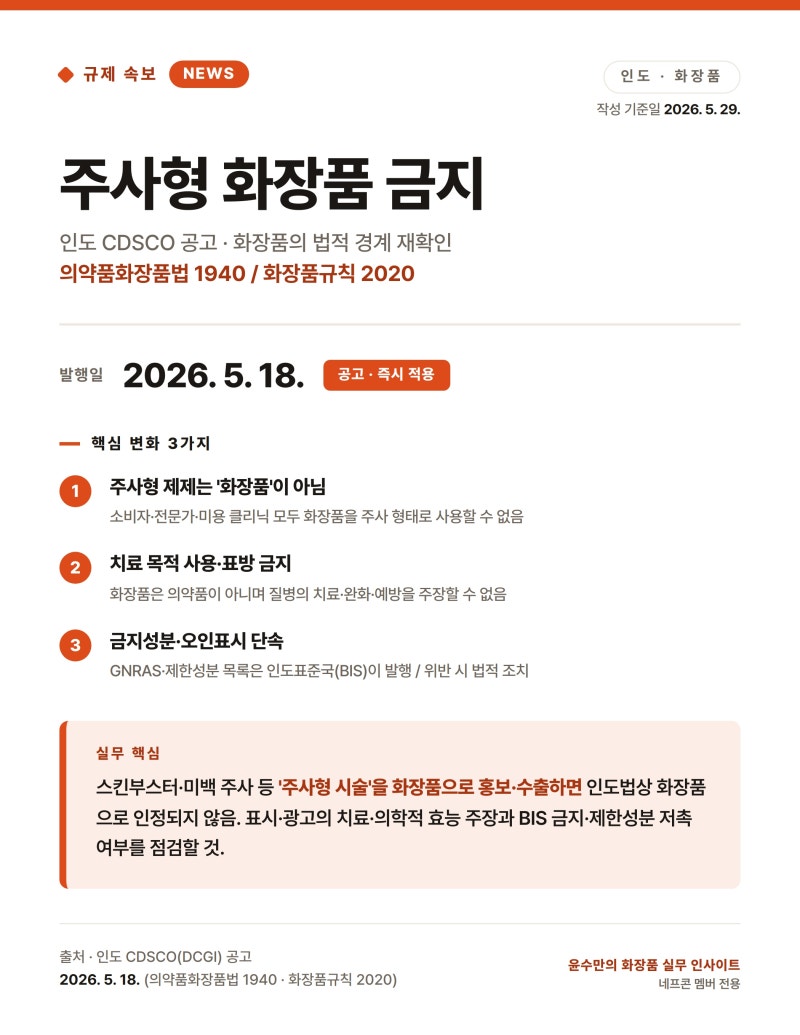
India's Central Drugs Standard Control Organization (CDSCO/DCGI) has issued a notice reaffirming the legal boundaries of cosmetics, with immediate enforcement implications for exporters and marketers of injectable aesthetic products. The notice clarifies that injectable formulations do not fall under the legal definition of cosmetics under the Drugs and Cosmetics Act, 1940, and cannot be used by consumers, professionals, or aesthetic clinics via injection. This development directly impacts overseas suppliers of skin boosters, whitening injections, and salmon DNA injections who may have marketed these as K-beauty cosmetics for the Indian market.
Legal boundary reaffirmed
The CDSCO notice, dated May 18, 2026, restates three core points: First, any formulation supplied in injectable form does not meet the definition of a cosmetic under the Drugs and Cosmetics Act, 1940, and cannot be administered by injection by any party. Second, cosmetics are not medicines and cannot claim to treat, mitigate, or prevent disease. Third, use of prohibited ingredients, misleading labeling, therapeutic claims, or injectable administration all constitute violations of the Drugs and Cosmetics Act and the Cosmetics Rules, 2020. The Bureau of Indian Standards (BIS) publishes the lists of ingredients that are not generally recognized as safe (GNRAS) and restricted substances.
Immediate enforcement for importers and marketers
The notice applies immediately to all businesses exporting cosmetics to India or marketing cosmetics within India, especially those dealing with aesthetic procedures and injectable products. While this is not a new regulation but a reaffirmation of existing boundaries, the practical impact is significant. The growing trend of promoting skin boosters, whitening injections, and salmon DNA injections as K-beauty cosmetics will not be recognized as cosmetics under Indian law.
What buyers should watch
For overseas suppliers and distributors, the key takeaway is clear: if a product is injectable, it cannot be classified as a cosmetic for Indian customs clearance or marketing. Companies should immediately review their product labeling, advertising claims, and regulatory classification for any injectable products intended for the Indian market. Claims implying therapeutic or medical effects, even indirectly, should be removed. The CDSCO notice serves as an enforcement baseline effective immediately.
Sourcing context
This notice is particularly relevant for Korean and other Asian suppliers who have been positioning injectable aesthetic products as cosmetics for the Indian market. The CDSCO's reaffirmation means that such products must now be registered as drugs or medical devices, requiring separate regulatory pathways and compliance with the Drugs and Cosmetics Act. Exporters should consult with Indian regulatory partners to reclassify affected products and ensure compliance before shipment.
Source: Read the original report | Published: June 02, 2026