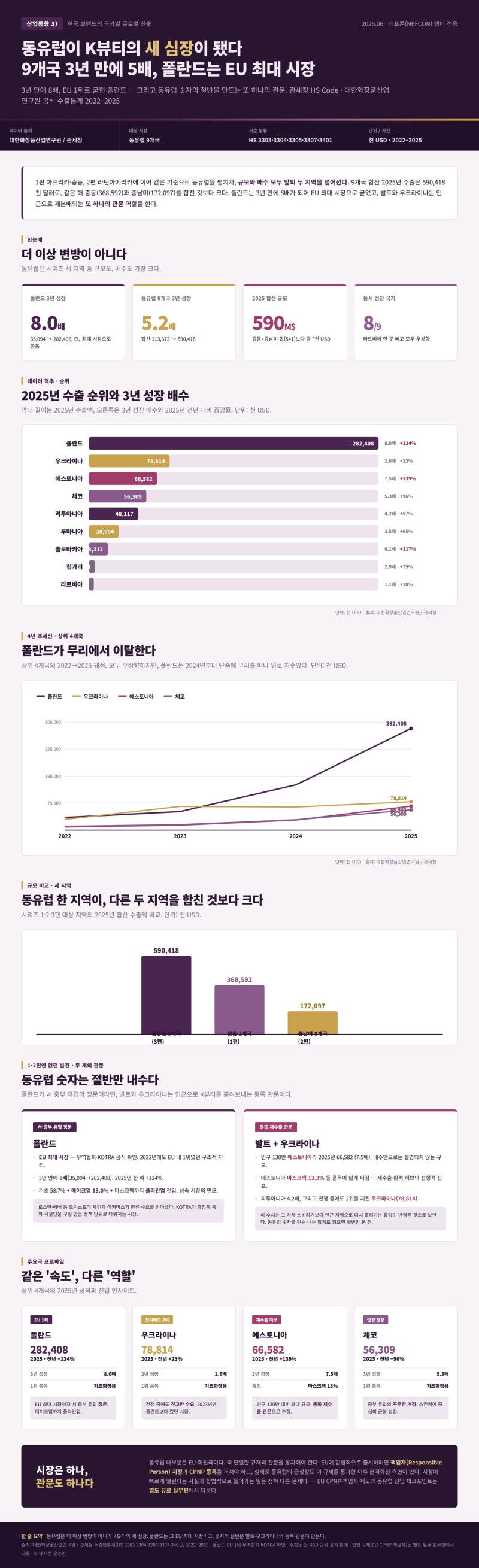
Eastern Europe has emerged as K-beauty's fastest-growing region, with nine countries collectively importing USD 590 million in Korean cosmetics in 2025—more than the Middle East and Latin America combined. Poland alone surged 8x in three years to USD 282 million, now officially the EU's top market for Korean beauty products. For overseas buyers and distributors, this signals a structural shift: Eastern Europe is no longer a fringe market but a core demand hub with dual gateway dynamics.
Market signal
K-beauty's penetration in Eastern Europe mirrors the Hallyu wave. K-pop and K-drama fandom has naturally translated into demand for Korean cosmetics, with Polish drugstore chains like Rossmann and Hebe, along with fast-growing e-commerce platforms, absorbing the surge. KOTRA Warsaw Trade Office has even organized a cosmetics-specific trade delegation, reflecting policy-level attention.
Poland: The EU's top market
Poland's imports from Korea jumped from USD 35 million in 2022 to USD 282 million in 2025, an 8-fold increase with +124% growth in 2025 alone. Both the Korea International Trade Association (KITA) and KOTRA confirm Poland as Korea's No.1 cosmetics market within the EU. Notably, Ukraine's exports (USD 65.9 million in 2023) once exceeded Poland's (USD 51.5 million), but since Ukraine is not an EU member, Poland has consistently held the top EU spot structurally.
Broad-based growth across the region
Estonia grew 7.5x in three years (+139% in 2025), Slovakia 6.1x (+117%), Czech Republic 5.3x, and Lithuania 4.2x. Only Latvia showed stagnation. Compared to single-digit growth in traditional markets like the US and China, Eastern Europe is experiencing synchronized acceleration.
Dual gateway structure
Estonia's 2025 exports of USD 66.6 million—despite a population of 1.3 million—suggest a re-export hub role, with mask packs accounting for 13.3% of the mix. Lithuania's rapid growth and Ukraine's resilience (USD 78.8 million, ranking second even during war) reinforce this pattern. Poland serves as the western gateway to Central/Western Europe, while the Baltics and Ukraine form an eastern corridor for K-beauty distribution.
Product mix maturity
In Poland, skincare accounts for 58.7% of imports, but makeup (13.0%) and mask packs (3.6%) show a full-lineup adoption. K-beauty has moved beyond skincare into color cosmetics, indicating market maturity.
Regulatory and channel signals
Most Eastern European countries are EU members, requiring compliance with the EU Cosmetics Regulation: appointment of a Responsible Person and CPNP notification. The region's rapid growth has accelerated only after these regulatory hurdles were cleared. Buyers should note that legal market entry remains a separate challenge from market openness.
What buyers should watch
For overseas importers and distributors, Eastern Europe offers a dual opportunity: Poland as a mature, full-line market for direct retail, and the Baltics/Ukraine as re-export hubs for broader Eastern European distribution. However, EU regulatory compliance (Responsible Person, CPNP) is non-negotiable. Sourcing partners should prioritize suppliers with established EU registration and logistics networks in Poland or Estonia.
Source: Read the original report | Published: June 08, 2026