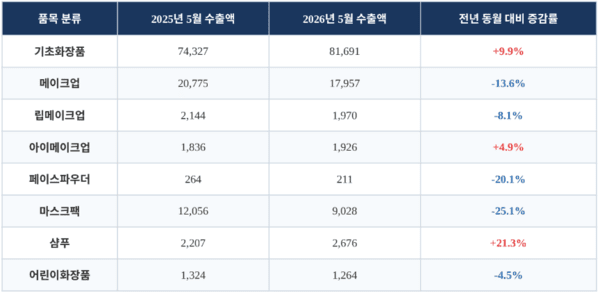
K-Beauty exports to China in May 2025 reveal a diverging trend: while basic skincare and shampoo categories rebounded, color cosmetics and mask packs continued to lose ground to local C-Beauty brands. For overseas buyers and distributors, this signals a shift in demand toward premium functional skincare and hair care, while low-cost categories face increasing competition.
Skincare and Shampoo Drive Recovery
Exports of basic skincare to China reached $81.69 million in May 2025, up 9.9% year-on-year from $74.33 million. This recovery suggests sustained demand for premium K-skincare lines despite China's domestic slowdown and patriotic consumption trends.
Shampoo exports also performed strongly, rising 21.3% to $2.68 million from $2.21 million, reflecting China's growing premiumization in scalp and hair care. Eye makeup saw a modest 4.9% increase to $1.93 million.
Color Cosmetics and Mask Packs Struggle
In contrast, color cosmetics continued to decline. Makeup exports fell 13.6% to $17.96 million, lip makeup dropped 8.1% to $1.97 million, and face powder plunged 20.1% to $0.21 million.
Mask packs, once a flagship K-Beauty export to China, saw a sharp 25.1% decline to $9.03 million. Analysts attribute this to fierce competition from local affordable sheet masks and a shift toward live-commerce distribution channels that Korean brands have been slow to adapt to.
What Buyers Should Watch
For importers and distributors, the data underscores a clear market signal: China's demand for K-Beauty is polarizing. Premium functional skincare and hair care with unique bioactive ingredients or skin longevity claims are gaining traction, while low-cost color cosmetics and mask packs face mounting pressure from local brands.
Buyers should prioritize sourcing from Korean OEMs and brands that offer differentiated, high-efficacy formulations rather than relying on generic K-Beauty labels. The days of easy growth based on 'Made in Korea' alone are over.
Source: Read the original report | Published: June 19, 2026