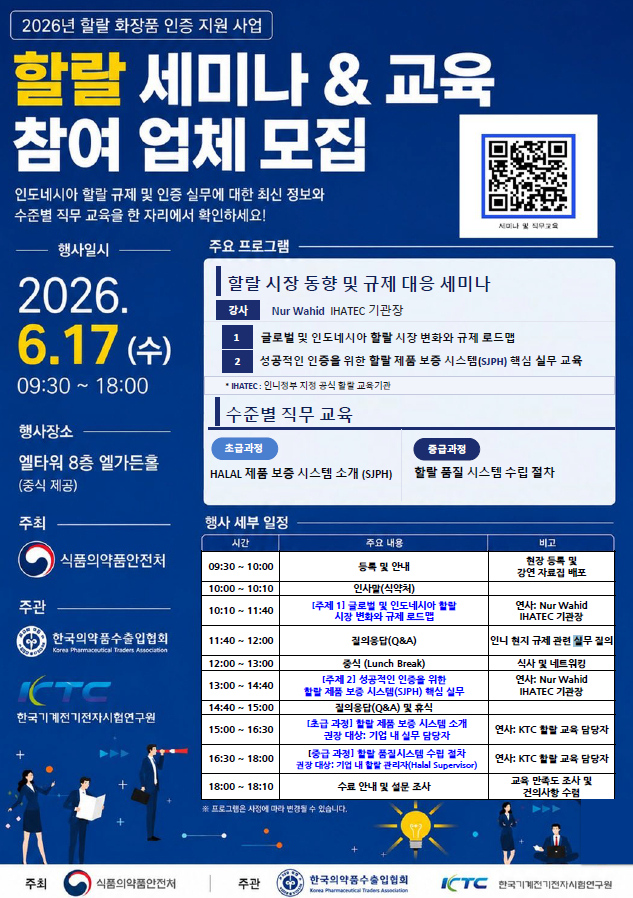
South Korea's Ministry of Food and Drug Safety (MFDS) is hosting a halal cosmetics certification seminar and job training on June 17 in Seoul, aiming to help domestic manufacturers enter the fast-growing halal market. With Indonesia set to mandate halal certification for cosmetics from October 2026, the event provides timely regulatory guidance for Korean exporters seeking to maintain their global momentum.
Market signal
The global halal cosmetics market is projected to grow from $87 billion in 2023 to $118 billion by 2028, a compound annual growth rate of 6.3%. Indonesia, the world's largest halal market, will require mandatory halal certification labeling for cosmetics starting October 2026. This regulatory shift creates both urgency and opportunity for Korean beauty exporters, who saw the country's cosmetics trade surplus exceed $10 billion for the first time in 2025, making South Korea the world's second-largest cosmetics exporter.
Training and certification details
The MFDS has invited Nur Wahid, head of Indonesia's official halal certification training institution IHATEC, to lead the seminar and job training. The event will take place on June 17 from 10:00 AM to 6:00 PM at El Tower in Yangjae-dong, Seoul. The seminar will cover global and Indonesian halal market trends, regulatory roadmaps, and quality management strategies for certification. The job training is divided into practitioner and manager tracks, covering certification procedures and halal quality system implementation.
What buyers should watch
Importers and distributors targeting the Indonesian and broader ASEAN halal market should note that Korean manufacturers are actively preparing for the October 2026 mandate. The training includes a Q&A session where Indonesian halal certification experts will address company-specific challenges. Participants who complete the training will receive certificates and priority access to future halal cosmetics certification consulting. This signals that Korean suppliers are building compliance infrastructure, which may reduce lead times for halal-certified product sourcing.
Regulatory and channel signals
MFDS Bio-Pharmaceutical Bureau Director Ahn Young-jin stated, "Halal certification is a key competitive edge for domestic cosmetics companies entering Islamic markets. The MFDS will continue expanding support for certification acquisition and provide country-specific regulatory information." The agency plans to strengthen policy support to help K-beauty capture the high-growth global halal market. This regulatory push aligns with broader Korean government efforts to diversify export destinations beyond traditional markets.
Sourcing context
Korean cosmetics manufacturers interested in halal certification can apply through partner organizations including KTC, the Korea Pharmaceutical Export-Import Association, the Korea Pharmaceutical Testing Institute, the Korea Cosmetics Association, and the Cosmetics Global Regulatory Harmonization Support Center. For overseas buyers, this indicates that Korean suppliers are increasingly equipped to meet halal requirements, potentially offering a wider range of certified products for Middle Eastern and Southeast Asian distribution channels.
Source: Read the original report | Published: June 09, 2026