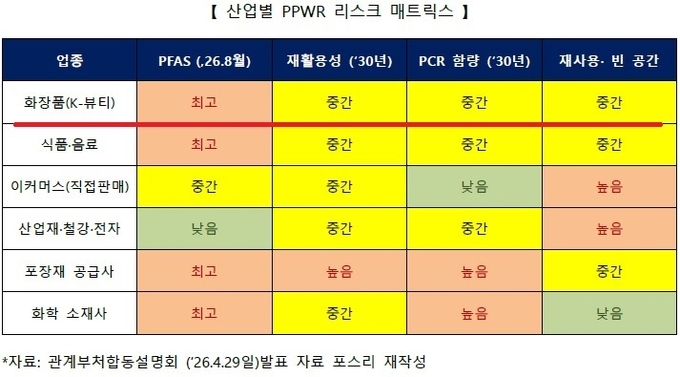
The EU Packaging and Packaging Waste Regulation (PPWR), effective August 12, 2026, will impose the highest compliance burden on the cosmetics sector, according to a POSCO Research Institute report. Overseas buyers, including importers and distributors, must prepare for mandatory Declaration of Conformity (DoC), Technical Documentation (TD), PFAS-free materials, and recycled content requirements, or risk supply chain exclusion, customs rejection, and recalls.
Regulatory timeline and buyer demands
Starting August 12, 2026, all packaging placed on the EU market—including B2B shipments—must comply with PPWR. EU buyers are already requesting DoC and TD for shipments scheduled in the second half of 2026. Manufacturers must submit these documents within 10 days upon request by regulators or EU importers. Non-compliance can lead to sales bans, customs holds, recalls, and criminal penalties across all 27 member states.
Key sustainability requirements
Seven sustainability criteria will phase in from 2026 to 2040. From January 1, 2030, all packaging must be designed for recyclability, with grades A through E. D/E-grade packaging (below 70% recyclability) will be banned from 2030, and C-grade (70–80%) from 2038. Post-consumer recycled (PCR) content in plastic packaging must reach 10–35% by 2030 and 25–65% by 2040, using only EU-certified waste streams. Heavy metals (lead, cadmium, mercury, hexavalent chromium) are capped at 100 mg/kg total.
PFAS and component-level testing urgency

Cosmetic packaging—including caps, droppers, cushioning, and outer boxes—must demonstrate PPWR compliance for each component. Functional parts like pumps and caps often contain PFAS, requiring immediate component-level testing. The report warns that cosmetics firms with short product cycles and frequent ODM/OEM supplier changes must re-verify compliance with each change, adding operational complexity.
What buyers should watch
EU importers are already restructuring supply chains. German importers and distributors have built internal PPWR compliance manuals, while France has aligned its national AGEC law with PPWR. Korean suppliers face infrastructure gaps: lack of standardized BOM and supply chain documentation, inability to source EU-certified PCR materials, and fragmented purchasing, packaging, and logistics departments. Buyers should prioritize suppliers that can provide PFAS-free materials, A/B-grade recyclable packaging, EU-certified PCR inputs, and complete TD/DoC packages.
E-commerce and B2B implications
E-commerce (direct overseas sales) faces additional burdens: producer registration in each EU country, appointment of an EPR representative, and payment of eco-modulation fees. From 2030, empty space in e-commerce packaging must not exceed 50%. Current standard box sizes used by many e-commerce firms already exceed this limit. For B2B exports, the same PPWR rules apply, and non-compliant packaging will be blocked at customs regardless of production date.
Source: Read the original report | Published: June 15, 2026