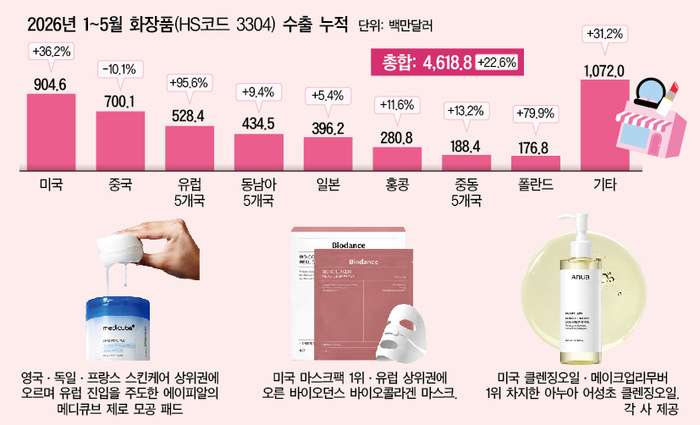
K-Beauty exports set a new record in the first five months of 2026, with the US overtaking China as the top market. The shift signals growing demand for Korean skincare among overseas buyers, especially in North America and Europe, reshaping supply-chain opportunities for distributors and clinic operators.
Export data highlights
From January to May 2026, South Korea's cosmetic exports (HS code 3304) reached $4.68 billion, up 22.6% year-on-year — the highest ever for the period. Broader industry data including shampoos and perfumes put the figure at $5.6 billion, surpassing agricultural exports for the first time and ranking first among five key consumer goods.
US market overtakes China
Exports to the US totaled $904.6 million, a 36.2% jump, accounting for 19.3% of total exports and making it the top destination. China fell to second place with $700.1 million, down 10.1%. The gap widened to $67.6 million by May. The US alone contributed over a quarter of total export growth.
Europe emerges as new growth driver
Exports to five major European countries (UK, France, Germany, Italy, Spain) nearly doubled to $528.4 million, now 11.3% of total exports. Demand is spreading beyond logistics hub Poland to the UK, where direct brand entry is rising. Japan remained a key market with $396.2 million (8.5% share).
Skincare dominates, color cosmetics decline
Skincare products drove growth, with basic cosmetics (skincare) reaching $2.41 billion, up 23.5% and representing 51.5% of total exports. In contrast, color cosmetics (makeup, lip, eye) fell 5.0% to $644 million. On Amazon US, Korean products dominated bestseller lists: 43 cleansing oils, 36 facial serums, 31 mask packs, and 20 makeup removers in the top 100. BB cream and sunscreen each had 16 entries. Emerging indie brands like Medicube, Anua, Beauty of Joseon, and Biodance diversified the competitive landscape.
What buyers should watch
Offline expansion is accelerating in the US: CJ Olive Young opened its first local store in May 2026, while Ulta Beauty and Sephora are expanding K-Beauty dedicated shelves. Over 70% of K-Beauty sales in the US are still online, so offline shelf growth is a key lever for further gains. In Europe, Korean products are already ranking in Amazon bestseller lists — 10 in France (top 3), 14 in Germany, and 11 in the UK for skincare. With global K-Beauty penetration at only about 4%, medium-to-long-term growth potential remains strong, according to analyst Kwon Woo-jung of Kyobo Securities.
Source: Read the original report | Published: June 08, 2026