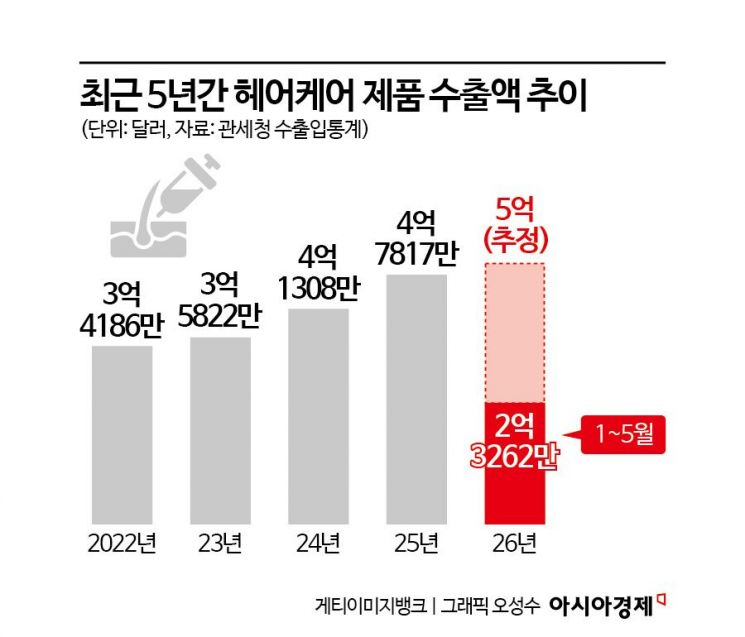
Korean hair care exports surged 30.6% year-on-year to USD 232.62 million from January to May 2026, driven by ingredient innovation and global brand expansion. Industry forecasts suggest annual exports will exceed USD 500 million for the first time, signaling a major shift in K-beauty's export portfolio beyond skincare. This trend offers overseas buyers new sourcing opportunities in functional hair and scalp care products.
Export growth and market momentum
According to Korea Customs Service data released on June 19, 2026, hair care product exports totaled USD 232.62 million in the first five months of the year, up from USD 178.15 million in the same period last year. If the current growth rate continues, full-year exports are expected to comfortably surpass USD 500 million, a milestone for the category.
Industry analysts attribute the surge to K-beauty's established ingredient competitiveness and brand equity, which are now being applied to hair care. Ingredients such as PDRN, exosomes, microbiome actives, and biotin—previously popular in Korean skincare—are increasingly featured in new hair and scalp care formulations.
Key players and channel expansion
Amorepacific's Mise-en-scène brand saw its "Perfect Serum" rank first in the hair oil category during Amazon's Big Spring Sale. The brand is now present in 17 countries across Asia, the Americas, Europe, the Middle East, and Africa.
LG Household & Health Care's scalp care brand Dr. Groot entered all 680 Costco stores in North America last year and has recently expanded into major Sephora locations in the United States. Aekyung Industrial placed its Kerasys brand in approximately 390 Walmart stores across the US in March 2026, while targeting Europe with its Chicarabo and Alpist brands.
Independent brands are also gaining traction. Polyphenol Factory's Gravity brand surpassed cumulative sales of 1.85 million bottles within two years of launch, with strong performance on Amazon US and Rakuten Japan. It recently became the first Korean shampoo brand to enter the French luxury department store Printemps. Aromatica's "Rosemary Root Enhancer" consistently ranks among top sellers in the scalp treatment category on Amazon in both the US and Europe.
Market forecasts and functional segment growth
Fortune Business Insights projects the global hair care market will grow from USD 113.9 billion in 2025 to USD 213.5 billion by 2032. Mordor Intelligence estimates the functional hair loss care segment alone will expand from USD 2.9 billion in 2026 to USD 4.3 billion by 2030.
The shift from basic cleansing products to high-value functional offerings—focusing on scalp health, hair loss prevention, and anti-aging—is driving demand for specialized formulations. This mirrors the ingredient-centric strategy that propelled K-beauty skincare globally.
What buyers should watch
Overseas importers and distributors should monitor Korean hair care brands that are leveraging proven skincare ingredients and R&D capabilities. The expansion of K-beauty hair care into North American and European retail channels—including Costco, Sephora, Walmart, and Printemps—indicates growing acceptance among Western consumers.
Buyers seeking functional hair and scalp care products may find competitive advantages in Korean suppliers that offer clinically tested formulations with ingredients like PDRN, exosomes, and microbiome complexes. The diversification of export markets beyond China to the US, Europe, and Japan also reduces supply chain concentration risk.
Regulatory and channel signals
An industry official commented: "While skincare once drove the overseas growth of K-beauty, hair care is now poised to take the baton. As the export structure for cosmetics diversifies beyond China to the United States, Europe, and Japan, functional hair care is set to establish itself as a new export powerhouse."
This shift suggests that Korean hair care manufacturers are increasingly compliant with international regulatory standards and are building distribution networks that can support consistent cross-border supply.
Source: Read the original report | Published: June 19, 2026