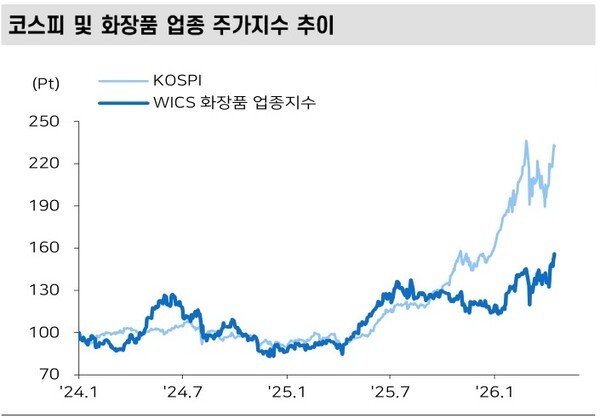
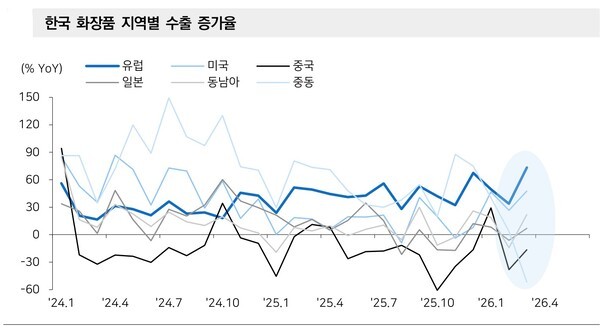
K-Beauty and other Korean consumer goods are emerging as a new export powerhouse, with Europe overtaking China and the US as the fastest-growing market. According to a recent Meritz Securities report, Korean beauty exports to Europe surged 53% year-on-year in Q1 2026, reshaping the global supply chain for OEMs, distributors, and clinic buyers seeking diversified sourcing options.
Market signal: Europe-driven export surge
Korean beauty exports to Europe grew 53% in Q1 2026 compared to the same period last year, surpassing growth rates in the US and China. This shift is driven by strong performance in the UK, Poland, and the Netherlands. APL recorded 30 billion won in UK sales alone in Q1, while distribution platform Silicone2 posted 140 billion won in European revenue, far exceeding market expectations. Dalba Global saw an estimated 190% sales increase to 13 billion won, and indie brands like Cosrx (Amorepacific) and VT also reported rapid European growth.
Sourcing context: Logistics and OEM expansion
To meet rising demand, Silicone2 expanded its Poland logistics center from 900 pyeong to 4,000 pyeong and plans to add another 2,000 pyeong in Q2. Poland serves as a key logistics hub, while Rotterdam in the Netherlands is a major entry point for Northeastern Europe. This infrastructure build-out signals growing opportunities for overseas buyers to source K-beauty products with faster delivery and lower costs.
OEM performance: Strong Q1 results
Major OEMs Cosmax and Kolmar Korea reported domestic sales growth of around 15% and 20% respectively in Q1, exceeding their annual guidance of 13-15%. Kolmar's growth was fueled by increased orders from key clients like Gudai Global, Dalba Global, and Olive Young, plus new indie brands such as Beplain, Objet, and Sallymax. Cosmax saw strong performance in basic skincare categories like essences, mists, and creams.
What buyers should watch: Color cosmetics gap and localization needs
While basic skincare exports to the US and Europe grew 34% and 68% respectively in Q1, color cosmetics remained flat at 0% growth. Western markets require at least 20+ shade variations for retail placement, posing a challenge for Korean brands that typically produce only 3-4 shades. Some indie brands are adapting: TirTir offers 33 shades for its Mask Fit Red Cushion on Amazon, and Milktouch is testing Western entry with its Dew Stain Sheer Lip Gloss. Buyers should monitor these localization efforts as indicators of future supply diversity.
Regulatory and channel signals: Export diversification
K-beauty exports are projected to grow over 20% in 2026, up from 15% earlier forecast and 10% in 2025. This dynamic shift—from China in 2024 to the US in 2025 and now Europe in 2026—reduces Korea's reliance on semiconductor exports and creates a more stable supply chain for international buyers. The trend underscores the importance of multi-region sourcing strategies for clinics and distributors.
Source: Read the original report | Published: June 04, 2026