South Korea's beauty industry is accelerating its R&D competition to secure next-generation growth drivers, moving beyond simple manufacturing and sales toward proprietary raw materials, bio-tech integration, and regenerative-medicine-based new materials. This shift signals a critical supply-chain evolution for overseas importers and distributors sourcing from K-beauty OEMs and ingredient suppliers.
Microbiome and lactic acid bacteria
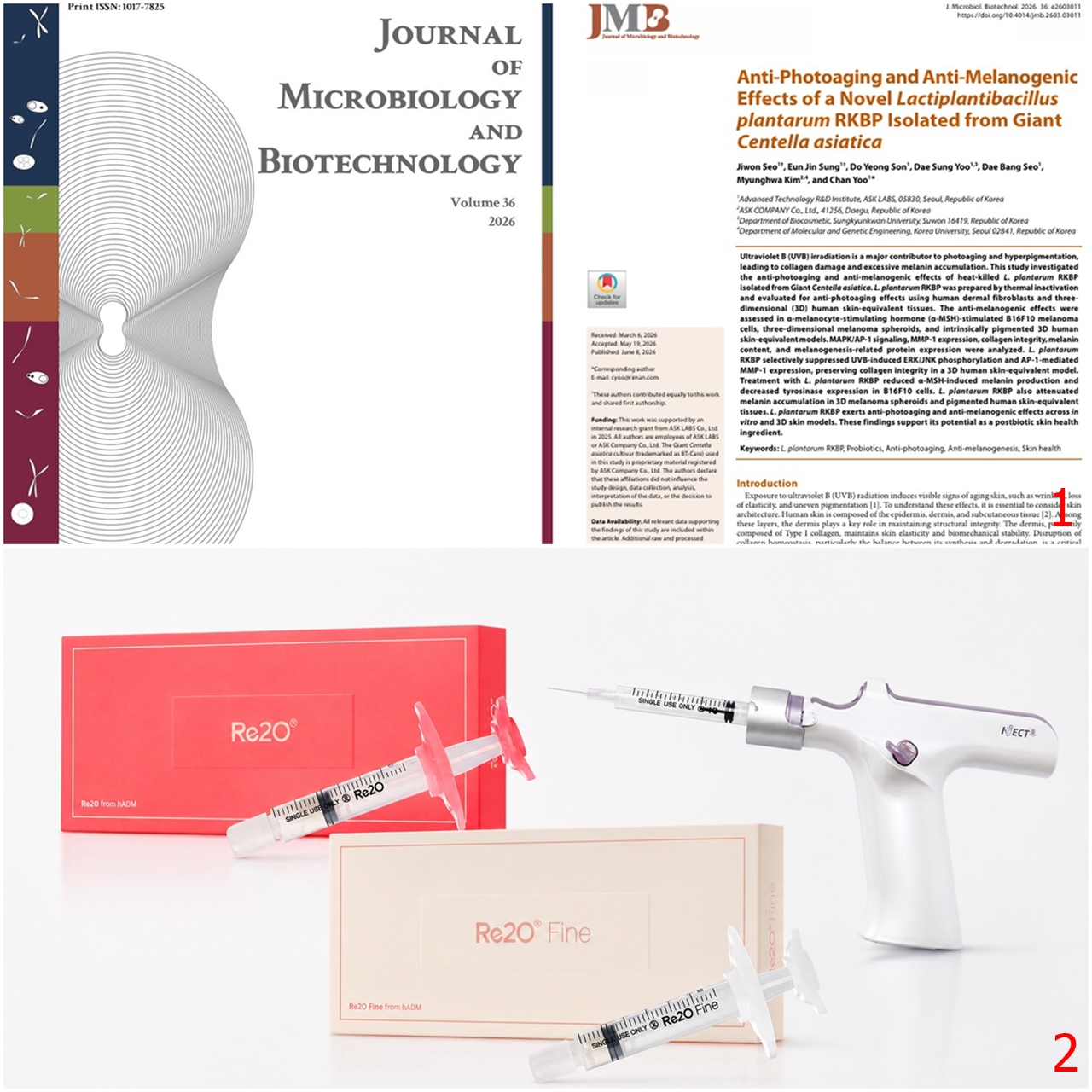
On June 18, Riman Korea's R&D affiliate S-CLASS announced that its proprietary lactic acid bacteria strain, Lactiplantibacillus plantarum RKBP, isolated from the giant centella asiatica variety BT-Care, demonstrated dual efficacy in suppressing UVB-induced skin photoaging and reducing melanin production. The study, published in the Journal of Microbiology and Biotechnology (JMB) June issue, used 3D human artificial skin models and melanoma spheroid models to validate efficacy under conditions mimicking real skin environments. Riman Korea plans to expand inner-beauty product development and functional material research based on the gut-skin axis.
ECM-based regenerative medicine for hair loss

On June 13, L&C Bio presented a regenerative approach to hair loss treatment at the Hair Loss Practical Academy hosted by the Korean Society of Dermatology, Obesity, and Plastic Surgery. The company's ECM-based skin booster, Re2O, focuses on regenerating the scalp tissue environment where hair follicles reside, rather than merely promoting hair growth. As the medical community increasingly recognizes hair loss as a disease rather than a cosmetic issue, regenerative strategies restoring follicular ECM structure are emerging as a new alternative. L&C Bio plans to expand into scalp regeneration by securing additional clinical data.
Industry-academia collaboration and smart-farm sourcing
Cosmecca Korea announced on June 8 a joint research project with Professor Park Woo-jun's team at Korea University to develop new microbiome-based dermocosmetic materials. The partnership will identify novel ingredients from skin microbiome data and validate their efficacy and safety. Separately, on June 11, IMINE signed an MOU with smart-farm specialist Plantyfarm and bio-material firm Biosplash to develop centella asiatica-based cosmetic ingredients and establish an ODM supply chain. This green-bio convergence model combines smart-farm cultivation, bio-material processing, and cosmetic ODM capabilities, addressing growing supply-chain instability and climate change concerns.
Inner-beauty portfolio expansion

Nutri, the company behind the EverCollagen brand, is expanding its cosmetic and functional material businesses and plans to launch new products based on EPA (high-purity omega-3) and HMO (human milk oligosaccharides) in the second half of this year. The strategy broadens its portfolio from skin-health-focused inner beauty into circulatory health and brain healthcare.
What buyers should watch
An industry insider noted: "In the past, K-beauty competitiveness relied on product planning and marketing. Now, proprietary raw materials, bio-tech, and clinical data determine a company's competitive edge. The convergence of material development, regenerative medicine, microbiome research, and AI-based bio studies will accelerate." For overseas buyers, this means K-beauty suppliers are increasingly offering differentiated, clinically backed ingredients and technologies—from microbiome-derived actives to ECM-based devices and smart-farm-sourced botanicals—that can elevate product portfolios and meet evolving regulatory and consumer demands for efficacy and sustainability.
Source: Read the original report | Published: June 19, 2026