Samsung Bioepis is expanding its oral drug delivery platform S-PASS from oral insulin and semaglutide to tirzepatide and the cancer immunotherapy Keytruda (pembrolizumab), according to a recent investor relations event in Hong Kong. The move signals a push to convert injectable blockbusters into oral formulations, offering new sourcing opportunities for overseas distributors and clinics seeking differentiated products in the obesity, diabetes, and oncology markets.
Platform expansion and pipeline progress
The S-PASS platform aims to convert injectable drugs into oral forms. The most advanced candidate is oral insulin (SCD0503), which received European Medicines Agency (EMA) and German BfArM approval for a global Phase 1 trial in type 1 diabetes on May 28. The trial will be conducted by Profil, a German CRO specializing in metabolic diseases. Samsung Bioepis reports a relative bioavailability of 10% and a 4:1 dose ratio versus injectable, outperforming Novo Nordisk's Rybelsus (100:1). The company targets Phase 2 completion by 2027 and Phase 3 by 2029.
Oral semaglutide (SCD0509) is being developed as a generic of Novo Nordisk's Rybelsus. In a 14 mg bioequivalence study, the drug showed an AUC of 101% and Cmax of 106% versus Rybelsus. Samsung Bioepis awaits FDA pre-ANDA feedback in the second half of this year. Planned launches include Canada and emerging markets in 2027, South Korea in 2029, and the US, EU, and Japan in 2031, aligned with patent expirations.
Tirzepatide oral development strategy
Samsung Bioepis has added oral tirzepatide to its pipeline. Tirzepatide, a GIP/GLP-1 dual agonist developed by Eli Lilly, is approved as an injectable for obesity and diabetes. While Lilly is pursuing the oral small molecule orforglipron, Samsung Bioepis aims to formulate the tirzepatide peptide itself into a pill. The company targets weight loss comparable to injectable tirzepatide's 22.5% (SURMOUNT-1 trial), versus orforglipron's 12.4% (ATTAIN-1, 36 mg).
To reduce development time and costs, Samsung Bioepis plans to use the FDA's 505(b)(2) pathway, referencing Lilly's safety and efficacy data from injectable tirzepatide trials. The timeline includes non-clinical efficacy data in Q2 2025, a human pilot study in Q3, results and Phase 1 CRO contract (with Profil) in Q4, and an IND filing in 2027.
Oral antibody challenge: Keytruda and Opdivo
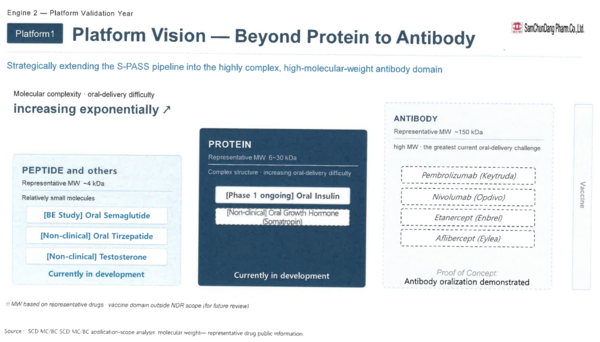
The most ambitious project is oral Keytruda (SCD0513), a monoclonal antibody with a molecular weight of 150 kDa. Samsung Bioepis is also developing an oral formulation of Opdivo (nivolumab). The company presented mouse pharmacokinetic data showing systemic circulation after oral Keytruda administration, though full data and interpretation await study completion.
As scientific proof of concept, Samsung Bioepis cited results from applying S-PASS to Eylea (aflibercept, 115 kDa) and Enbrel (etanercept, 150 kDa), demonstrating meaningful systemic exposure after oral delivery. This suggests the platform can work beyond peptides to monoclonal antibodies.
Sourcing context
Samsung Bioepis' S-PASS pipeline is structured by increasing molecular weight complexity: peptides and small molecules (4 kDa range) include semaglutide, tirzepatide, and testosterone; proteins (6-30 kDa) include insulin and somatropin; antibodies (150 kDa) include Keytruda, Opdivo, Enbrel, and Eylea. Oral insulin is in Phase 1, semaglutide has completed BE studies, while tirzepatide and antibody candidates are in non-clinical or formulation stages. The company has designated 2025 as the year to demonstrate commercial and clinical value of the S-PASS pipeline.
Source: Read the original report | Published: June 10, 2026