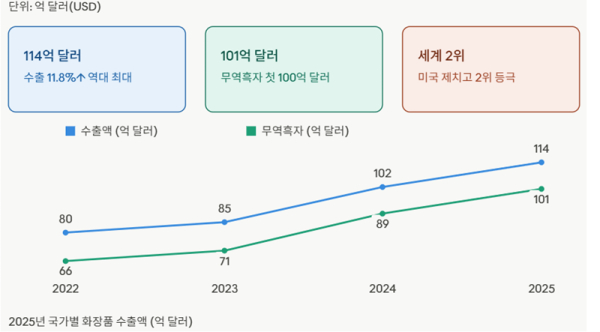
South Korea's cosmetics export value hit a record $11.4 billion in 2025, making it the world's second-largest exporter after France, according to the Ministry of Food and Drug Safety (MFDS). The trade surplus also surpassed $10 billion for the first time. For overseas buyers, this signals a mature, regulation-friendly supply chain with globally competitive ODM manufacturers and a growing portfolio of indie and premium brands.
Record exports and global ranking
South Korea's cosmetics exports reached $11.4 billion in 2025, up 11.8% year-on-year, while the trade surplus grew 13.5% to $10.1 billion. The country jumped from fifth to second place in global export rankings, surpassing the United States. Export destinations expanded to 202 countries. U.S. trade publication Retail Merchandiser recently reported that South Korea has overtaken France as America's largest cosmetics supplier for the first time, reshaping global distribution dynamics.
Regulatory roadmap as a non-tariff barrier breaker
The MFDS has implemented a phased safety evaluation system for functional cosmetics, aligning with global standards. To ease industry burden, it provides guidelines, professional consulting, workforce training, and a raw material safety database. The agency is upgrading the existing 'One Asia Beauty Forum' into a ministerial-level multilateral cooperation body called GCORAS (Global Cosmetics Regulatory Authorities Summit), expanding to the Middle East and South America. MFDS official Ahn Young-jin said, "We will innovate regulations to harmonize technology and systems with the pace of new cosmetics technology development, and focus on supporting companies' overseas expansion."
ODM ecosystem as the manufacturing backbone
South Korea's ODM sector remains a key competitive advantage. Cosmax recorded production of 1.61 trillion won ($1.2 billion), and Kolmar Korea reached 1.30 trillion won ($970 million), both firmly in the '1 trillion won club'. Kolmar CEO Choi Hyun-kyu emphasized, "The domestic ODM industry must evolve into a long-term partner that upgrades technological competitiveness through continuous R&D and develops blockbuster products with brands. We will nurture premium cosmetics and expand K-beauty as an independent category globally."
Balanced growth: conglomerates and indie brands
LG Household & Health Care maintained the top production spot with 3.92 trillion won ($2.9 billion), while indie brand APR surged to fourth place. This reflects a healthy generational shift where both large corporations and emerging brands thrive together, offering overseas buyers a diverse sourcing landscape from mass-market to cutting-edge indie products.
Public-private collaboration via 'Jump-Up K-Cosmetics Council'
The MFDS operates the 'Jump-Up K-Cosmetics Council' as a communication channel with the industry. This body has driven field-oriented regulatory innovations, including international harmonization of CGMP (Cosmetic Good Manufacturing Practices) and the shift to self-regulation for natural and organic certification. MFDS official Kim Ji-yeon stated, "We will do our utmost to establish international standards and support the industry so that high-quality, efficacious domestic cosmetics can maintain solid competitiveness in the global market."
Source: Read the original report | Published: June 17, 2026