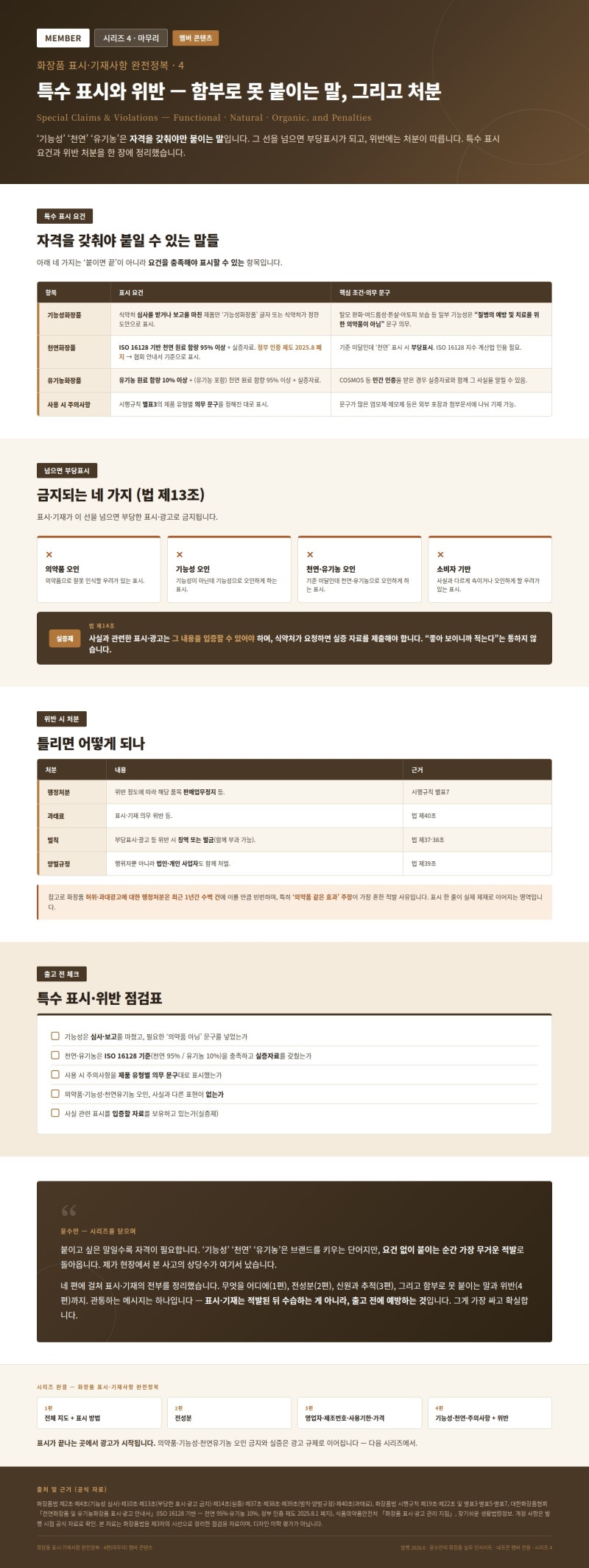
South Korea's Ministry of Food and Drug Safety (MFDS) is enforcing stricter rules on cosmetic labeling, particularly for claims like 'functional', 'natural', and 'organic'. Overseas buyers and distributors sourcing from Korea must ensure their products meet these requirements to avoid penalties, including sales suspensions and fines. The shift from government certification to ISO 16128-based self-declaration for natural and organic claims adds a new layer of compliance responsibility for suppliers.
Functional cosmetics: mandatory review and disclaimer
Products labeled as 'functional cosmetics' must first undergo MFDS review or submit a report. The label must include the phrase 'functional cosmetic' or an approved design. For certain functions—such as hair loss relief, acne-prone skin care, stretch marks, or atopic moisturizing—a mandatory disclaimer must appear: 'This is not a medicine for the prevention or treatment of diseases.' This prevents consumers from mistaking cosmetic benefits for medical efficacy.
Natural and organic claims: ISO 16128-based self-declaration
Since August 2025, the government certification system for natural and organic cosmetics has been abolished. Now, brands can use these terms only if they meet ISO 16128-based criteria set by the Korea Cosmetic Association and maintain supporting documentation. Private certifications like COSMOS are also acceptable with proper evidence. Using 'natural' or 'organic' without meeting these standards constitutes unfair labeling, a common compliance pitfall.
Mandatory usage warnings and prohibited practices
Usage warnings are not optional; specific phrases are legally required based on product type. If space is limited, warnings can be split between outer packaging and an insert. Beyond this, four categories of unfair labeling are prohibited: misleading consumers into thinking a product is a drug, implying functionality without approval, falsely claiming natural/organic status, and any deceptive or false information. Additionally, all factual claims must be substantiated upon MFDS request.
Penalties and dual liability
Violations trigger administrative measures such as sales suspension, fines, and heavier sanctions for unfair labeling. Under Korea's dual liability principle, both the individual responsible and the corporate entity (including sole proprietors) can be held accountable. This makes pre-compliance critical—correcting issues after shipment is far more costly than prevention.
What buyers should watch
For importers and distributors, the key takeaway is that Korean cosmetic labeling is now a high-stakes compliance area. Ensure your Korean suppliers provide documentation proving functional cosmetic review, ISO 16128 compliance for natural/organic claims, and correct usage warnings. Request a pre-shipment label audit to avoid customs delays or market withdrawal. The shift to self-declaration means suppliers bear full responsibility for substantiating claims.
Source: Read the original report | Published: June 17, 2026