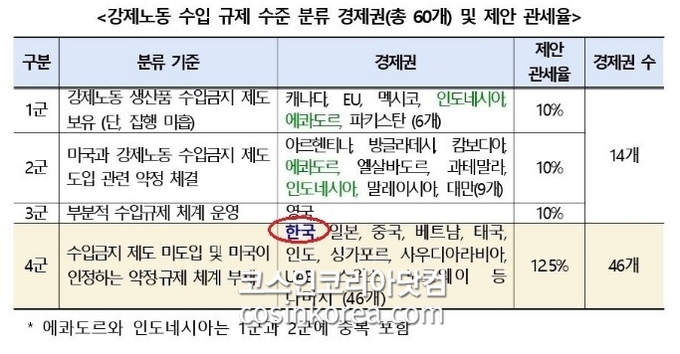
The U.S. Trade Representative (USTR) has proposed a 12.5% tariff on South Korea under a Section 301 investigation into imports linked to forced labor, raising concerns among Korean exporters including cosmetics and medical aesthetics suppliers. South Korea's Ministry of Trade, Industry and Energy has reaffirmed that the final tariff will not exceed the 15% ceiling agreed in prior bilateral tariff negotiations, providing some reassurance to the supply chain.
Tariff proposal details
On June 2, 2026, USTR proposed differential tariffs of 10% to 12.5% on 60 economies based on the Section 301 investigation into forced labor-related imports. Canada, the EU, and Mexico are among 14 economies facing 10%, while South Korea, Japan, and 46 other economies face 12.5%. South Korea was classified as an economy that has not introduced or effectively enforced a ban on imports of forced labor-produced goods, despite prohibiting forced labor domestically.
Next steps and finalization
The proposed tariff remains at the proposal stage. A public hearing is scheduled for July 7, 2026, after which USTR will make a final decision. KOTRA noted that this tariff is expected to replace the global universal tariff of 10% set to take effect on July 24. Additionally, a separate Section 301 investigation into overcapacity is nearing announcement, which could lead to further cumulative tariffs.
Government response and bilateral talks
South Korea's Trade Minister Yeo Han-koo met USTR Jamieson Greer on June 3 in Paris during the OECD Ministerial Council Meeting to discuss the investigation results. The Korean government has submitted a written opinion arguing that the Section 301 action is inappropriate and unnecessary given Korea's efforts to eradicate forced labor and voluntary private-sector measures. Minister of Trade, Industry and Energy Kim Jung-kwan also held a video call with U.S. Commerce Secretary Lutnick, confirming that tariffs on Korea will not exceed the 15% level agreed in last year's tariff deal.
What buyers should watch
Overseas importers and distributors of Korean medical aesthetics products—including devices, injectables, and skincare—should monitor the final tariff decision expected after July 7. If the 12.5% tariff is confirmed, it could increase landed costs for Korean-origin goods in the U.S. market. However, the 15% cap provides a degree of predictability. Buyers should also watch for potential additional tariffs from the overcapacity investigation, which could further affect pricing and sourcing strategies.
Source: Read the original report | Published: June 05, 2026