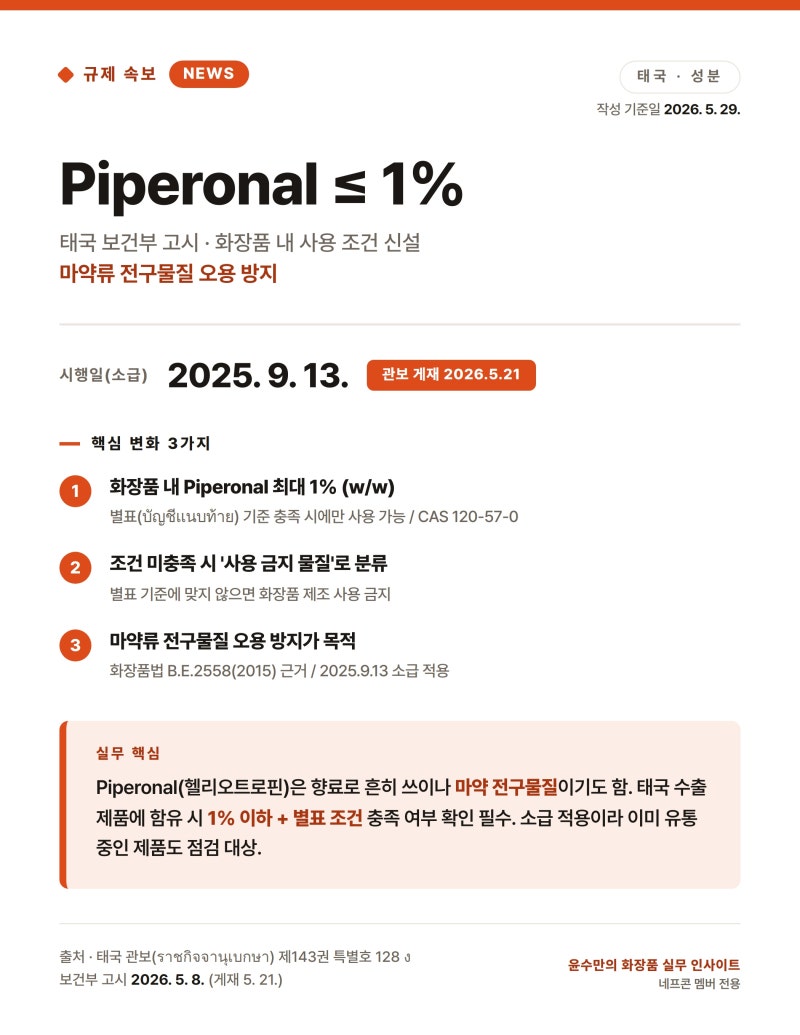
Thailand's Ministry of Public Health has published a notification (B.E. 2569) in the Royal Gazette on May 21, 2026, restricting Piperonal (heliotropin, CAS 120-57-0) in cosmetics to a maximum concentration of 1% w/w. The measure, signed by the Minister on May 8, 2026, retroactively applies from September 13, 2025, aiming to prevent misuse of this fragrance ingredient as a drug precursor. Overseas cosmetic exporters, especially those using Piperonal in fragrances, must verify compliance.
Regulatory context
Piperonal, commonly used in vanilla and cherry-type fragrances, has been classified as a Category 4 narcotic under Thai law. However, an exception allows its use in cosmetics if it meets the specified conditions, including the 1% w/w concentration limit and other criteria detailed in the annex. Products not meeting these conditions are considered prohibited substances for cosmetic manufacturing.
Retroactive enforcement impact
The notification applies retroactively to September 13, 2025, meaning products already exported to Thailand before the publication date are subject to compliance checks. Importers and distributors should review their existing inventory and supply chain documentation to ensure Piperonal content in fragrance blends does not exceed the limit and meets all annex requirements.
What buyers should watch
Buyers sourcing cosmetic products containing Piperonal for the Thai market should immediately request ingredient specifications from their fragrance suppliers. The key compliance point is not just the concentration but also adherence to the full annex conditions. Non-compliance could result in products being classified as containing a prohibited substance, leading to regulatory action.
Sourcing context
This regulation highlights the growing global scrutiny of fragrance ingredients with dual-use potential. For medical aesthetics and cosmetic supply chains, it underscores the importance of verifying raw material compliance with local narcotics and drug precursor regulations, particularly in markets like Thailand where such rules are being tightened.
Source: Read the original report | Published: June 04, 2026